.webp)








Listen To Our Podcast🎧

Introduction
How sure are you that your financial data security can stop today’s cyberattacks on banks? According to IBM's Cost of a Data Breach Report 2024, the average cost of a data breach in the financial services sector reached USD 6.08 million — nearly 22% above the global cross-industry average.
Companies handling sensitive financial transactions cannot rely on outdated measures. They are now focusing on bank level security, online banking security measures, and data security in financial services to protect client information and meet regulatory requirements. Together, these efforts are forming what experts call a protocol layer for financial security.
This layer acts as a structured defense. It brings together banking API security, open banking API security, and digital banking security into a single, secure system.
PwC’s 2024 Digital Trust research shows that more than 70% of executives are prioritizing cybersecurity investment. As digital banking matures, this emphasis increasingly differentiates institutions that can scale innovation securely from those that cannot.
A protocol-based risk management approach reinforces financial services security and ensures consistent protection of financial data across all platforms and touchpoints. From keeping client transactions safe to securing backend systems, this layer is quickly becoming essential for organizations that manage large volumes of sensitive financial data.
Next, we will look at how banks are building these secure transactions protocols, the technologies powering them, and the benefits of having a strong protocol layer strategy for secure financial systems.
How Banks Are Structuring Financial Data Security at the Core ?
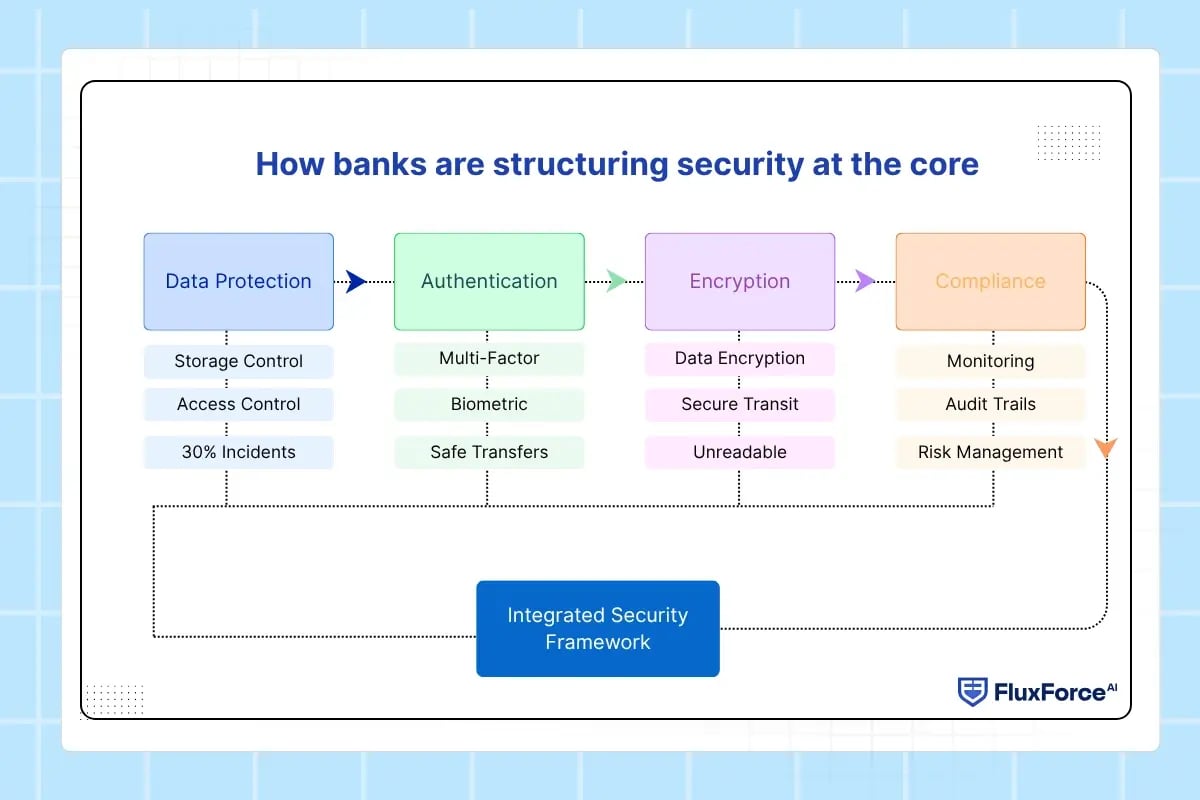
What actually makes a protocol layer for financial security reliable? At its core, it’s about creating a structured approach that covers people, processes, and technology.
Protecting Data at Every Level
The foundation starts with data security for banks. Protocols governing financial information protection, banking data security, and access controls determine how sensitive financial data is stored, accessed, and shared across systems.
Deloitte’s 2025 cybersecurity research shows that organizations with integrated, well‑governed security and data protection frameworks experience lower risk exposure and faster incident containment than those operating fragmented systems.
Ensuring Authorized Access
Central to any protocol layer is identity verification and authentication. From multi-factor authentication (MFA) to biometric checks, these protocols ensure that only authorized users can perform critical actions. This directly strengthens how safe a bank transfer is in practice — reinforcing digital banking security and online banking security measures across all customer-facing and backend systems.
Securing Transactions with Encryption
Encryption and transaction safeguards form another critical layer. Implementing bank encryption and secure transactions protocols makes intercepted data unreadable, strengthening financial services security and protecting both banks and their clients.
Integrating Compliance Automation and Risk Monitoring
Finally, automated compliance and monitoring systems are integrated into the protocol layer. These track suspicious activity, enforce regulatory requirements, and provide audit trails, embedding protocol-based risk management into daily operations.
When combined, these measures create a strong framework that protects financial info protection and ensures trust across the institution.
How Banks and Fintech Companies Apply Protocol Layers for Financial Security
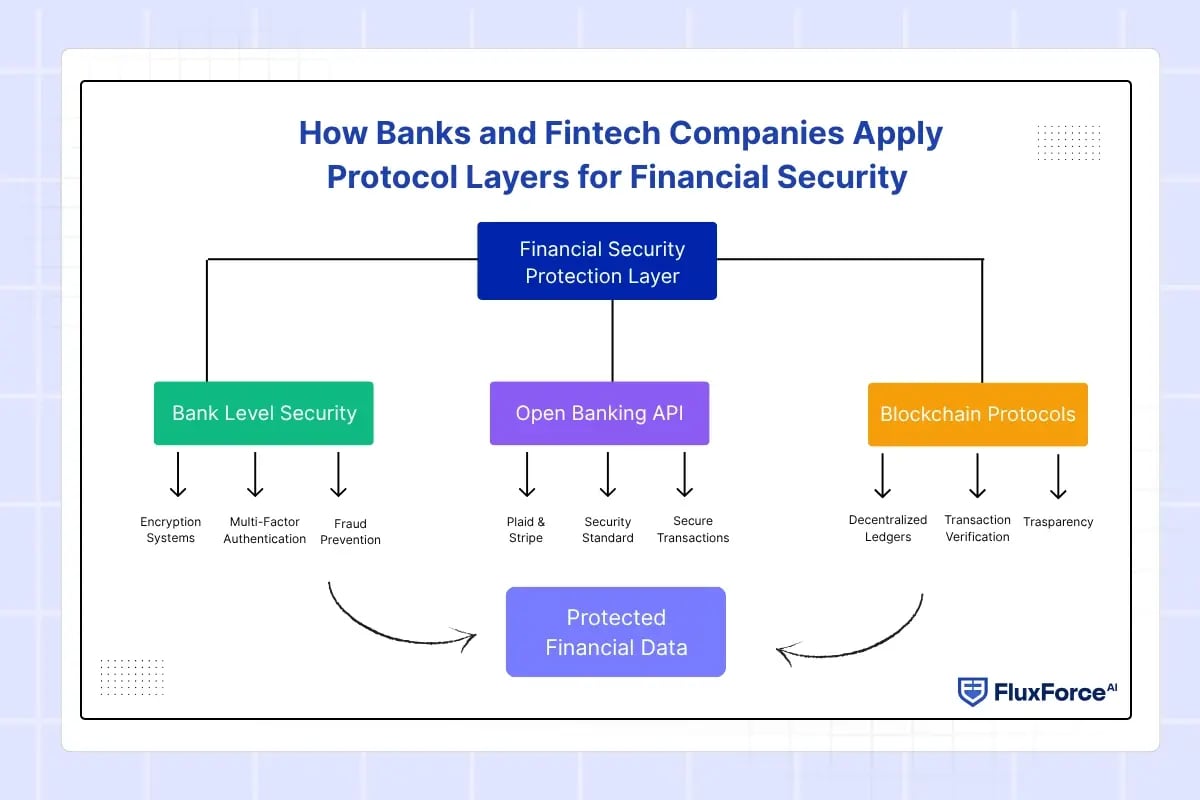
Real-world examples show how protocol layers for financial security protect sensitive information and improve banking data security.
Bank Level Security for Protecting Financial Information
Leading banks implement bank-level security systems to safeguard client assets and funds. Advanced bank encryption and multi-factor authentication (MFA) work together to reduce fraud exposure and enhance financial information protection. These measures form the foundation of a secure transactions protocol and reinforce financial services security at every layer.
Open Banking API Security in Digital Finance
Fintech companies rely on open banking API security and banking API security to connect multiple services safely and at scale. Platforms such as Plaid and Stripe adhere to digital financial security standards — including OAuth 2.0 and TLS encryption protocols — to ensure consistent online banking security measures, protecting sensitive financial data while enabling fast, secure transactions.
Blockchain Protocols for Financial Data Protection
Some banks adopt blockchain protocols for financial security. Decentralized ledgers verify transactions without exposing sensitive financial details protection, lowering risk and increasing transparency. For example, the European Investment Bank issued its first blockchain-based digital bond in 2021 — a pilot that demonstrated how distributed ledger technology can streamline settlement and improve transaction transparency in capital markets.

Challenges in Building a Protocol Layer for Financial Security
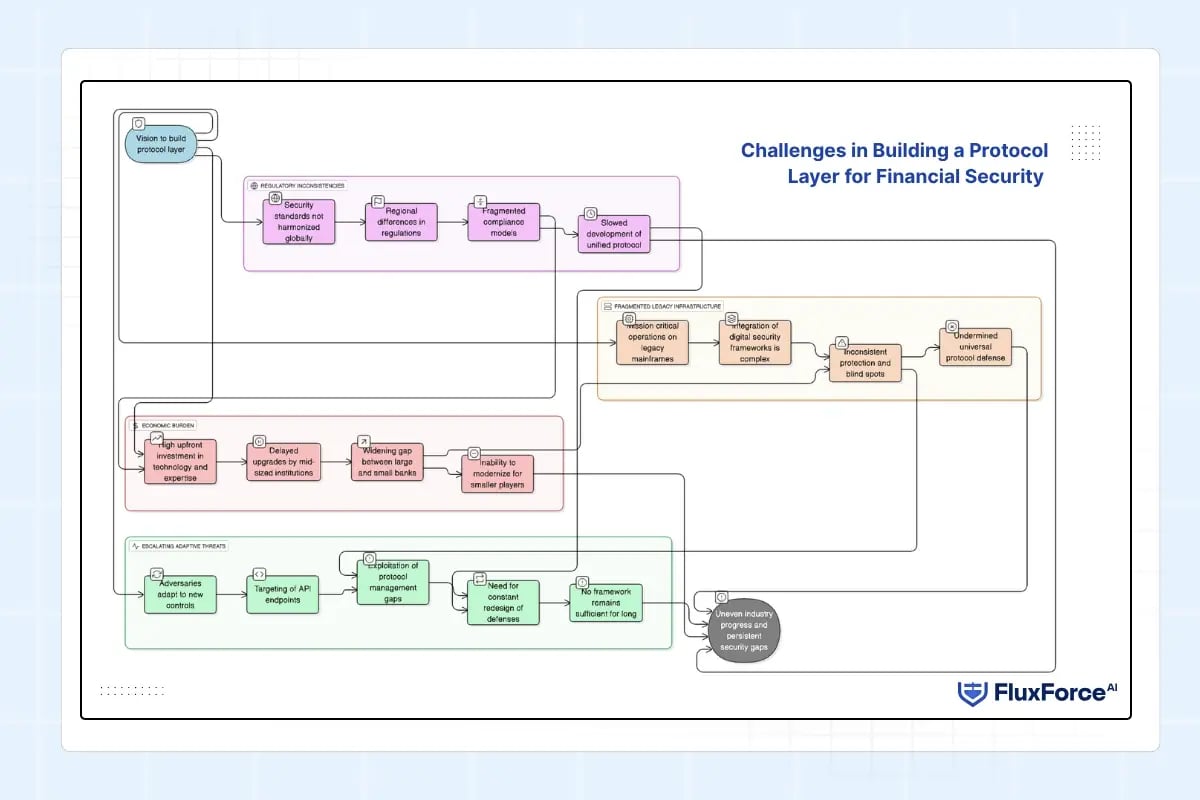
The shift toward a protocol layer for financial security is promising but translating that vision into reality exposes a series of structural and operational hurdles. These challenges highlight why the industry is progressing unevenly despite heavy investment in financial data security and banking security systems.
Fragmented Legacy Infrastructure
According to a 2024 McKinsey report on banking technology modernization, more than 70% of core banking transactions globally still run on legacy systems — creating significant friction when integrating modern security frameworks. Integrating digital banking security frameworks into these outdated environments is complex, costly, and often inconsistent. This leaves blind spots where protecting financial information becomes unreliable, undermining the goal of universal, protocol-driven defense.
Regulatory Inconsistencies Across Jurisdictions
Security standards such as data protection for banks and data security in financial services are not harmonized globally. While Europe enforces PSD2 and GDPR, other regions adopt less stringent rules. For multinational banks, this creates fragmented compliance models that slow down efforts to build a single secure transactions protocol spanning all operations.
Economic Burden of Modernization
Deploying advanced bank encryption, banking API security, and open banking API security requires large upfront investments in technology and expertise. According to Deloitte's 2024 Financial Services Industry Outlook, cost and complexity remain the top barriers to security modernization for mid-tier financial institutions — with technology upgrade cycles often stretching three to five years due to budget constraints. As a result, the market risks a widening gap between global banks with deep pockets and smaller players unable to modernize.
Escalating and Adaptive Threat Landscape
Even when controls are in place, adversaries adapt. Sophisticated cybercriminal groups now target API endpoints, bypassing traditional online banking security measures. Advanced persistent threats exploit gaps in protocol-based risk management, forcing banks to redesign defenses faster than budgets and regulatory cycles typically allow. The constant escalation of threats means that no data security in banking industry framework remains sufficient for long.
Onboard Customers in Seconds

The Future of Protocol Layers in Financial Security
The protocol layer for financial security is becoming a way for banks and fintech's to gain trust and stand out in the market. Companies that build this strong layer early will set the standard for financial services security in the years ahead.
Standardizing Digital Financial Security
Regulators and industry groups are working toward common digital financial security standards. This shift will remove the confusion caused by different rules in different regions. With shared frameworks, banks can improve data security in financial services at scale while staying compliant everywhere.
Secure Transactions as a Default
In the near future, secure transactions protocols will be built into every digital banking system. This means bank encryption, online banking security measures, and automated fraud checks will work together as one system. Customers will experience how safe a bank transfer feels without extra effort—it will simply be part of every transaction.
Blockchain for Safer Transactions
More banks are likely to use blockchain protocols for financial security in areas like payments and identity checks. Blockchain makes it harder to tamper with data and adds more transparency. For example, it can help with financial data security while cutting down on fraud and operational risks.
Smarter Risk Management with AI
Artificial intelligence is also shaping protocol-based risk management. AI tools can scan huge amounts of financial transactions in real time to catch unusual activity. This gives banks stronger banking security systems and allows financial IT security to respond quickly to new threats without waiting for manual reviews.
Conclusion
The emergence of a protocol layer for financial security marks a turning point for banks and fintech's. Protecting sensitive data is no longer just about compliance, it is about creating a trusted environment for customers. Measures such as bank level security, banking API security, digital banking security, and secure transactions protocols are central to this emerging layer, ensuring that financial info protection is consistent across all platforms.
Institutions that adopt this structured approach to financial services security are better positioned to reduce fraud, meet regulatory requirements, and build stronger customer trust. The protocol layer is becoming the backbone of modern banking, enabling secure, reliable, and resilient financial systems that can adapt to evolving threats.
As digital finance grows, the protocol layer for financial security will define which organizations lead the market, making it a strategic priority for any institution handling sensitive financial data.
While protocol-driven security strengthens the foundation, the real advantage lies in how institutions evolve beyond legacy tools to combat modern fraud.
Dive deeper: Legacy Financial Security Tools vs. AI-Powered Fraud Mitigation


Share this article