.webp)







Listen to our podcast 🎧
Introduction
What if a high-risk politically exposed person goes undetected during onboarding? For Compliance Directors, this is not a hypothetical concern. Missing a PEP can lead to regulatory penalties, reputational damage, and serious financial crime exposure.
How can you be sure your current KYC system flags every politically exposed person accurately? Traditional screening often relies on manual checks or static rules. These methods struggle to keep up with the growing volume of global PEP data and complex ownership structures.
A PEP screening AI tool fundamentally changes how compliance teams manage this risk. By combining AI-driven PEP detection with automated KYC for PEPs, compliance teams can identify and monitor high-risk PEPs in real time. This approach supports PEP monitoring with AI and enables better decision-making while reducing false positives.
Scaling manual PEP reviews across thousands of accounts is operationally unsustainable. A PEP screening AI tool solves this directly.
With a PEP screening AI tool, the answer is yes. It strengthens financial crime risk management, integrates enhanced due diligence (EDD) AI, and applies PEP risk scoring to prioritize cases efficiently.

Understanding the hidden risks of PEPs
Politically exposed persons are not always easy to identify. Some hide behind layered ownership and indirect roles, creating blind spots in traditional KYC processes. Below are the key challenges Compliance Directors face when monitoring PEPs: 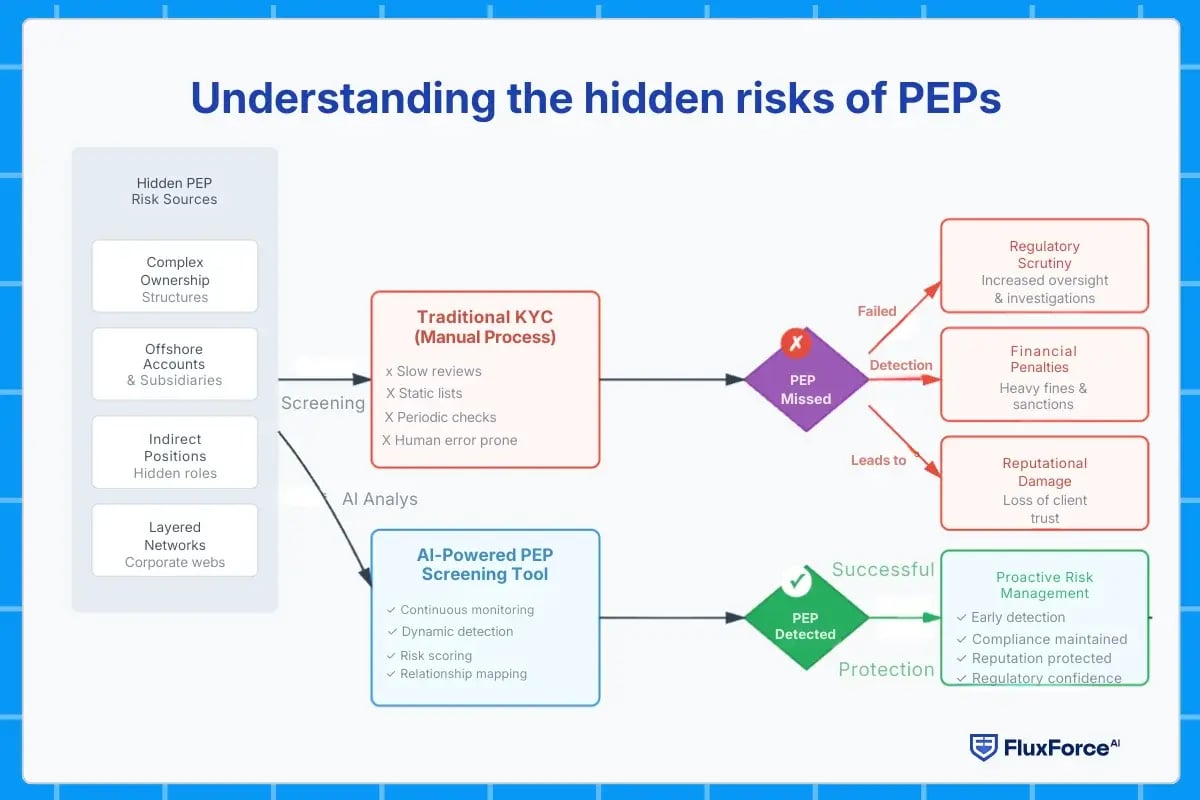
Complex ownership and hidden exposure
Not all politically exposed persons are visible at first glance. Some hold interests through subsidiaries, offshore accounts, or indirect positions. Traditional KYC processes often miss these complex connections. A PEP screening AI tool can analyze vast datasets, uncover hidden relationships, and strengthen PEPs monitoring.
Real-world implications for compliance directors
How much risk is hidden in your client base? Missing a high-risk PEP triggers regulatory scrutiny, significant fines, and reputational damage that takes years to rebuild. AI-driven PEP detection allows teams to identify subtle risk patterns across transactions, corporate networks, and relationships. This makes financial crime risk management more proactive and precise.
Limitations of manual KYC
Manual reviews are slow and prone to errors. Static lists or periodic checks fail to catch dynamic changes in a PEP’s status or emerging sanctions. Implementing a PEP screening AI tool automates continuous monitoring and applies PEP risk scoring, prioritizing high-risk cases for immediate review.
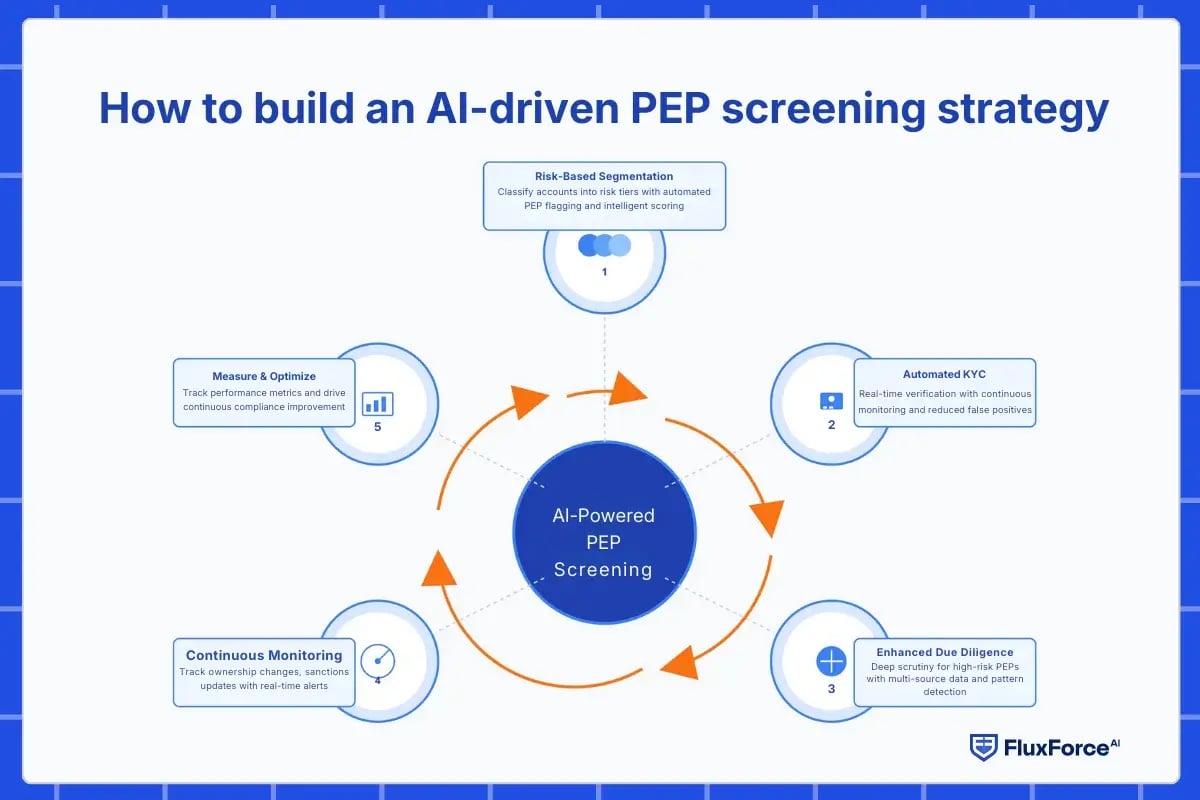
How to build an AI-driven PEP screening strategy ?
 Start with a risk-based client segmentation
Compliance teams classify accounts into low, medium, and high-risk tiers. Using a PEP screening AI tool, teams automatically flag politically exposed persons, apply PEP risk scoring, and focus resources on accounts requiring immediate attention.
Integrate automated KYC for PEPs into workflows
Traditional KYC checks are time-consuming and error-prone. Embedding a PEP screening AI tool within automated KYC for PEPs allows real-time verification and continuous monitoring. Compliance Directors can reduce false positives, maintain audit-ready records, and ensure regulatory compliance technology standards are met.
Apply enhanced due diligence (EDD) AI for high-risk cases
High-risk politically exposed persons require deeper scrutiny. With EDD AI, compliance teams gather data from multiple sources, monitor transactions, and detect unusual patterns. This step strengthens PEPs monitoring and significantly reduces the risk of high-risk PEPs going undetected.
Continuous identity threat detection
PEP risk is not static. Ownership structures, sanctions lists, and political positions change over time. A PEP screening AI tool enables AI-driven PEP detection to continuously monitor updates, trigger alerts, and integrate findings into KYC strategy for PEP risk classification.
Measure and optimize compliance operations
Regularly evaluate the performance of your PEP screening AI tool. Metrics such as alert reduction, case resolution time, and accuracy of risk scoring provide insight into operational efficiency.
Strengthening real-time PEP monitoring and proactive alerts
Continuous PEP monitoring with AI
High-risk politically exposed persons change constantly—ownership stakes shift, political roles evolve, and affiliations expand. Manual checks are not enough for banks managing thousands of clients. A PEP screening AI tool allows teams to track PEPs continuously across global databases, corporate records, and sanction lists. Any change in a PEP’s status triggers immediate attention for compliance teams.
Prioritized real-time alerts for compliance directors
Not all alerts need the same attention. By combining AI-driven PEP detection with PEP risk scoring, the system flags high-risk cases first. Compliance directors can focus on clients that pose the greatest risk while low-risk alerts are handled automatically.
Smooth integration into KYC workflow automation
Alerts are most useful when they fit seamlessly into existing processes. A PEP screening AI tool connects directly with automated KYC for PEPs, triggering investigations automatically for flagged accounts. Case histories, risk scores, and AI insights are visible in a single dashboard, giving directors clear oversight while reducing manual work.
Proactive identity threat detection
Compliance teams act before problems occur. Advanced AI analyzes transaction patterns, networks, and past behaviors to spot emerging PEP risks — enabling leadership to allocate resources efficiently and address issues before they escalate.
Continuous improvement through feedback
The PEP screening AI tool gets smarter over time. Every alert outcome, investigation, and false positive is used to refine the AI models. This reduces unnecessary alerts and adapts to changes in regulations.
How to turn PEP insights into smarter PEP risk management ?
PEP risks shift fast, so teams need a clear way to use insights in daily reviews without slowing down operations. Below are the practical steps that help Compliance Directors turn signals from a PEP screening AI tool into real control and better decision making.
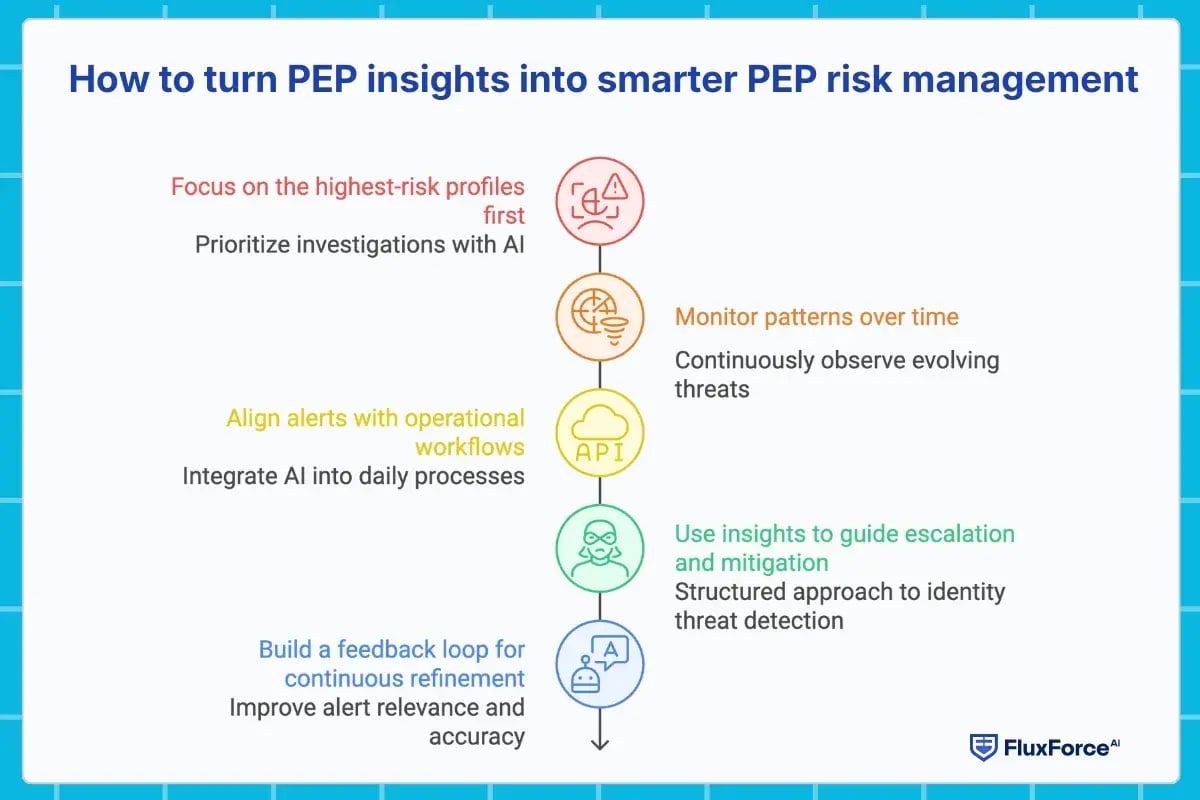
Focus on the highest-risk profiles first
Compliance teams should direct attention to accounts flagged with the most concerning patterns. Using a PEP screening AI tool, high-risk politically exposed persons are highlighted, allowing teams to prioritize investigations without getting bogged down by low-risk cases.
Monitor patterns over time
PEP risks are dynamic and can change quickly. Continuous observation of transaction behavior, ownership links, and political connections uncovers evolving threats. Patterns that appear minor at first may reveal larger risks, strengthening KYC strategy for PEP risk classification.
Align alerts with operational workflows
Alerts and risk signals are most valuable when they connect seamlessly to daily compliance processes. Integrating a PEP screening AI tool into existing monitoring routines ensures that flagged accounts flow naturally into review cycles. This reduces bottlenecks, minimizes manual effort, and keeps Compliance Directors informed about high-priority risks.
Use insights to guide escalation and mitigation
Not every flagged account requires the same action. Insights from the system allow teams to escalate critical cases promptly while lower-risk cases are monitored systematically. This step-wise approach ensures identity threat detection is structured, predictable, and aligned with regulatory expectations.
Build a feedback loop for continuous refinement
While the team focuses on risk management, every reviewed case adds indirect insight to improve alert relevance and accuracy. Over time, the system highlights subtle risk signals that may have been missed initially, creating a more reliable PEP monitoring with AI framework.
Conclusion
Insurance firms face a future where political influence, global connections, and digital identities are more intertwined than ever. A PEP screening AI tool lays the groundwork for a KYC strategy that reads these patterns early and supports a stronger compliance posture overall. To help compliance teams translate this capability into day‑to‑day controls, PEP Screening: A Practical Guide for Compliance Officers provides practical guidance on identifying political exposure, managing indirect relationships, and operationalizing continuous PEP monitoring across the customer lifecycle. Compliance Directors who embrace these tools today will lead organizations that stay agile, audit-ready, and better protected against emerging PEP-related threats.
Share this article