.webp)







Listen to our podcast 🎧
Introduction
Can your current core banking system keep up with the speed of modern finance? For most banks, the answer is no. Legacy cores are rigid, costly to maintain, and prone to creating bottlenecks in operations. Every delayed product launch, every slow payment process, and every manual intervention in compliance adds risk.
Banking ops leaders know that core banking modernization is not just a tech upgrade but a strategic move to reclaim agility. API-driven core migration allows banks to unlock capabilities in modern core banking systems without overhauling everything at once. By adopting banking API integration, legacy systems can become more responsive, scalable, and aligned with digital customer expectations.
According to Accenture's Banking Technology Outlook (2025), institutions that have modernized their core infrastructure report an average 45% improvement in operational efficiency, while modernization can reduce total cost of ownership by 38–52% compared to maintaining legacy systems.
In this blog, we explore how strategic API-driven migration transforms a rigid legacy core into a real-time, agile banking engine, and answer key questions for operations leaders:
- How do we prioritize which systems to modernize first?
- How can compliance and audit readiness be maintained during migration?
- What measurable business outcomes should we expect from API-driven modernization?
The hidden costs of sticking with legacy core systems
Many banks underestimate how much legacy cores drain operational efficiency. Old architectures were designed for batch processing and manual interventions. Today, customers expect real-time banking architecture, instant transfers, and seamless digital experiences that traditional cores simply cannot keep pace.
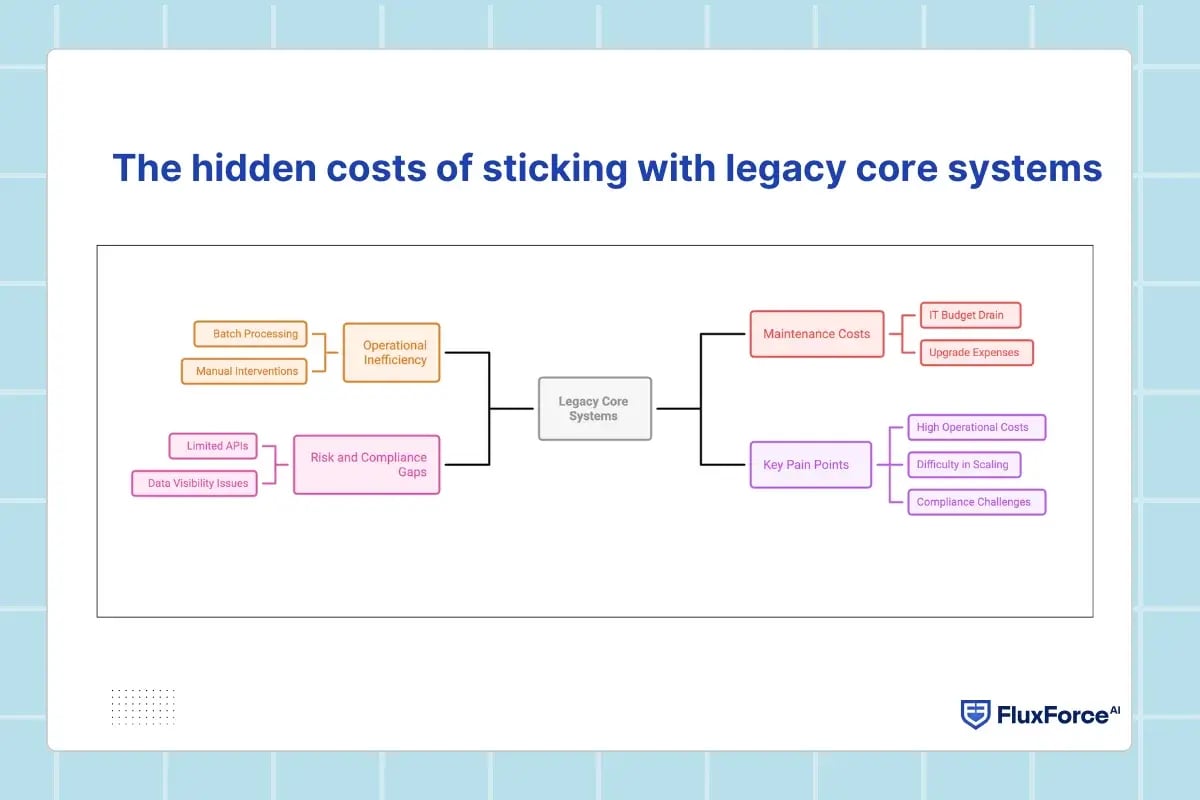
Operational friction is the first cost. Every new product, regulatory update, or integration with fintech partners requires extensive IT resources. Siloed systems make banking operations transformation slow and error-prone.
Maintenance and upgrade expenses are another significant burden. Banks spend an average of 70–78% of their IT budgets maintaining legacy core systems — leaving only 20–30% available for innovation, new products, and competitive initiatives, according to multiple industry analyses (Gitnux; SaaScada, 2025). Legacy core modernization has become a business imperative.
Moreover, risk and compliance gaps are growing. Without modern APIs, banking API integration becomes cumbersome. Data visibility is limited, slowing AML monitoring, KYC updates, and regulatory reporting. In fintech partnerships, delayed integration can block innovation.
Key pain points for banking operations leaders include:
- High operational costs and slow time-to-market
- Difficulty in scaling digital offerings
- Limited agility for core banking migration or API-driven enhancements
- Compliance challenges due to fragmented systems
These constraints highlight why API-first core banking is essential. By introducing APIs as an abstraction layer, banks can modernize gradually, retain control over sensitive operations, and enable digital core banking upgrades without halting daily workflows.
How banking leaders can execute API-driven core migration strategically ?
Modernizing a core banking system is more than a technical upgrade. For operations leaders, it’s a strategic initiative that impacts risk, compliance, and business agility. API-driven core migration allows banks to modernize incrementally while maintaining control over critical operations.
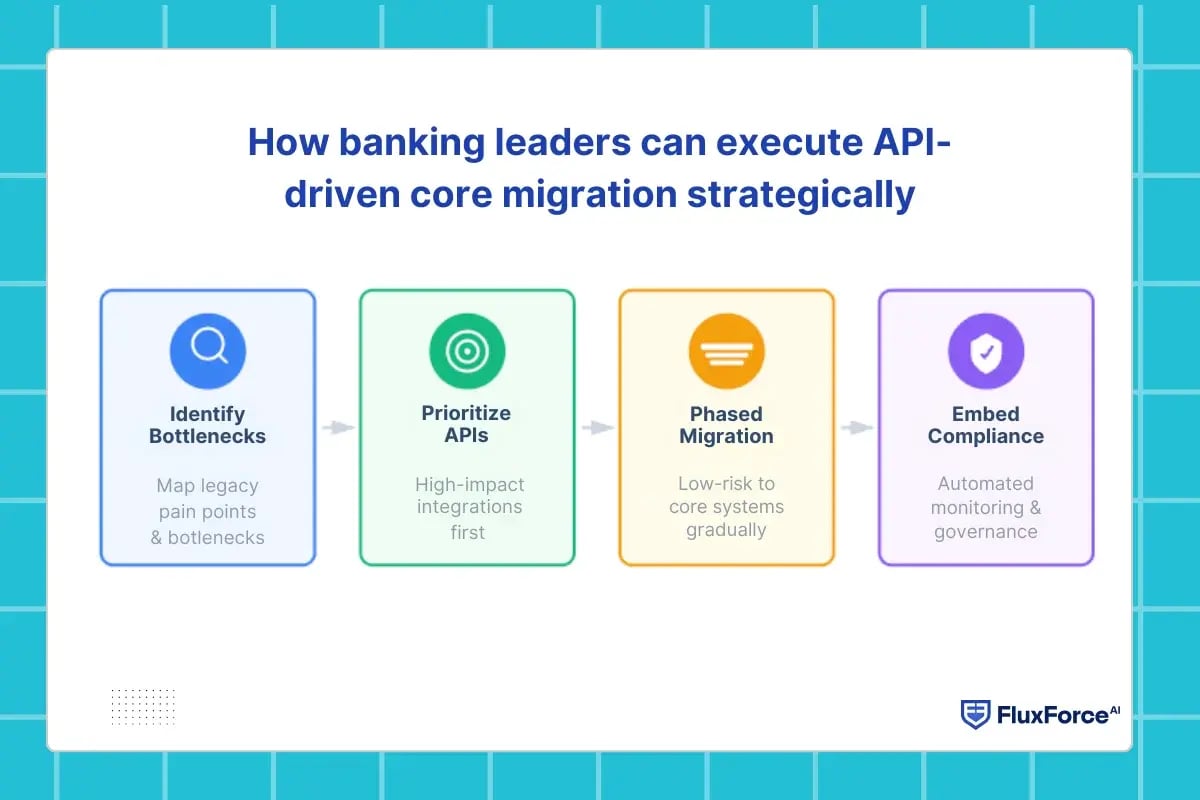
Identify critical bottlenecks before migration
The first step is mapping the pain points in legacy cores. Which processes are slow, error-prone, or costly? Focus on areas where banking API integration can unlock immediate efficiency, such as payments, customer onboarding, or regulatory reporting.
Prioritize API deployment for maximum impact
Not every function requires immediate modernization. API-first core banking should begin with integrations that accelerate innovation or compliance. Examples include enabling real-time banking architecture, automating data flows, or exposing legacy services for digital channels. This ensures the migration delivers measurable business value from day one.
Plan a phased, risk-aware migration
A structured rollout reduces operational risk:
- Begin with non-core or low-risk systems to test integrations.
- Gradually expose legacy core functions via APIs, minimizing downtime.
- Continuously monitor operational performance and adjust the roadmap.
This approach allows core banking modernization without disrupting daily banking operations or compliance processes.
Embed compliance and operational governance
Every API deployment should include automated monitoring and audit-ready controls. Banking operations transformation requires visibility into all transaction flows, regulatory reporting, and data governance. Leaders should leverage cloud-native core migration and digital core banking upgrades to integrate compliance at every stage.
Discover the future of banking!
Modernize operations, boost efficiency, and stay competitive

Roadmap for executing API-first core migration
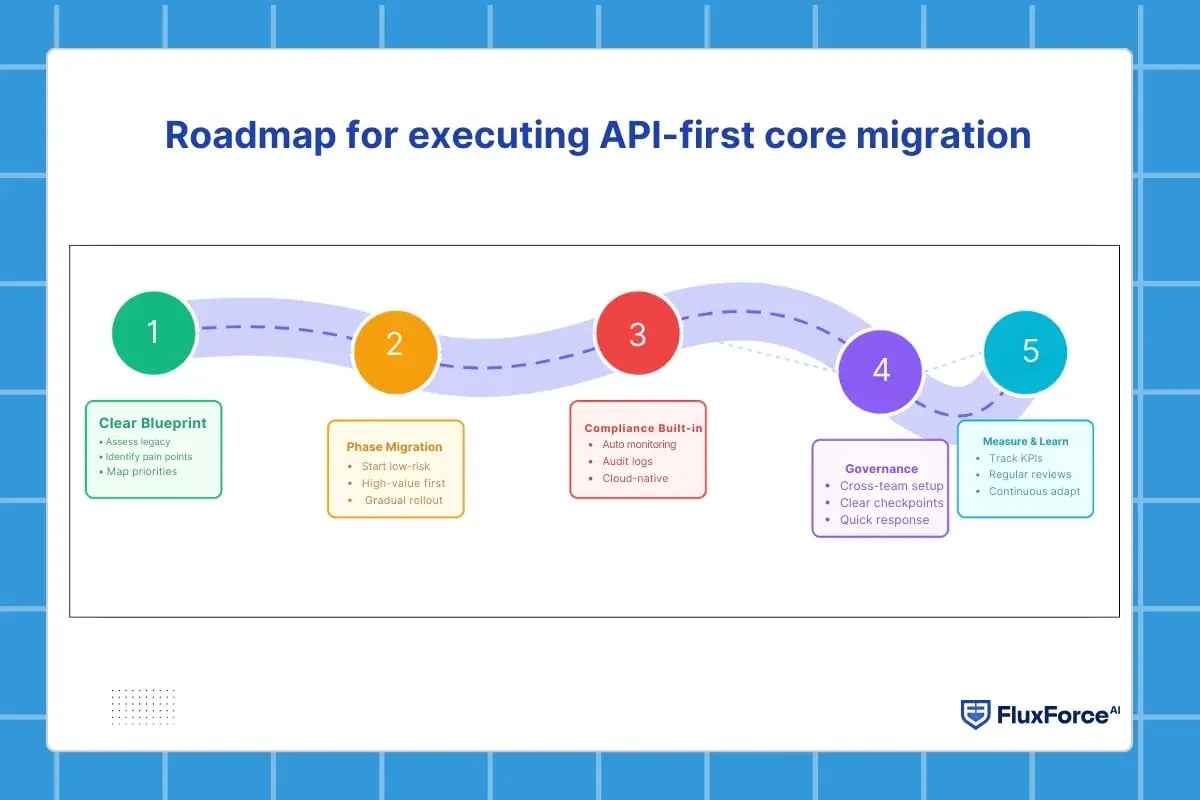
For banking operations leaders, the challenge is turning a modernization plan into real, working results. API-driven core migration needs careful planning to avoid operational hiccups while delivering measurable improvements.
Start with a clear blueprint
Understand your legacy systems and pinpoint where processes slow down daily operations. Identify the high-impact areas in payments, lending, and customer services. This ensures your core banking modernization plan focuses on the most critical business needs.
Phase migration by risk and value
Not everything needs to change at once. Start with low-risk, high-value functions like reporting, analytics, or digital channels. Gradually move core transaction processes using banking API integration. This minimizes downtime and lets teams adapt smoothly.
Build compliance and monitoring into every step
Every API deployment should include automatic monitoring and audit-ready logs. Using cloud-native core migration and digital core banking upgrades ensures systems remain compliant and aligned with internal controls.
Set up cross-team governance
Core migration involves IT, operations, compliance, and product teams. Clear responsibilities and checkpoints — what Oliver Wyman calls a "Core Modernization Control Tower" — help teams respond quickly to issues, enforce governance, and keep daily operations running.
Measure, learn, and improve
Track key indicators like transaction speed, system errors, and time to launch new products. API-driven core migration is a continuous process. Regular review and adjustments ensure your modernization delivers real efficiency and agility.
Transform your bank with API-driven core migration
Modernize operations, boost efficiency, and stay competitive
Conclusion
Legacy cores are expensive, rigid, and slow — but API-driven core migration offers a smarter, lower-risk path forward. For banking operations leaders, core banking modernization is about reclaiming agility and cutting operational friction that costs the industry billions annually. By strategically exposing legacy systems through APIs, banks can automate key processes, streamline workflows, and reduce maintenance costs without disrupting day-to-day operations. Measurable KPIs — transaction speed, error rates, and time-to-market for new products — provide tangible proof of improvement. When executed strategically, API-first modernization transforms legacy systems into lean, responsive engines that save costs, accelerate innovation, and empower operations teams to focus on value-added work rather than maintaining aging infrastructure.
For a more specific lens on payments teams, see Legacy to Cloud: Core Banking Modernization Strategy for Payments Risk Officers.
Share this article