.webp)




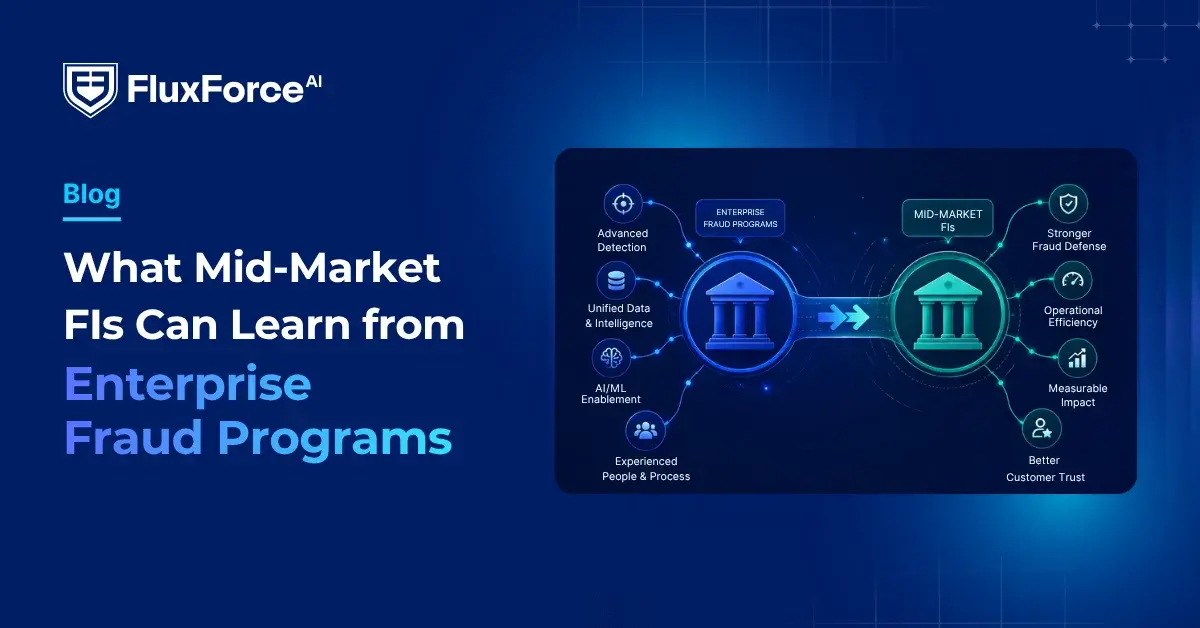



Mid-market financial institution fraud is the quiet budget crisis that most compliance teams don't address until a loss lands on the board agenda. Regional banks, community FIs, and credit unions collectively absorbed billions in fraud losses in 2024 alone, yet most of their fraud programs still rely on rule sets designed for a pre-digital threat landscape. This post is for risk officers, compliance heads, and operations leaders who want to understand what enterprise fraud programs actually do well, and which of those approaches are realistically within reach for a mid-market institution today.
The Enterprise Fraud Playbook Most Mid-Market FIs Don't Have
Enterprise banks spent the 2010s building multi-layer fraud detection programs. What emerged wasn't a single tool but a philosophy: catch signals early, automate triage at scale, and preserve analyst bandwidth for complex cases that genuinely need human judgment. Mid-market FIs often skip one or more of these layers, not from negligence, but because the vendor market kept selling point solutions that didn't integrate with each other.
How Enterprise Banks Approach Fraud Detection Differently
The clearest difference is data integration. Large banks run transaction data, device fingerprints, behavioral patterns, and external threat feeds through a unified model stack. A suspicious login attempt doesn't trigger an isolated alert; it feeds a composite risk score that already accounts for the customer's normal behavioral pattern, their device history, and whether the IP address appears on known fraud networks.
Mid-market FIs often have those same data sources somewhere in their stack, but they sit in siloed systems. Each signal fires its own alert, analysts spend more time correlating than deciding, and faster fraud patterns slip through the gaps between systems. The result is a program that looks comprehensive on paper but misses coordinated attacks that cross system boundaries.
Why Manual Compliance Cost Keeps Climbing Without a System Change
Mid-market FIs spend a disproportionate share of their compliance budget on manual review. Analysts triage alerts that a well-tuned model could dismiss in milliseconds, and the manual compliance cost compounds as transaction volumes grow. In our client engagements, we've seen mid-size banks running fraud operations with a handful of analysts, each triaging well over a hundred alerts a day, with the large majority turning out to be false positives. That's a significant portion of salary budget being spent on noise rather than genuine risk.
The compounding effect is real. As the bank grows, alert volume grows faster than revenue, and adding analysts is the only lever that seems available. Most compliance operations don't break this cycle until they hit a capacity wall or take a material fraud loss that forces a program review.
What Is AI in Banking 2026?
AI in banking 2026 means something more specific than chatbots and auto-approvals. The current generation of financial AI focuses on decision automation in regulated workflows: transaction monitoring, KYC refresh, anomaly detection, and case management. The key shift between 2023's pilot projects and today's production deployments is that models now run on live transaction flows, with explainability outputs that satisfy regulatory examination requirements.
AI Automation Banking vs. Rule-Based Systems
Traditional transaction monitoring runs on rules: if the amount exceeds X, and the country is Y, and the account age is below Z, flag it. Rules are predictable and comfortable for examiners. They're also poor at catching novel fraud patterns. When a fraudster figures out the rule thresholds (and they typically do within weeks of a new system going live), they adjust behavior to stay just below every limit.
AI automation banking flips this by learning what normal looks like for each customer and flagging deviations from that baseline. The false positive rate drops, analysts handle fewer alerts, and novel attack patterns get caught before causing material losses. The honest take on ai in banking hype vs reality: the hype is mostly about generative AI capabilities that aren't directly relevant to fraud operations. What's delivering consistent results today is supervised learning for transaction classification, unsupervised anomaly detection, and automated case triage.
Agentic AI Financial Services: What It Actually Means
Agentic AI financial services describes AI systems that don't just flag an issue but take a sequence of actions in response to it. A conventional fraud detection system creates an alert for an analyst. An agentic system detects the anomaly, pulls the customer's full transaction history, cross-references known fraud patterns, checks sanctions lists, generates a case summary, and either auto-resolves if confidence is high enough or escalates to a human with all context pre-populated.
This is agentic ai banking in practice, and it's what's driving the fraud prevention roi numbers enterprise banks are now reporting. For a mid-market FI, this workflow automation typically recovers 3-5 hours of analyst time per complex case, which adds up to a measurable headcount equivalent across a full year of operations.
How Mid-Market Financial Institution Fraud Differs From Enterprise
The scale difference between mid-market FIs and large banks isn't just about transaction volume. It changes which fraud patterns are most dangerous and which defenses are most practical to maintain on a regional institution's budget.
Scale Differences That Change the Math
Enterprise banks see enough volume that statistical models train quickly and stay current as attack patterns evolve. A mid-market FI with 200,000 accounts has a much smaller window of fraud events, which means models take longer to calibrate and need more careful tuning to avoid both false positives and missed detections.
This is actually an argument for AI automation at smaller institutions, not against it. When you don't have the volume to sustain a large analyst team, automated triage makes the unit economics work in ways it doesn't at a bank where headcount expansion is the default response to volume growth. The math is more favorable for automation when your alternative is three analysts, not thirty.
Total Cost of Ownership: Fraud Platform Considerations
The total cost of ownership fraud platform calculation is where mid-market institutions consistently underestimate their current spend. Most compliance officers compare licensing costs for a new system against the status quo, but the status quo carries costs that don't appear in a single budget line:
- Analyst headcount dedicated to manual alert review and case construction
- Fraud losses that rule-based systems miss (often misclassified as a process failure rather than a detection gap)
- Regulatory examination findings resulting from weak documentation and manual error rates
- Customer friction from false declines, which shows up in deposit outflows and satisfaction scores rather than a compliance budget line
When these are tallied up, the cost of compliance financial services at a mid-market FI typically runs 30-40% higher than leadership realizes. The FDIC's quarterly banking profile data consistently shows operational risk costs at community and regional institutions exceeding initial estimates when indirect costs are properly attributed.
Onboard Customers in Seconds

Why Fraud Prevention ROI Looks Different for Mid-Market FIs
Compliance automation roi is real, but it takes longer to materialize at smaller institutions because initial setup costs are proportionally higher. The ROI case typically rests on three numbers: fraud loss reduction, analyst time recovered, and regulatory risk reduction. Getting all three right requires a more careful baseline assessment than most institutions do before they start vendor conversations.
Measuring Fraud Prevention ROI Honestly
A fraud prevention roi calculation that holds up in a board presentation includes three components. First, direct loss prevention: how much fraud does the new system catch that the current one misses? This requires a retrospective analysis of 12-24 months of transaction data, not just headline loss numbers. Second, operational efficiency: how many analyst hours are freed by automated triage? In our experience, recovering a meaningful share of each analyst's time across a six-person team, once fully loaded analyst costs are factored in, can generate six figures in annual savings. Third, regulatory posture: a documented, explainable AI-based monitoring system materially reduces the probability of a Matter Requiring Attention (MRA) finding, which can cost six figures in remediation work.
The Manual Compliance Cost Problem at Scale
Enterprise banks absorb high manual compliance cost because they have the headcount to sustain it. A regional FI with 3-5 compliance analysts doesn't have that option. When volume spikes during tax season, stimulus events, or account opening fraud waves, those teams hit capacity and either miss detections or create backlogs that push Suspicious Activity Reports past regulatory deadlines. Both outcomes carry examination risk.
AI automation banking addresses this by scaling triage capacity without scaling headcount. The team stays the same size, but its effective throughput grows in proportion to alert volume, not analyst count. This is the structural change that makes mid-market fraud programs genuinely competitive with enterprise programs on a per-account basis.
Agentic AI Banking: The Missing Link Between Detection and Response
Detection without response isn't a fraud program. It's a notification system. The shift toward agentic ai banking is about closing the loop between identifying a suspicious event and acting on it, automatically, in cases where the risk signal is clear enough to warrant autonomous action without sacrificing auditability.
How Agentic AI Works in Production Fraud Programs
In a production deployment, agentic AI handles 70-80% of fraud alerts without human involvement. The system reads a transaction, pulls customer history, runs the event against multiple detection models, checks external databases (sanctions lists, PEP registries, negative news feeds), and makes a disposition. Cases meeting the auto-resolve threshold are handled in under a second. Cases above the threshold go to an analyst with a pre-built dossier that takes seconds to review rather than 15 minutes to construct.
This is how agentic AI fraud agents cut false positives by 80%: not by being more aggressive in blocking transactions, but by being more precise about what genuinely requires human judgment. The analyst's time shifts from triage to decision, which is where their expertise actually matters.
AI in Banking Hype vs Reality: Where Mid-Market FIs Should Focus
The future of ai in banking for mid-market institutions isn't about deploying every capability on a vendor's roadmap. It's about identifying the two or three workflows where automation delivers the fastest payback. Transaction monitoring triage is almost always the first priority. KYC refresh automation is usually second. SAR narrative generation is the third workflow gaining real production traction in 2026.
Detecting synthetic identity fraud in real-time is another area where AI automation consistently outperforms manual review, because synthetic identities are deliberately constructed to pass rule-based thresholds. The behavioral anomaly detection that AI enables is the only reliable defense against fraud patterns that are engineered to look clean at the transaction level.
Compliance Automation ROI: Lessons From Enterprise Programs
Enterprise banks running AI-augmented compliance programs for 3+ years have produced enough performance data that the lessons are no longer theoretical. Several patterns repeat consistently across institutions of different sizes, geographies, and regulatory environments.
What Enterprise Compliance Programs Get Right
First, they invest in data infrastructure before model deployment. The models aren't the hard part. Getting clean, normalized transaction data from 15 legacy systems into a unified feature store is the hard part, and institutions that tried to shortcut this step rebuilt it later at considerably greater cost.
Second, they treat explainability as a first-class requirement from day one, not a retrofit. Examiners from the OCC and FDIC now routinely request model documentation and adverse action rationale during examinations. Institutions that built explainability into their model architecture from the start are in a substantially better position than those running black-box systems that work well but can't be documented in a way that satisfies an examiner.
Third, they measure outcomes, not activities. Alert volume reviewed and headcount deployed are activity measures. Fraud loss rate, false positive rate, and SAR accuracy rate are the metrics that actually indicate program effectiveness. Enterprise programs made this shift years ago, and mid-market FIs that don't make it will struggle to justify continued AI investment internally.
Adapting Enterprise Lessons to Mid-Market Scale
The good news is that purpose-built platforms have made the enterprise playbook genuinely accessible. You don't need to build a feature store from scratch or maintain a dedicated data science team. Modern fraud detection software like FluxForce delivers pre-built connectors, pre-trained models on financial transaction data, and explainability outputs formatted for regulatory documentation. The mid-market FI's job shifts from building infrastructure to configuring a system that already understands what normal financial transaction patterns look like.
The compliance automation roi case is clearest when mid-market teams frame the question correctly: not "can we build what the big banks built?" but "can we acquire what the big banks spent eight years building?" In 2026, the answer is yes, and deployment timelines are measured in weeks rather than quarters.
How FluxForce Brings Enterprise Capabilities to Mid-Market FIs
FluxForce is designed specifically for the gap between enterprise-grade fraud programs and what most mid-market institutions can actually deploy and maintain. The platform's agentic architecture means it doesn't just surface alerts; it works cases through a configurable decision workflow that mirrors what enterprise compliance teams built manually over years.
FluxForce AI: Core Capabilities for Mid-Market Risk Teams
FluxForce AI covers the primary workflows where mid-market FIs feel the most operational strain: transaction monitoring, KYC/AML screening, SAR case management, and regulatory reporting. The platform's agents handle alert triage, context enrichment, and case documentation with human review reserved for cases above defined risk thresholds. For institutions running legacy core banking systems, FluxForce's pre-built API connectors reduce integration complexity significantly.
Compliance teams frequently cite the onboarding speed as the most visible differentiator from legacy vendors that require 9-18 month implementation cycles. Most mid-market deployments reach production on transaction monitoring within 60-90 days, which changes the ROI timeline considerably from what institutions have come to expect from compliance technology projects.
FluxForce Review: What Compliance Teams Report
Common themes from compliance officers who have deployed FluxForce: alert fatigue drops measurably within the first 60-90 days, SAR narrative drafts require minimal analyst editing, and the audit trail quality satisfies regulatory examination requests without additional documentation effort. The card fraud analytics capabilities within the platform consistently receive recognition from risk heads who previously maintained separate specialized tools for card fraud versus ACH fraud, consolidating that operational overhead into a single workflow.
On the agentic ai banking dimension specifically, fluxforce review feedback from compliance operations teams highlights the case pre-population quality as the biggest practical time saver. Analysts report spending 5-8 minutes on cases that previously required 20-30 minutes, which effectively doubles the team's throughput without any change in staffing.
Building a Fraud Program That Scales With You
The right question for mid-market FIs isn't "do we need AI?" The more useful question is: which specific bottlenecks in our current fraud operations are costing us the most, and which of those can AI address fastest?
Where to Start: Quick Wins for Mid-Market Risk Programs
The fastest fraud prevention roi typically comes from automating alert triage first. If analysts are closing more than 40% of their alerts as false positives, that's the starting point. KYC refresh automation is usually the second priority, particularly for higher-risk customer segments where annual reviews accumulate into backlogs that create both regulatory risk and analyst burnout.
SAR narrative automation follows, addressing both quality risk (inconsistent narratives across analysts) and timeliness risk (late filings due to capacity constraints). For institutions thinking about the broader security posture, combining zero trust with agentic AI creates a layered defense that covers both fraud detection and access control in an integrated architecture rather than two separate program tracks.
The Future of AI in Banking for Mid-Market Institutions
The future of ai in banking isn't about replacing compliance teams. It's about making a 5-person team as effective as a 15-person team was three years ago. The institutions that will struggle are those waiting for the technology to prove itself further before acting. The technology is proven. Deployment models are tested. Regulatory acceptance of AI-based monitoring, with proper governance, is established across the OCC, FDIC, and FinCEN examination frameworks.
According to NIST's AI Risk Management Framework, institutions deploying AI in high-stakes decision contexts need governance structures that balance automation efficiency with human oversight. Well-designed agentic ai financial services platforms build this governance architecture directly into their documentation and explainability outputs, which means the compliance burden of running AI is lower than many risk officers assume going in.
The ai in banking 2026 reality is that mid-market FIs moving now will be operating at a fundamentally different efficiency level than those waiting for a larger crisis to force the decision. The fraud patterns they're waiting to understand better are already being used against them.
Onboard Customers in Seconds
Conclusion
Mid-market financial institution fraud demands the same systematic approach that enterprise banks have refined over the past decade. The technology gap that made enterprise-grade fraud programs inaccessible to smaller institutions has largely closed. The compliance automation roi is measurable. The fraud prevention roi pays back within the first year in most deployments. What remains is a decision: continue running a manual compliance operation that scales poorly against growing fraud volumes, or adopt the automation tools that make a lean team genuinely competitive. The mid-market FIs winning on fraud today made that choice. If your institution is ready to close the gap between your current fraud posture and what enterprise programs actually look like, start with an honest assessment of where your manual processes are creating the most exposure right now.

Share this article