.webp)




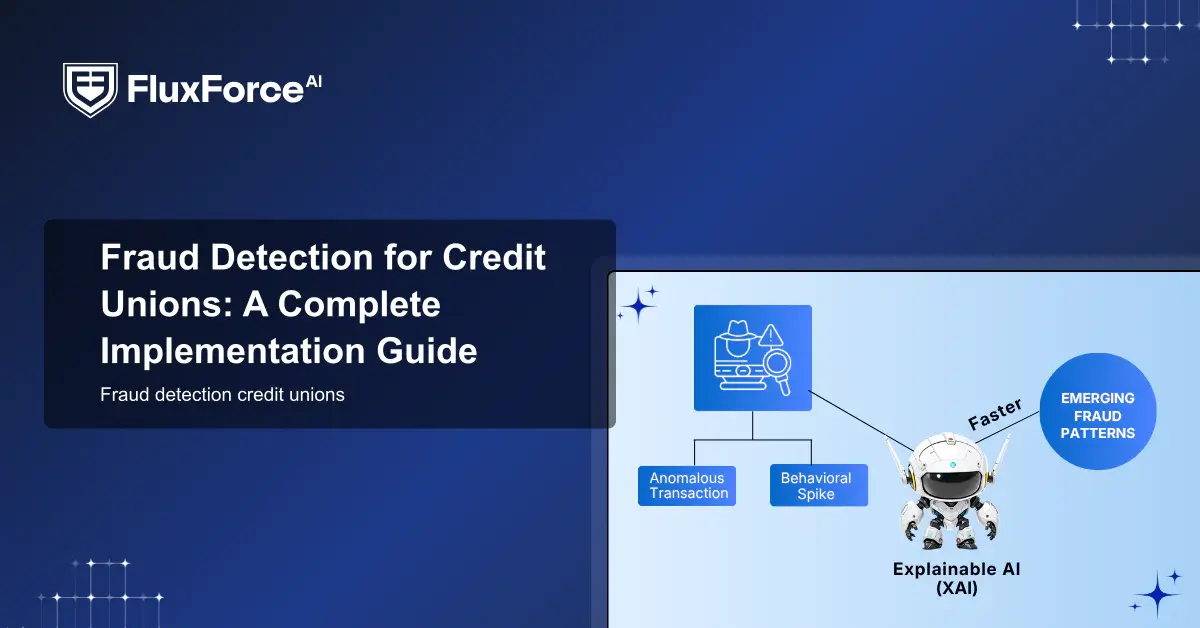



Fraud detection credit unions depend on is one of the most resource-constrained areas in financial compliance today. Credit unions serve well over 100 million Americans, yet most compliance teams are a fraction of the size found at comparable banks. Account takeover, payment fraud prevention gaps, and synthetic identity fraud have accelerated sharply since 2022, leaving many credit unions with tools that were not built for the threats they face now.
This guide covers how ai fraud detection works, how to evaluate transaction monitoring software for your size and risk profile, why false positives fraud detection generates cost more than most risk officers account for, and what a phased rollout looks like with limited in-house engineering capacity.
Why Fraud Detection Credit Unions Face Unique Challenges
Credit unions operate under a cooperative charter that creates a member-first culture commercial banks do not replicate. But fraudsters do not care about member relationships. The same account takeover techniques hitting large banks are hitting your members, and your fraud team might be three people managing the same regulatory obligations as institutions ten times your size.
The Member-First Tension in Fraud Prevention
When a credit union declines a transaction on a longtime member's account, the member sometimes calls the branch manager directly. That social pressure is real, and it creates tolerance for borderline approvals that commercial institutions rarely experience the same way. Automated transaction monitoring removes that human judgment from routine decisions, so the branch manager never receives the call because the transaction was already scored and released in under a second.
Regulatory Pressure Without Enterprise Budgets
The Bank Secrecy Act, FinCEN guidance on beneficial ownership, and NCUA examination requirements create compliance obligations that do not scale down by asset size. A $500 million credit union is expected to document fraud controls to the same standard as a $50 billion bank. The FinCEN advisory library makes clear that regulators expect institutions of all sizes to detect synthetic identity schemes. Staffing constraints are not an acceptable examination finding.
How Does AI Detect Fraud in Credit Unions?
AI fraud detection scores every transaction against a model trained on behavioral patterns. Instead of a human analyst deciding whether a $400 wire from a new device looks suspicious, the model assigns a risk score in milliseconds based on hundreds of simultaneous signals.
AI Fraud Detection Explained: The Core Mechanics
AI fraud detection explained in plain terms: a machine learning model observes every transaction a member makes over time, learns what normal looks like for that account, and flags deviations. A member who always transacts near home, suddenly initiating a transfer to an unrecognized account from a new IP in another state, scores high even on a modest dollar amount.
AI fraud detection in banking has moved beyond simple velocity checks. Modern systems layer behavioral biometrics, device fingerprinting, and graph-based network analysis to build a complete risk picture per transaction. The difference from rule-based systems is continuous adaptation: rules require a human to update them as patterns shift, while a machine learning fraud detection system recalibrates as new labeled data flows in.
Machine Learning Fraud Detection Models in Practice
Most production fraud systems at credit unions use gradient boosting (XGBoost, LightGBM) for fast interpretable scoring on tabular data, neural networks for complex behavioral sequences, and graph models for detecting synthetic identity fraud through account relationship mapping. Model type matters less than data quality. As our post on AI vs. traditional fraud detection covers, the real advantage is the shift from static rules to adaptive scoring.
Real-Time Fraud Detection for Credit Unions: What You Need to Know
Real time fraud detection is now a baseline requirement for payment fraud prevention. The gap is not card transactions, which have operated in real time for decades. The gap is ACH, wire, peer-to-peer payments, and account opening.
Real Time Fraud Detection: What Banks Are Deploying Now
Real time fraud detection banks use operates at millisecond latency for card transactions but frequently lags hours for ACH and wire. The shift to faster payments (FedNow, RTP) compresses that window to near-zero: fraud must be caught before settlement. A fraudster initiating a push payment from a compromised account can move funds in seconds. Reviewing that event the next morning means reviewing a completed crime.
Why Batch Processing No Longer Cuts It
Batch processing made sense when the payment itself was the slowest part of the system. That is no longer true. Automated transaction monitoring systems built on event-streaming architectures evaluate every event as it occurs and hold or release within a defined SLA. The infrastructure complexity is where commercial transaction monitoring software earns its cost: your team focuses on tuning and reviewing alerts instead of maintaining data pipelines.
Onboard Customers in Seconds

The Hidden Cost of False Positives in Transaction Monitoring
False positives fraud detection generates may be the most underestimated operating expense in compliance. A blocked legitimate transaction is not just an inconvenience. It is analyst time, a member complaint, and an erosion of internal confidence in your fraud controls.
False Positive Cost Fraud: The Numbers
In our client engagements, manual alert review commonly consumes several analyst hours a day even at moderate alert volumes, much of it confirming clean transactions. If your false positive rate fraud detection runs at 90% or above (not unusual for rule-based systems), nine of every ten analyst hours go toward clearing legitimate activity. Examiners increasingly scrutinize BSA/AML staffing adequacy, making an unsustainable alert volume both an operational and regulatory problem.
How Fraud Alert Fatigue Degrades Your Team
Fraud alert fatigue is predictable: when analysts review hundreds of alerts daily and find a true positive less than 10% of the time, they develop shortcuts. Those shortcuts are exactly what sophisticated fraud rings exploit. A synthetic identity scheme designed to behave like a normal member account sails through a fatigued queue. High false positive rates also drive burnout and turnover, and institutional knowledge leaves with every departing analyst.
How to Reduce False Positives in AML and Transaction Monitoring
Reducing false positives requires combining better contextual data, layered rules, and continuous tuning cycles. There is no single threshold adjustment that fixes it.
Reduce False Positives Transaction Monitoring With Layered Signals
The fastest way to reduce false positives transaction monitoring generates is adding context to individual rules. A rule that flags all transactions over $5,000 generates noise. The same rule conditioned on account age, device fingerprint, historical velocity, and counterparty reputation generates far fewer alerts at much higher precision. Fraudsters can trigger an individual rule but struggle to simultaneously replicate a complete behavioral profile. The approach in our post on how agentic AI agents cut false positives by 80% applies directly to credit union environments carrying legacy alert volumes.
How AI Fraud Detection Software Learns Over Time
AI fraud detection software improves through feedback loops. Every analyst decision is a labeled data point the model uses to recalibrate. This is why the question of how to reduce false positives in aml needs a multi-quarter answer. The first 90 days post-implementation typically show similar false positive rates as the system calibrates. By month six, well-tuned deployments see false positive rate fraud detection drop by 40 to 60% compared to the legacy rule-based baseline.
Synthetic Identity Fraud: The Fastest-Growing Credit Union Threat
Synthetic identity fraud accounts for the largest share of new account fraud losses at US financial institutions. The Federal Reserve estimates losses exceed $6 billion annually. Unlike traditional identity theft, synthetic identities combine real and fabricated information, often using a real Social Security number from a child or deceased person paired with a fake name and address.
What Makes Synthetic Identity Fraud So Hard to Catch
Synthetic identities are built over 12 to 18 months, behaving like model customers to build credit history. The fraud is discovered only at the bust-out event, when the account defaults on a large credit line and losses are already realized. Traditional fraud detection looks for transaction-level anomalies. Synthetic identity fraud hides at the account level, requiring graph-based analysis: device sharing across accounts, address clustering, and application velocity patterns. For strategies built specifically for this threat, see our post on detecting synthetic identity fraud in real-time.
Choosing Transaction Monitoring Software: Sardine vs Unit21 and Beyond
The sardine vs unit21 comparison comes up most frequently on credit union shortlists. Both platforms are credible. The choice depends on which capability gap you are closing first.
Sardine vs Unit21: Key Differences
| Feature | Sardine | Unit21 |
|---|---|---|
| Primary strength | Payments fraud and device intelligence | AML case management and SAR workflows |
| Real-time scoring | Sub-100ms | Configurable |
| Rules engine | Visual, no-code | SQL-based, more flexible |
| SAR filing tools | Limited | Strong |
| Credit union deployments | Emerging | Established |
| Transaction monitoring cost model | Usage-based | Platform fee plus usage |
Sardine excels at payment fraud prevention and real-time ACH decisioning. Unit21 is stronger for AML workflows and regulatory reporting. If exam findings center on SAR quality and AML documentation, Unit21 addresses that directly. If payment fraud losses are the immediate problem, Sardine's device intelligence is the right starting point. Platforms like Alloy and Hawk AI offer more unified coverage if you need to address both.
Transaction Monitoring Cost: Build vs. Buy
Transaction monitoring cost for credit unions breaks into three scenarios: legacy rule-based systems carry low licensing cost but high analyst labor cost and inadequate detection rates; commercial platforms carry meaningful annual licensing costs that scale with volume but reduce analyst burden significantly; building on open-source ML carries low licensing cost but requires dedicated ML engineers most credit unions do not employ. For most credit unions under $5 billion in assets, the commercial platform path offers the best risk-adjusted outcome. For credit unions evaluating fraud detection software built on agentic AI, the economics favor commercial platforms further because vendor teams absorb ongoing tuning and model maintenance.
Building Your Fraud Detection Implementation Plan
Credit unions that successfully modernize fraud detection credit unions programs use a phased approach. Replacing all fraud systems at once creates operational risk that outweighs any speed benefit.
Phase 1: Baseline and Risk Assessment
Before evaluating any vendor, pull 24 months of fraud loss data by type: card fraud, ACH fraud, wire fraud, account takeover, and new account fraud. This baseline tells you where to prioritize and gives you a measurement benchmark post-go-live. Audit your current false positive rate at the same time. Most credit unions find it exceeds 85%, which surprises leadership. This data also protects you in vendor negotiations: any vendor promising specific false positive reductions needs to be measured against your actual starting point, not an industry average.
Phase 2: Integration and Configuration
Integration consistently takes longer than planned. Transaction monitoring software needs connections to your core banking system, card processor, online banking platform, and loan origination system. Most vendors offer pre-built connectors for major cores (Symitar, DNA, Corelation, FiServ), but custom data fields add time. Plan 90 to 120 days for a typical credit union integration. Run the system in shadow mode for the first 30 days post-go-live alongside existing tools without acting on new scores. This validates model output against analyst expectations before switching over decisioning. The phased approach in our post on card fraud analytics for risk heads applies here: sequence investments against the problems causing the most measurable loss.
Onboard Customers in Seconds
Conclusion
Fraud detection credit unions need in 2025 is not what worked five years ago. Faster payment rails have eliminated the detection window batch processing relied on. Synthetic identity fraud operates on a timeline transaction-level rules cannot see. Fraud alert fatigue is degrading analyst teams behind whatever automated system is currently in place.
AI fraud detection, automated transaction monitoring, and real-time scoring are operational requirements for credit unions serious about member protection and exam outcomes. Start with your baseline. Know your losses by fraud type and your false positive rate before evaluating any platform. Hold vendors to those specific numbers, not generic industry claims.
A phased implementation with shadow mode validation and multi-quarter tuning cycles consistently outperforms rushed replacements. The credit unions that solve payment fraud prevention treat it as a system design problem with clear metrics and a tuning plan that extends well past go-live day.

Share this article