.webp)




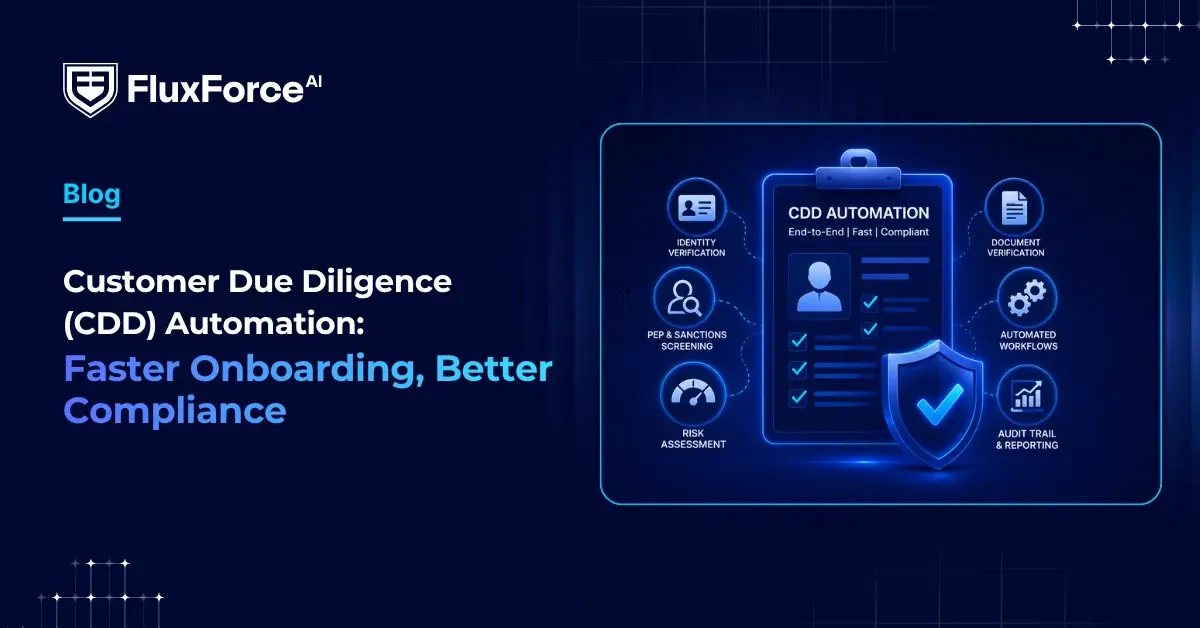



CDD automation customer onboarding sits at the intersection of competitive pressure and regulatory obligation. Financial institutions today face a familiar bind: customers expect account opening in minutes, while AML compliance frameworks demand thorough identity verification, risk scoring, and ongoing monitoring. The gap between those two realities is where manual processes fail and automated systems deliver. This post covers how CDD automation reshapes onboarding timelines, what a practical AML compliance framework looks like across different institution types, and what anti-money laundering technology platforms are doing differently in 2026. If you're weighing whether to invest in automation or strengthen an existing program, this is the operational breakdown you need.
What Is CDD Automation and Why Does It Matter for Customer Onboarding?
Customer due diligence (CDD) automation is the use of software systems to collect, verify, and analyze customer identity information, risk signals, and behavioral data without relying on manual analyst review at every step. For customer onboarding, this means a new applicant can move from submission to approved account in minutes rather than days.
The regulatory driver is explicit: the Financial Crimes Enforcement Network (FinCEN) requires financial institutions to identify and verify beneficial owners, assess customer risk, and maintain updated customer profiles on an ongoing basis. Automated systems execute these checks in parallel rather than sequentially, which is why adoption is accelerating across banking, fintech, and insurance.
How Automated CDD Differs from Manual Review
Manual CDD workflows involve an analyst pulling documents, cross-referencing sanctions lists, checking adverse media, and entering data into a risk scoring model. Each step adds hours. Automated systems connect directly to identity verification APIs, sanctions databases, and PEP screening services, completing those checks in seconds. The analyst role shifts from data entry to exception handling, and that is where the real efficiency gain materializes.
The Regulatory Framework Behind CDD Requirements
KYC/CDD requirements banks must meet include the FinCEN Customer Due Diligence Rule (effective 2018), which mandates four core elements: customer identification, beneficial ownership identification, understanding the nature of the customer relationship, and ongoing monitoring. The EU's 6th Anti-Money Laundering Directive adds behavioral analytics requirements for higher-risk customers. Automation produces a documented, auditable trail that manual processes rarely match.
The Real Cost of Manual CDD in AML Compliance
AML compliance teams in mid-sized institutions often spend 60-70% of their time on routine data collection and verification tasks that software could handle. That leaves less bandwidth for high-judgment work: investigating complex patterns, writing SARs, and responding to regulatory inquiries.
The financial cost is measurable. In our client engagements, manual KYC checks run a meaningful cost per check once analyst time is factored in. For a bank onboarding 10,000 business customers annually, that adds up to substantial labor spend for a single process step. Automation typically brings that per-check cost down significantly.
Time-to-Onboard Benchmarks and What They Cost
The average time to onboard a new business customer manually runs between 7 and 14 days for institutions with thorough AML compliance programs. That timeline causes measurable drop-off: research from Signicat found that 68% of business customers who abandon an onboarding process cite friction or length as the primary reason. Every abandoned application is revenue that went to a competitor who moved faster.
Compliance Team Burnout and Error Rates
Manual review introduces consistency problems. When analysts work through hundreds of files per week, error rates climb and documentation quality drops. Automated workflows apply the same rules every time, which matters when regulators review BSA/AML examination findings. As explored in our analysis of manual compliance vs. AI automation, the human-in-the-loop model works best when automation handles the routine and humans handle the exceptions, not the reverse.
Onboard Customers in Seconds

How CDD Automation and KYC Tools Change the Onboarding Equation
KYC automation in 2026 goes well beyond document capture and OCR. Modern platforms integrate liveness detection, device intelligence, behavioral biometrics, and real-time sanctions screening into a single orchestrated flow. The result is a risk-scored customer profile before a human ever reviews the case.
For fintechs running lean compliance functions, kyc automation 2026 means maintaining regulatory standards without proportionally growing headcount. A platform handling 50,000 onboardings per month doesn't need 50,000 analyst hours. It needs accurate automation and a well-designed escalation path.
How KYC Automation Works in Practice
A modern automated KYC flow works like this:
- Customer submits identity documents and a selfie via mobile or web
- OCR and NLP extract structured data from the document
- Liveness detection confirms the selfie matches the document photo and is captured live
- The system cross-references the identity against sanctions lists, PEP databases, and adverse media feeds in parallel
- A risk score is generated based on jurisdiction, document type, and data consistency
- High-risk or flagged cases route to an analyst queue; standard cases proceed to account opening automatically
This flow completes in 90-180 seconds for most standard applications. Compare that to the 7-14 day manual baseline.
KYC/CDD Requirements Banks Must Meet in 2026
KYC CDD requirements banks face have grown more specific since the FinCEN CDD Final Rule. Institutions must now maintain a customer risk rating that updates dynamically based on transaction behavior, not just the initial onboarding profile. The EU AI Act financial services provisions, phasing in through 2026-2027, add explainability requirements when AI systems make risk determinations. Institutions using AI-driven risk scoring need to document how the model reaches its conclusions, which makes vendor selection more consequential than it was three years ago.
For teams managing AML risk checks across insurance and lending contexts, AML risk checks in policy issuance shows how the same CDD principles apply outside traditional banking.
Building a BSA/AML Compliance Checklist That Scales
A BSA/AML compliance checklist isn't a static document. It's a living framework that your institution updates as regulations shift and your product mix changes. The Bank Secrecy Act and its implementing regulations set the floor; your institution's risk profile determines what goes above it.
The FFIEC BSA/AML Examination Manual is the practical reference. It defines what examiners look for and gives compliance officers a benchmark for program design. Building your checklist around that structure keeps you aligned with exam expectations regardless of which examiner reviews your program next cycle.
Core Components of a BSA/AML Compliance Checklist
A complete bsa aml compliance checklist covers seven core areas:
- Customer Identification Program (CIP): Documented procedures for collecting and verifying identity at account opening
- CDD and Beneficial Ownership: Procedures for legal entity customers
- Ongoing Monitoring: Transaction monitoring rules, alert thresholds, and review frequencies
- SAR Filing Procedures: Clear escalation paths, documentation standards, and filing timelines
- CTR Filing Rules: Automated detection and timely filing for cash transactions above $10,000
- Training Program: Annual training records for all relevant staff
- Independent Testing: Documented internal audit or third-party review schedule
Adapting the Checklist for Community Banks
BSA AML compliance community banks face a specific tension: regulatory expectations are identical to those for large institutions, but teams are smaller. A community bank with a three-person compliance function can't build the same program as a money center bank, but it can build a proportionate one.
BSA/AML programs at community banks typically rely more on third-party aml compliance software to compensate for team size. The key is selecting platforms with explainable risk scores so examiners understand your methodology. For digital-first lenders facing similar scaling constraints, AML screening in digital lending covers how these principles apply outside traditional deposit contexts.
SAR Filing Efficiency: From Bottleneck to Workflow
SAR filing efficiency is one of the clearest measures of whether an AML compliance program is working operationally. The regulatory requirement is straightforward: file a SAR with FinCEN within 30 days of detecting suspicious activity, or 60 days if no subject is identified. In practice, investigation and documentation can consume most of that window before a single word of narrative is written.
SAR filing best practices start with the investigation workflow, not the filing form. If analysts rebuild transaction history from scratch for each case, you're losing 8-12 hours per investigation before narrative writing begins. Automated systems that pre-populate case data from transaction monitoring alerts cut that setup time substantially.
SAR Filing Requirements 2026
SAR filing requirements 2026 include continued use of FinCEN's BSA E-Filing system and compliance with the updated SAR XML data schema. Institutions filing more than 10 SARs annually must file electronically. The FinCEN SAR filing instructions detail specific data fields and timing requirements.
One important update for 2026: FinCEN's beneficial ownership database under the Corporate Transparency Act creates new cross-referencing obligations. Institutions can now verify whether a business entity has filed beneficial ownership information with FinCEN, adding a valuable data source to SAR investigation workflows.
Suspicious Activity Report Guide for Operations Teams
A practical suspicious activity report guide for operations teams: when a transaction monitoring alert fires, the analyst should make an initial determination within 24 hours. If the case moves to investigation, document the who, what, when, where, and why of the suspicious pattern, the corroborating evidence reviewed, and the business rationale for why the activity can't be explained. Narratives should not exceed two or three paragraphs for most cases. Clarity is what examiners want, not length.
For institutions dealing with high false positive rates that stretch SAR timelines, agentic AI agents that cut false positives by 80% shows what modern alert triage looks like in practice.
What Fintechs Get Wrong About CDD Automation and AML Compliance Software
The most common mistake in AML compliance software selection is treating it as a point solution rather than a platform. Institutions buy a transaction monitoring tool, then separately buy a KYC tool, then separately buy a case management tool. The result is three systems that don't communicate. The analyst is still re-entering data. The audit trail is fragmented. The efficiency gain is minimal.
AML compliance fintech environments amplify this problem because product teams move fast and compliance tooling often gets bolted on after the fact. The architecture decision made at launch is hard to undo at 100,000 accounts a month.
Fintech BSA/AML Challenges for Small Teams
Fintech BSA/AML compliance for small teams has a specific tension: fintechs move fast and often launch products before compliance infrastructure is fully mature. The practical answer isn't to slow product launches; it's to build modular compliance architecture that scales with the product. A fintech BSA AML small team of four people can manage a compliant program if the core automation is solid. The team's job is to set thresholds, review exceptions, and maintain program documentation, not to manually review every transaction.
Choosing the Right AML Compliance Software
When evaluating AML compliance software, the criteria that matter most in practice:
- Core banking integration: Can it pull transaction data directly, or does it require a manual export?
- Explainable risk scoring: Can the system tell you why a customer received a particular risk rating?
- Case management workflow: Does it track the full investigation history from alert to resolution?
- Regulatory reporting: Does it support direct SAR and CTR filing, or export to a separate system?
- Audit trail quality: Will an examiner be satisfied with the documentation it produces?
Institutions that implement regulatory compliance automation platforms addressing all five criteria typically reduce total compliance workload by 40-60% in the first year, especially when replacing disconnected point tools with an integrated workflow.
Enhanced Due Diligence: When Standard CDD Isn't Enough
Enhanced due diligence applies when a customer's risk profile exceeds the threshold for standard CDD. The triggers include high-risk geographies, politically exposed persons (PEPs), complex legal structures, and businesses in cash-intensive industries. Getting EDD right requires a clear enhanced due diligence guide that goes beyond the standard checklist.
Enhanced Due Diligence Guide: Triggers and Thresholds
EDD triggers should be explicitly defined in your compliance program. Common thresholds include:
- Customers from FATF high-risk jurisdictions
- PEPs and their immediate family members or close associates
- Customers in industries with elevated money laundering risk: money services businesses, real estate, casinos
- Complex corporate structures with multiple beneficial ownership layers
- Customers with prior SAR history or adverse media matches
Once triggered, EDD requires deeper source-of-wealth verification, more frequent relationship reviews, and senior management sign-off.
AML Risk Assessment Guide for High-Risk Customers
An AML risk assessment guide for high-risk customers should structure the analysis around five factors: customer type, geographic risk, product and service risk, delivery channel risk, and transaction volume. Each factor receives a risk rating, and the combined score determines both EDD requirements and ongoing monitoring frequency. This maps directly to what examiners expect when reviewing your risk methodology. Extending this approach to cover identity-based threats is explored in detecting synthetic identity fraud in real-time, which is particularly relevant when EDD triggers involve unusual identity presentation patterns.
Anti-Money Laundering Technology Trends Shaping CDD Automation in 2026
Anti-money laundering technology in 2026 looks different from what most institutions deployed three or four years ago. The shift is from rule-based transaction monitoring, which generates high false positive rates, to behavioral analytics and network analysis, which surface suspicious patterns that static rules miss.
Three developments are reshaping the market. Graph analytics maps relationship networks between accounts, identifying coordinated structuring and layering schemes that individual account monitoring can't detect. Federated learning allows institutions to train shared ML models on cross-institution transaction patterns without sharing raw customer data, improving detection accuracy while preserving privacy. And the EU AI Act financial services provisions are pushing vendors to build explainability into core products, since AI-driven risk decisions now require documented rationale under incoming regulatory requirements.
Anti-money laundering technology 2026 also shows tighter integration between CDD and transaction monitoring. Rather than treating onboarding and ongoing monitoring as separate programs, modern platforms use the customer risk profile built at onboarding to calibrate monitoring thresholds from day one. The result is a continuous compliance posture rather than a point-in-time check.
Onboard Customers in Seconds
Conclusion
CDD automation customer onboarding delivers the clearest ROI in compliance technology today. It cuts onboarding time from weeks to minutes, reduces per-check costs by 80-90%, and produces documentation that holds up under regulatory scrutiny. The institutions that move decisively on this in 2026 will be better positioned on customer experience and regulatory risk simultaneously.
The practical path: audit your current onboarding process to find where the manual steps are, evaluate aml compliance software against the five criteria above, and build your BSA/AML compliance checklist around the FFIEC examination framework. If your team is small, prioritize integrated platforms over point tools. If you're scaling fast, make sure your kyc automation approach grows with your transaction volume, not just your current headcount. The compliance fundamentals don't change as you grow. Your automation infrastructure needs to keep pace.

Share this article