.webp)







Listen to our podcast 🎧
Introduction
Why do many banking AI models still fail to deliver meaningful efficiency, and what does the agentic vs generative ai debate actually mean for your stack? Despite years of investment in automation and analytics, many banks still struggle to achieve fully connected operations. The goal was to make systems smarter, but instead, many financial institutions rely on isolated tools that perform individual tasks well but do not talk to each other.
The core challenge lies in AI models operating in isolation. With legacy systems, fragmented data, and rigid rule-based AI in banking, these tools often struggle to understand or react effectively to real-world conditions. Traditional AI is good at following patterns but struggles when those patterns change. This lack of flexibility becomes a problem in banking, where rules, risks, and regulations shift constantly, leading to AI operational inefficiency in finance.
Learn which AI solution best drives innovation and efficiency.
and find the best fit for your bank.

Why the banking AI fails is its lack of context ?
One main reason banking AI often fails is its lack of context. For example, an AI model can process thousands of transactions in seconds yet overlook subtle fraud patterns. It can generate financial summaries instantly but struggles to explain unusual results or anomalies.
In simple terms, older AI systems can perform tasks, but they lack deeper contextual understanding. This is a key reason behind banking AI limitations that can slow banking digital transformation from reaching its full potential.
That’s where the next stage of AI comes in.
Generative AI has already proven useful as a creative assistant. It helps write reports, summarize policy documents, and answer customer queries. It’s great at creating and explaining information. However, when tasks demand complex reasoning, autonomous decision-making, or strict compliance checks, Generative AI begins to reach its limits.
Agentic AI, on the other hand, observes, reasons, and takes action. Instead of waiting for instructions, it can connect data across departments, detect issues, and trigger automated responses under defined rules, though banks still need to decide how much autonomy to give it.
This reflects the growing role of agentic AI in banking: systems that support decisions and execute them within defined governance frameworks.
The banking AI bottleneck: Where generative AI falls short
Generative AI has changed how banks handle information. It writes reports, automates customer chats, and helps teams work faster. In many cases, it has improved AI automation in banks, especially in front-office tasks like customer support and engagement. But when it comes to deep financial operations, Generative AI still struggles to deliver consistent results
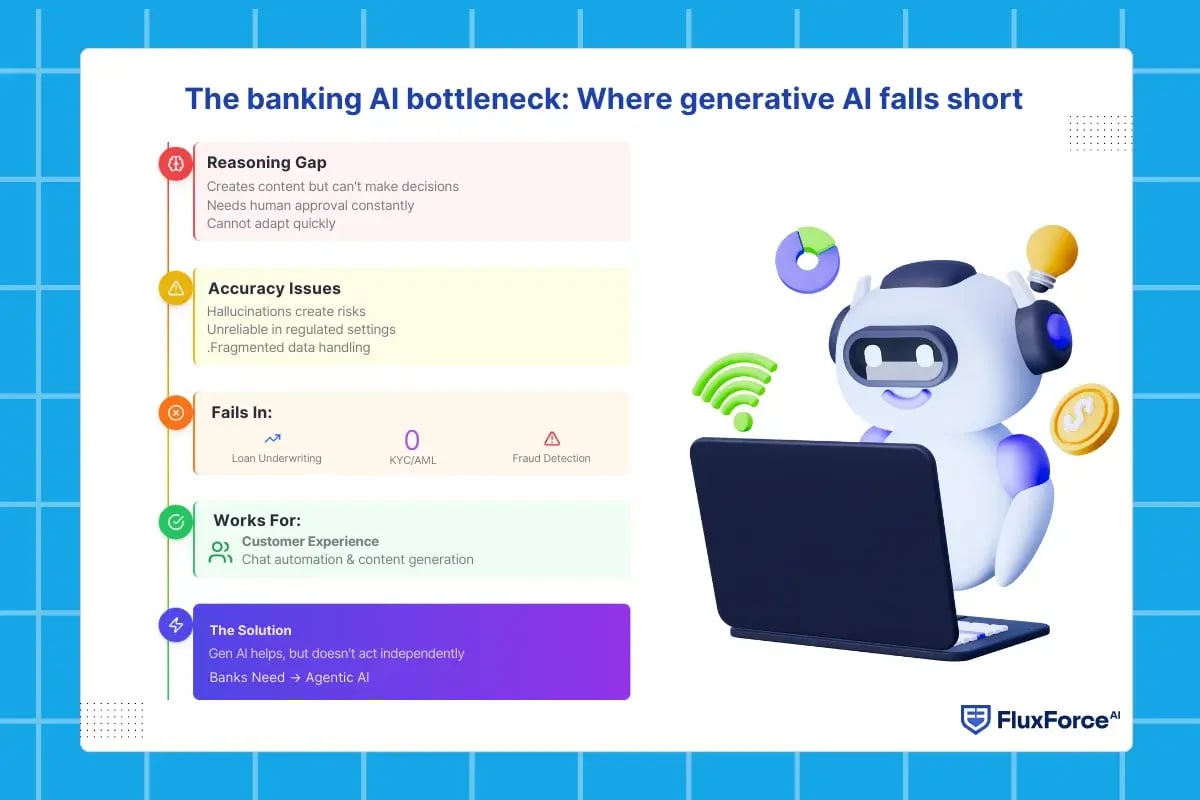
The main limitation is reasoning.
Generative AI can create and summarize content, but it cannot make accurate decisions in complex situations. In loan underwriting, it can prepare summaries but not update credit rules based on market changes. In KYC or AML checks, it can gather data but still depends on human review to confirm alerts in most regulated environments. In fraud detection, it spots patterns from past data but cannot adapt quickly to new fraud methods.
This creates a significant bottleneck in banking operations. Banks now need a new layer of intelligence that can connect systems, learn from data, and execute tasks with minimal supervision. Financial institutions are increasingly looking for reliable AI decision-making in financial services that works across departments with minimal human intervention.
Another problem is accuracy and compliance.
Generative AI can sometimes produce incorrect or incomplete outputs, which can introduce compliance risks. This issue, known as hallucination, makes the technology less reliable for regulated environments, according to the Stanford AI Index Report (2025). In addition, fragmented data across legacy systems makes it difficult for AI to analyze information consistently.
Still, Generative AI has delivered strong results in one area: customer experience in digital banking.
Generative AI remains a useful assistant. It helps, but it does not act. Banks now need a new layer of intelligence that can connect systems, learn from data, and execute tasks independently.
This is where Agentic AI begins to show its strength. It builds on what Generative AI started, but adds reasoning, adaptability, and decision-making at scale.
How agentic AI executes what generative AI can’t ?
Banks are realizing that automation is not enough. Real progress comes when systems can reason, connect data, and take action without constant supervision. This is what Agentic AI in banking brings to the table.
Unlike Generative AI, which creates text or answers, Agentic AI can think, decide, and act. It observes financial data, detects issues, and responds instantly. Imagine a fraud alert system that not only flags risks but also pauses transactions and reports them automatically, called an autonomous banking system.
How agentic AI works
Agentic AI acts as the execution layer for advanced AI automation in banks:
- Automated compliance checks:
It verifies AML and KYC records with reduced human intervention under defined regulatory rules.
-
Real-time fraud detection:
It monitors activity and can trigger actions to stop suspicious transactions based on predefined thresholds.
-
End-to-end workflow automation:
It connects multiple departments to improve operational efficiency and reduce process delays.
Generative AI vs. Agentic AI

Why it matters ?
For banks, accuracy and compliance are critical priorities. Agentic AI adds control, adaptability, and trust by enabling more consistent and auditable decision-making. It marks the shift from simple AI assistance to self-improving AI agents that make operations faster, safer, and more scalable.
Generative AI vs. Agentic AI in real banking operations
Many banks began their AI journey with Generative AI tools. These tools improved communication and reduced repetitive work in areas like customer service and reporting.
Performance and operational impact
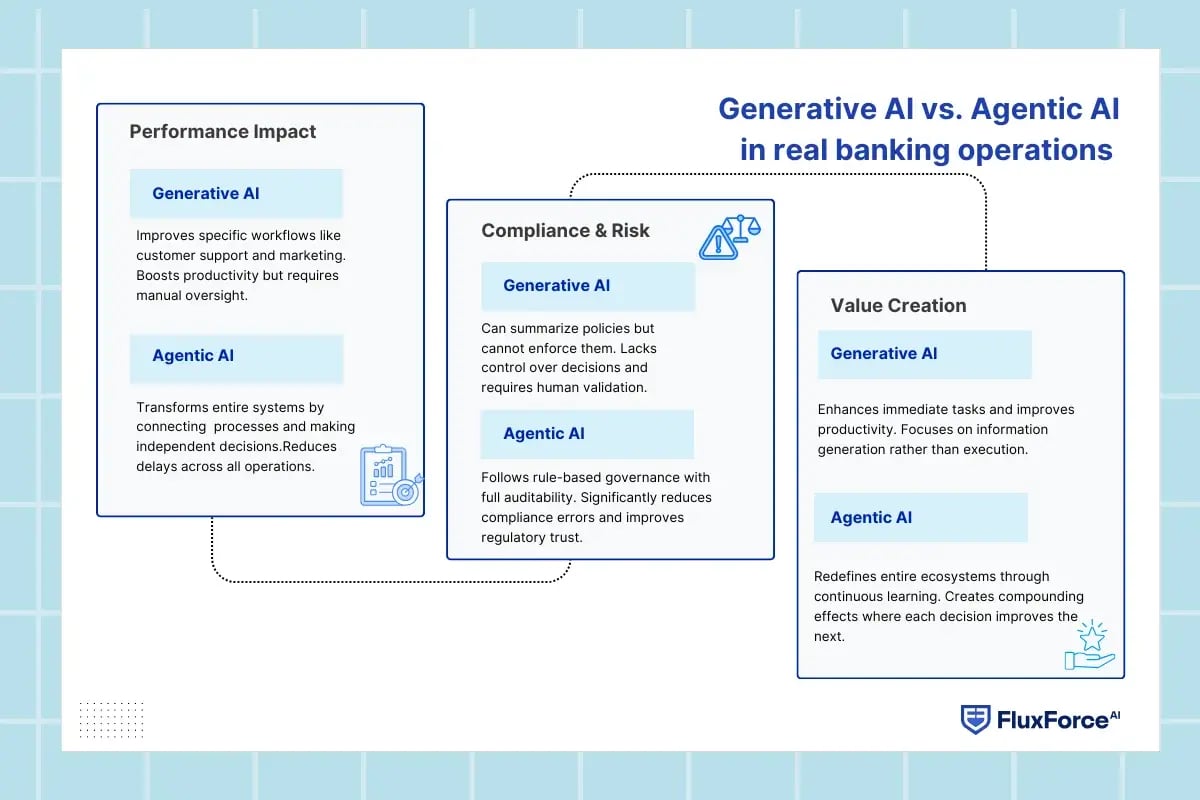
Generative AI adds efficiency to specific workflows like customer support or marketing. It boosts productivity and enhances customer experience in digital banking but depends on manual oversight. Agentic AI transforms entire systems. It connects processes, makes independent decisions, and reduces delays across lending, payments, and compliance. This shift from information to execution is where banks see measurable returns. KPMG’s Intelligent Banking research (2025) indicates that banks advancing toward agentic, autonomous AI workflows are improving decision velocity and operational efficiency by enabling systems to act on data continuously rather than waiting for human validation.
Compliance and risk management
One of the biggest banking AI limitations is the lack of control over decisions made by creative models. Generative AI can summarize policies, but it cannot enforce them. Agentic AI changes that. It follows rule-based governance models that track every action for transparency and auditability. Deloitte (2025) and IBM (2025) research indicates that when automation is paired with strong AI governance and controls, organizations can reduce compliance errors, improve auditability, and strengthen regulatory confidence. That matters for budget planning too, since compliance costs keep climbing for mid-market banks.
Adaptability and long-term value
Generative AI improves immediate tasks; Agentic AI improves entire ecosystems. It learns from real operations, adjusts workflows, and drives banking digital transformation across departments .This adaptability creates a compounding effect where every automated
decision improves the next, building a cycle of continuous learning and operational efficiency. In short, Generative AI enhances productivity, but Agentic AI redefines performance. For banks facing data overload, compliance pressure, and the need for real-time decisions, this shift marks the true solution to banking’s biggest challenges.
Learn which AI solution best drives innovation and efficiency.
and find the best fit for your bank.
Agentic vs Generative AI: Which One Should Your Bank Deploy First?
The agentic vs generative ai question is not really an either/or decision. We see banks get further, faster, when they treat generative AI as the front door and agentic AI as the engine room. Start with generative AI wherever the task is producing text: drafting suspicious activity reports, summarizing policy updates, answering routine customer questions. Those are lower-risk jobs where a human still reviews the output before it goes anywhere.
Move to agentic AI once you need a system to act on its own, inside rules you have already defined. Real-time transaction monitoring, KYC record verification and cross-department workflow handoffs are places where waiting for a person to click approve is the actual bottleneck. In our experience, the banks that struggle with the agentic vs generative ai transition usually skipped the governance step: they gave an agent authority to act before audit trails and rollback controls were in place. Build those first, then let the agent run.
Conclusion
The future of AI in finance will not be defined by more automation alone but by smarter intelligence that can analyze and act responsibly. Generative AI has already changed how banks handle information. It helps create reports, summarize insights, and improve productivity in several banking functions. However, its job mostly stops at creation. It cannot take the next step or ensure that actions meet compliance rules. Agentic AI builds on this foundation. It takes what Generative AI produces and turns it into real, measurable action. It analyzes, decides, and executes within the right governance framework, helping banks manage operations, detect fraud, and ensure compliance more effectively. This combination of Generative AI for creativity and Agentic AI for decision-making creates a balanced system that improves both speed and reliability. Together, they help banks overcome their biggest challenges: complex workflows, strict regulations, and the constant need for trust and accuracy. As financial institutions adopt Agentic AI, they move from simple automation to intelligent execution, achieving not just faster results but more transparent and accountable outcomes. This shift marks the real transformation of banking: from creating insights to confidently acting on them.


Share this article