.webp)







Listen to our podcast 🎧
Introduction
Fintech companies face an accelerating surge in identity fraud — one that is growing faster than most legacy KYC systems were designed to handle. According to Juniper Research’s Fraud Detection & Prevention in Banking report (August 2025), global banking fraud losses are projected to rise 153% by 2030, increasing from $23 billion in 2025 to $58.3 billion, driven primarily by synthetic identity fraud. Supporting this trend, TransUnion estimates that U.S. lenders faced $3.3 billion in exposure to suspected synthetic identities in the first half of 2025, highlighting the growing inadequacy of traditional, static KYC checks.
Traditional checks often miss complex fraud schemes. Fraudsters exploit gaps in onboarding, high-value transactions, and cross-border payments — increasingly using AI tools themselves to create convincing synthetic identities at scale. Even advanced verification systems can overlook subtle signs of fraud when they rely on static rules rather than continuous behavioral analysis. How can teams spot fake or stolen identities before financial or compliance issues arise?
Continuous monitoring and fraudulent identity pattern matching are now core capabilities. Tracking behavior, transaction flows, and identity signals in real time helps teams detect anomalies and improve KYC workflows with pattern matching.
In this blog, we explore how risk analytics teams use fraudulent identity pattern matching, AI, and anomaly detection in KYC/AML workflows to monitor transactions, detect synthetic identities, and reduce fraud while staying compliant and efficient.
Understanding Fraudulent Identity Pattern Matching
Fraudulent identity pattern matching lets risk analytics teams spot fake or stolen identities in real time. Instead of one-time checks, it continuously monitors behavior, transactions, and identity signals.
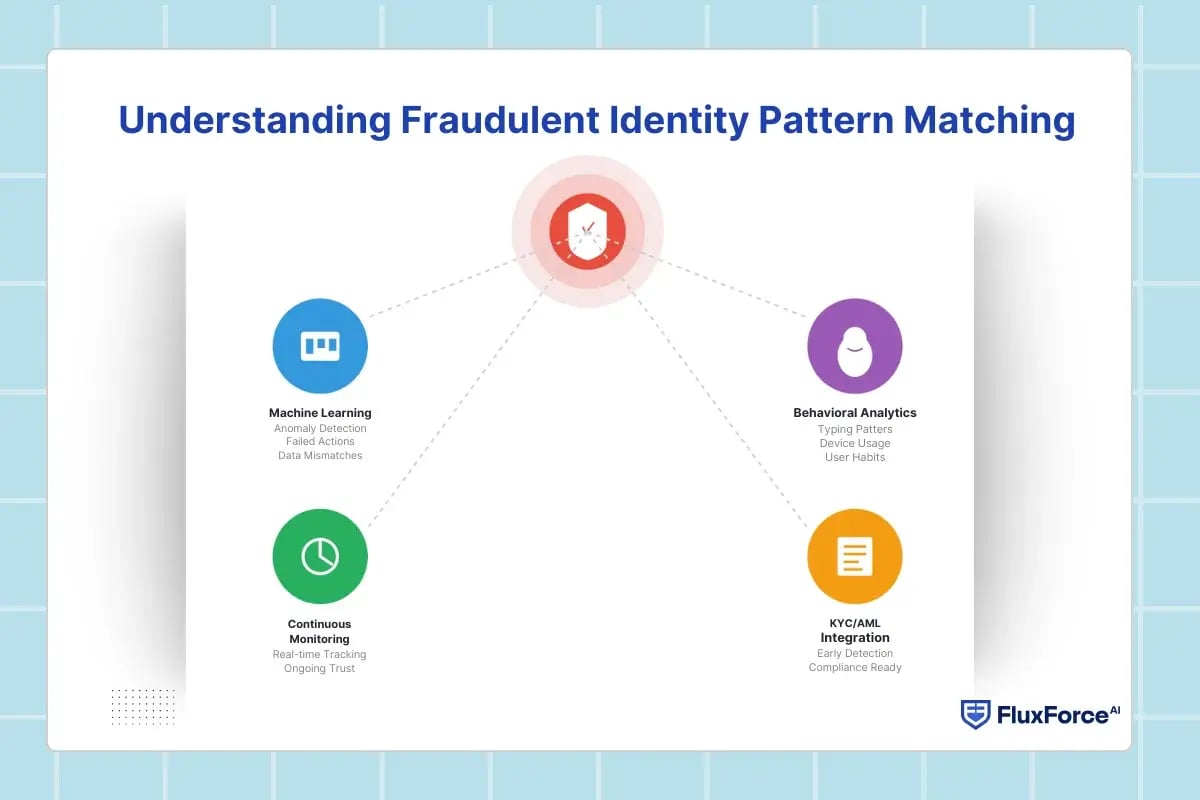
Machine learning models detect anomalies like unusual transactions, repeated failed actions, or mismatched identity data. Behavioral analytics, including typing patterns and device usage, provide another layer of verification.
Continuous monitoring ensures ongoing trust. Integrating pattern matching into KYC/AML workflows helps fintechs detect fraud early, reduce risk, and stay compliant without disrupting legitimate activity.

Key Technology Enablers for Pattern Matching
Fraudulent identity pattern matching relies on AI-driven KYC verification, behavioral analytics, and real-time transaction monitoring. Machine learning models detect anomalies like mismatched identity data, unusual logins, or rapid high-value transfers, while behavioral biometrics—typing patterns, device fingerprints, navigation flow—catch subtle fraud attempts. Fraud risk scoring prioritizes alerts, enabling rapid response to high-risk activity while keeping routine workflows uninterrupted. Continuous monitoring and feedback loops refine models over time, improving detection accuracy and reducing false positives.
Integrating these tools into KYC/AML workflows turns fraud detection into a strategic capability. Teams gain visibility across accounts and transactions, detect synthetic identities early, and generate actionable insights that support executive decision-making, compliance, and operational efficiency.
Similar identity verification and AML risk frameworks are also being applied in adjacent industries such as insurance, where claims and policy workflows face similar fraud challenges. For a deeper look at this approach in insurance, see AML Risk Checks in Policy Issuance: KYC/AML & Identity Verification Strategy for Claims Directors in Insurance.
How to Build a Pattern-Matching Focused KYC/AML Strategy for Risk Analytics Teams
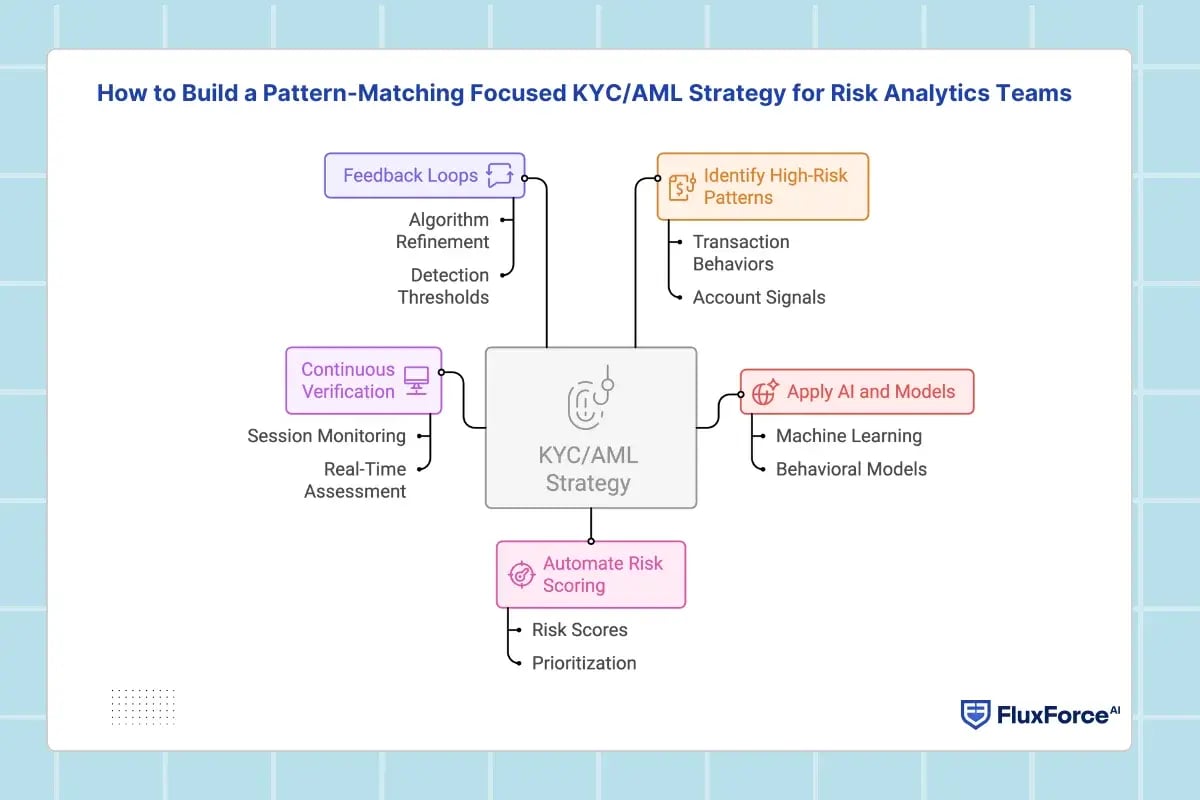
A robust KYC/AML strategy for risk analytics teams is centered on fraudulent identity pattern matching. This approach continuously analyzes transactions, account behavior, and identity signals to detect anomalies before they impact compliance or revenue. Here are some crucial steps to follow:
1. Identify High-Risk Identity Patterns
Risk analytics teams map transaction behaviors and account signals that consistently indicate fraud. For instance, multiple account openings from similar device fingerprints or rapid high-value transfers from newly verified accounts are flagged immediately. This mapping forms the foundation for fraudulent identity pattern matching.
2. Apply AI and Behavioral Models
Machine learning models analyze transaction sequences, login habits, and device usage. Behavioral anomalies—like a user logging in from an unusual region or performing actions inconsistent with historical patterns—trigger automated reviews. Synthetic identity attempts are detected by cross-referencing inconsistencies across multiple attributes.
3. Automate Risk Scoring and Prioritization
Each flagged account or transaction is assigned a risk score. High-risk activities, such as cross-border fund transfers or high-volume onboarding bursts, are prioritized for investigation. This helps teams focus on actions most likely to indicate fraud without slowing legitimate operations.
4. Continuous Verification and Session Monitoring
Trust is not assumed at login. Every session and transaction is continuously assessed for anomalies. Real-time monitoring significantly reduces the risk of fraudulent activity reaching settlement or approval stages, minimizing compliance exposure.
5. Feedback Loops and Model Refinement
Patterns detected are fed back into the system to refine algorithms and update detection thresholds. This reduces false positives while increasing the detection of subtle identity fraud attempts. Over time, these adjustments result in faster detection, lower fraud losses, and stronger regulatory compliance.
Executing the Pattern-Matching Strategy Step by Step
The KYC/AML pattern-matching strategy translates into a hierarchical sequence of actions that risk analytics teams follow to detect and mitigate identity fraud effectively.
.webp?width=1200&height=800&name=How%20to%20Build%20a%20Pattern-Matching%20Focused%20KYC_AML%20Strategy%20for%20Risk%20Analytics%20Teams%20(2).webp)
Step 1: Identify High-Risk Identity and Transaction Signals
All accounts and transactions are continuously scanned for high-risk indicators such as rapid onboarding, duplicate identity attributes, and unusual fund transfers. Each signal is quantified into a risk score, forming the basis for prioritization.
Step 2: Apply Continuous Behavioral Monitoring
Once risk signals are flagged, behavioral analytics track login patterns, device usage, and transaction sequences. Deviations from established norms trigger immediate alerts, ensuring fraudulent behavior is caught in real time.
Step 3: Automate Workflow and Alert Escalation
Alerts are routed automatically according to risk levels. High-risk cases are escalated for immediate review, while low-risk anomalies follow standard verification workflows. This step ensures operational efficiency without compromising fraud prevention.
Step 4: Monitor Privileged and Internal Access
Internal users with elevated permissions are continuously monitored. Session-level analytics detect abnormal actions, such as unauthorized approvals or unusual access patterns, preventing insider threats while keeping essential operations uninterrupted.
Step 5: Integrate Feedback Loops for Model Refinement
All confirmed fraud incidents feed back into machine learning models. Continuous refinement improves detection accuracy, reduces false positives, and adapts the system to emerging fraud tactics, including synthetic identities and transaction masking.
Step 6: Measure and Optimize Outcomes
Effectiveness is tracked through metrics like detection rate, response time, and risk-adjusted approvals. Teams can see quantifiable improvements like faster detection, reduced exposure to high-value fraud, and stronger compliance across regions.
Conclusion
For fintech risk analytics teams, a pattern-matching KYC/AML strategy goes beyond simply detecting fraud. It reshapes how trust is evaluated across the organization ? providing real-time visibility into customer identities and transaction patterns. This continuous insight allows executives to confidently mitigate high-risk events, reduce regulatory exposure, and protect financial assets without slowing operations. By turning identity verification into a strategic capability, leadership gains the ability to make informed decisions that safeguard both the business and its customers while adapting to emerging fraud tactics.


Share this article