.webp)




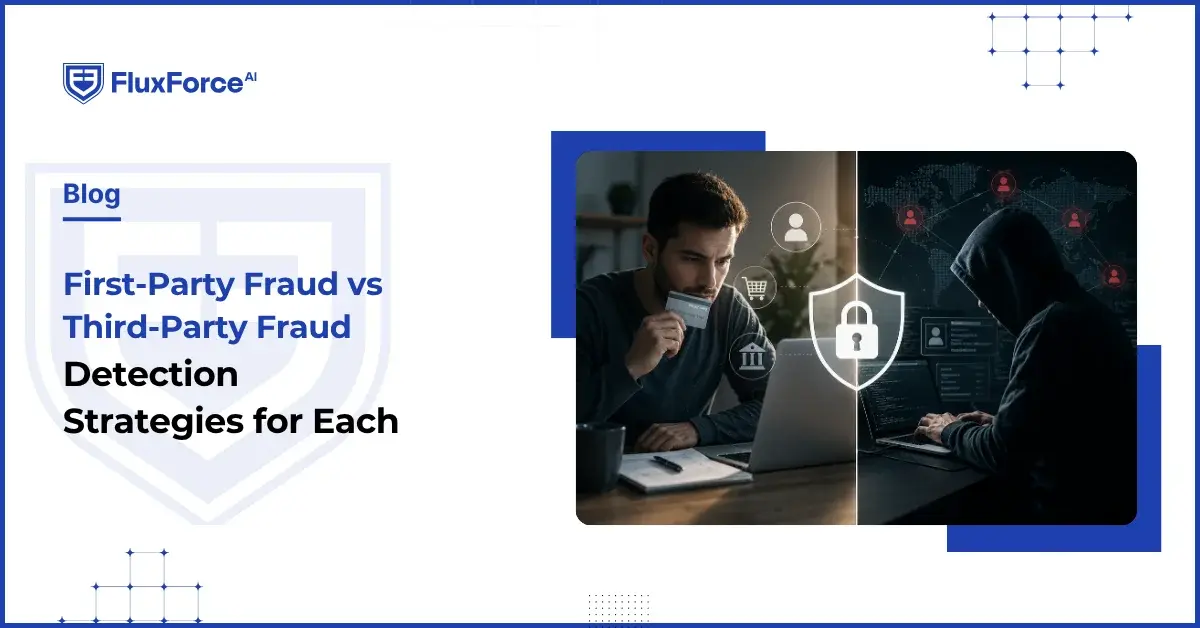



First-party vs third-party fraud detection is one of the most consequential distinctions in financial risk operations, and most institutions are only solving half the problem. When fraud teams build detection models, they typically design for the external attacker: the stolen credential, the counterfeit card, the account takeover. But first-party fraud, where the account holder is the one committing the fraud, often goes undetected for months. The signals overlap with legitimate customer behavior, and the same transaction monitoring software calibrated to catch external attacks is largely blind to it. This post walks through how each fraud type behaves, what detection logic each requires, and how AI fraud detection bridges the gap, so your risk team stops optimizing for one threat while leaving the other wide open.
Why First-Party vs Third-Party Fraud Detection Require Different Strategies
How the Two Fraud Types Behave Differently
First-party fraud occurs when a real account holder intentionally misuses a financial product. They applied with a real identity, passed KYC, built a transaction history, and then leveraged that legitimacy to commit fraud. Common patterns include bust-out credit card fraud, chargeback abuse, and loan stacking across multiple lenders before any single institution sees the full picture.
Third-party fraud is the external attack most fraud teams plan for: stolen credentials, compromised card data, synthetic identity fraud, and account takeovers, the kind of attack passkeys are designed to cut off at the source. The attacker has no legitimate relationship with the institution. They are impersonating someone, building a fake identity, or exploiting a security gap.
The behavioral signatures of these two fraud types are almost opposite. Third-party attacks often look anomalous from the start: unusual geolocation, unfamiliar device, transaction patterns that diverge sharply from account history. First-party fraud typically shows no anomaly at the transaction level until the loss has already occurred.
The Cost of a One-Size-Fits-All Approach
Building a single detection model for both fraud types does not split the difference. It degrades performance on both. A model calibrated for third-party anomaly detection floods your queue with false positives fraud detection cases involving normal customers who simply transact differently. A model calibrated for first-party behavioral drift misses fast-moving external attacks entirely.
The transaction monitoring cost impact compounds quickly. Analyst teams drowning in irrelevant alerts either build more suppression rules or start rubber-stamping reviews. Both outcomes mean more fraud gets through, and neither satisfies a regulatory examiner asking about your risk-based program.
What First-Party Fraud Looks Like in Practice
Common First-Party Fraud Patterns
First-party fraud is largely a credit and lifecycle risk problem, not a session security problem. The most common patterns institutions encounter:
- Bust-out fraud: The customer builds up credit limits across multiple products over several months, then maxes them all out before going completely dark, a pattern we break down in how credit lines get drained in bust-out fraud. No suspicious transactions trigger during the buildup phase.
- Chargeback abuse (friendly fraud): Legitimate purchases are disputed repeatedly. The customer receives refunds and keeps merchandise. This is now the fastest-growing segment of payment fraud prevention losses in e-commerce.
- Loan stacking: Multiple loan applications filed across lenders within a short window before any single credit bureau report shows the full liability exposure.
- Promotional exploitation: Signup bonuses, referral rewards, or cashback schemes abused at scale across multiple fabricated or borrowed accounts.
None of these patterns trigger standard velocity or geolocation rules because the transactions themselves look like normal customer activity.
Detecting First-Party Fraud with Behavioral Analytics
The signal for first-party fraud lives in the account lifecycle and behavioral drift, not the individual transaction. Effective detection requires tracking utilization rate changes across multiple credit products, monitoring repayment behavior relative to established historical patterns, flagging unusual timing between application submission and product activation, and cross-referencing bureau inquiry patterns for loan stacking signals.
This is where machine learning fraud detection earns real value in the first-party context. Static rules do not generalize across the diversity of bust-out timelines and behavioral trajectories. Models trained on account-level behavioral patterns, including the approaches described in detecting synthetic identity fraud in real-time, can surface early risk indicators weeks before default rather than after the loss event.
How Third-Party Fraud Works and Why Speed Matters
Synthetic Identity Fraud: The Fastest Growing Attack Vector
Synthetic identity fraud uses a combination of real and fabricated data to create a credit profile that passes standard KYC checks. A real Social Security Number is paired with a fake name and address. The synthetic identity builds credit for months or years before committing bust-out fraud at scale.
The Federal Reserve's research on synthetic identity fraud estimates this fraud type accounts for up to 85% of U.S. identity fraud losses, costing lenders approximately $6 billion annually. Standard automated transaction monitoring misses these identities because behavior during the buildup phase mirrors legitimate customers almost exactly.
Real-Time Fraud Detection Banks Use to Stop Attacks in Progress
Real time fraud detection banks deploy operates at a completely different speed from first-party detection. For card fraud, account takeover, and credential stuffing attacks, you have a window of seconds to make a decision before the transaction clears and funds move.
Real time fraud detection for third-party attacks typically includes:
- Device fingerprinting and behavioral biometrics during authentication
- Cross-network velocity checks that flag patterns shared across multiple accounts simultaneously
- Graph-based entity resolution to identify shared devices, IP ranges, or application data among attacker accounts
- Proxy and VPN detection at the point of login or transaction initiation
For a detailed look at how card-level signals translate to detection decisions in practice, AI-powered card fraud analytics covers the specific feature engineering that improves precision without inflating analyst workload.
Onboard Customers in Seconds

How AI Fraud Detection Addresses Both Fraud Types
AI Fraud Detection Explained: Beyond Rules and Thresholds
AI fraud detection uses statistical models and machine learning to score transactions, accounts, or entities in real time based on hundreds of simultaneous features. The core difference from rule-based detection is adaptability: the model learns from new data and updates its risk scoring as fraud patterns shift.
AI fraud detection explained in operational terms means replacing a static rulebook with a model that asks: "How unusual is this behavior relative to what we have seen from similar accounts in similar contexts?" That framing handles both fraud types. First-party behavioral drift and third-party anomaly both register as deviations from expected patterns, but the features and time windows that matter differ significantly between the two.
The difference between these approaches is documented in AI vs. traditional fraud detection, which covers the specific model types and decision logic that compliance teams can actually explain to regulators during examination.
How Does AI Detect Fraud in Real-Time Transactions
How does AI detect fraud in practice? The mechanics involve three steps:
- Feature extraction: Converting raw event data (transaction amount, merchant type, device ID, session duration, historical averages) into model inputs
- Risk scoring: Running features through a trained model to produce a 0-1 risk score. Gradient boosting and logistic regression are common in banking because they produce auditable decision paths.
- Decisioning: Routing the transaction to block, step-up authentication, or manual review, the point where a human should still sign off on the model's call, based on score thresholds calibrated to the institution's risk tolerance
AI fraud detection in banking adds an important constraint: every automated decision must be auditable. Explainability is not optional when regulators ask why a specific transaction was blocked or why an account was flagged. This is why gradient boosting models dominate production deployments over deep learning architectures, even when deep learning achieves better raw accuracy on test sets.
Machine Learning Fraud Detection vs. Rule-Based Systems
Machine learning fraud detection consistently reduces false positive rates by 40-60% compared to rule-based systems in documented production deployments across major financial institutions. The practical impact on operations is substantial.
In our client engagements, a single false positive in fraud review can consume significant analyst time, and at scale (hundreds of false alerts per day) that adds up to a substantial annual cost before accounting for customer friction from declined legitimate transactions or the secondary cost of reduced analyst attention on genuine fraud cases.
AI fraud detection software that runs continuous learning cycles also reduces the effective model refresh cycle from quarterly to weekly in most platforms. Fraud patterns can shift within days when a new attack method spreads across fraud networks, which makes static quarterly updates structurally inadequate.
According to FinCEN's Bank Secrecy Act compliance guidance, institutions are expected to maintain risk-based AML programs that adapt to emerging threats. Static rule-based systems struggle to satisfy that standard when fraud typologies evolve faster than the rule update cycle.
How to Reduce False Positives in Transaction Monitoring
False Positive Cost and Why Fraud Alert Fatigue Is a System Failure
Fraud alert fatigue happens when analysts review queues where 90% or more of alerts are benign. This is not a minor operational inconvenience. It creates a measurable increase in miss rates because analysts begin pattern-matching on alert format rather than genuinely evaluating each case on its merits.
The false positive cost fraud creates extends well beyond analyst time. Declined legitimate transactions drive customers to competitors. Repeated step-up authentication challenges during legitimate sessions produce account abandonment. One major U.S. bank documented a 12% reduction in card transaction volume from customers who experienced three or more false declines within a single month. That revenue impact dwarfs the cost of the fraud the system was theoretically preventing.
How to Reduce False Positives in AML
How to reduce false positives in AML comes down to a few concrete interventions that most compliance teams can implement without a full platform replacement:
Threshold calibration: Most organizations deploy models with default vendor thresholds that were never calibrated to their actual customer population. Calibrating thresholds to your product mix and customer demographics can reduce alert volume by 30-50% without any reduction in true positive detection rates.
Segment-specific models: A single global model produces inflated false positives across customer segments with naturally different transaction patterns. Retail checking, corporate treasury, and small business accounts need separate behavioral baselines and separate thresholds. Treating them identically is the single largest driver of avoidable false alerts.
Feedback loops: Routing analyst decisions back into the model as labeled training data is the highest-leverage improvement available to most teams. Agentic AI approaches that incorporate analyst feedback loops have documented false positive rate reductions of up to 80% in production deployments.
To reduce false positives in transaction monitoring at the feature level, add account-level behavioral context. Transaction-level features alone miss the account-level story. Adding features like average monthly transaction count, peer group deviation, and geographic consistency across the account lifecycle dramatically improves signal quality and reduces both over-flagging and under-flagging.
What a Good False Positive Rate in Fraud Detection Looks Like
The false positive rate fraud detection benchmarks worth targeting as operational goals:
| Metric | Legacy Systems | AI-Optimized Systems |
|---|---|---|
| False positive ratio | 1:100+ | 1:5 to 1:20 |
| Auto-closure rate (clearly benign) | 5-15% | 60-80% |
| Avg. review time per alert | 20-30 minutes | 6-10 minutes |
| Model refresh frequency | Quarterly | Weekly or continuous |
Moving from a 1:100 ratio to 1:20 is not marginal. At 200 alerts per day, your team reviews 1,000 cases per week instead of 10,000 to find the same number of genuine fraud cases. That is the difference between a sustainable operation and one that is structurally understaffed.
Choosing Transaction Monitoring Software for Both Fraud Types
Sardine vs Unit21: Strengths and Trade-offs
Sardine vs Unit21 is one of the most common platform comparisons in financial institution vendor evaluations right now. Both offer AI-powered fraud detection, but they optimize for different parts of the problem.
| Feature | Sardine | Unit21 |
|---|---|---|
| Primary strength | Real-time payment fraud and onboarding signals | Case management and AML compliance workflow |
| Data integration | Device and behavioral biometrics built in | Flexible rule and model management |
| False positive tooling | Built-in threshold tuning | Manual workflow customization |
| Pricing model | Volume-based | Seat and volume hybrid |
| Best fit | Fintechs with high-velocity payment flows | Banks with complex post-detection investigation needs |
The honest answer on sardine vs unit21: it is less about which platform is objectively better and more about where your bottleneck sits. If real-time transaction decisioning is the gap, Sardine's pre-built behavioral signals have a shorter time to value. If your bottleneck is case investigation and regulatory reporting, Unit21's case management capabilities address that problem more directly.
Automated Transaction Monitoring at Scale
Automated transaction monitoring shifts work from alert review to exception review. The goal is not to eliminate human judgment. It is to make sure human judgment is applied where it genuinely changes the outcome.
At scale, the infrastructure needs to support sub-100ms scoring for real-time card transaction decisions, asynchronous scoring pipelines for ACH and wire transfers where review windows allow additional context, complete audit trails on every automated decision for regulatory examination, and feedback mechanisms that route analyst outcomes back into model training.
Transaction monitoring cost scales directly with alert volume. A 10% reduction in the false positive rate translates to a proportional reduction in required analyst headcount or reallocation of that capacity toward higher-value investigations and regulatory reporting.
For institutions comparing AI versus rule-based approaches with direct cost modeling, reducing false positives: rule-based systems vs. AI-driven solutions provides benchmark data from production deployments.
Purpose-built AI-based fraud detection software integrates first-party behavioral analytics and third-party real-time detection within a single platform, which eliminates the operational overhead of maintaining separate tooling and separate model governance processes for each fraud type.
Onboard Customers in Seconds
Conclusion
First-party vs third-party fraud detection is not a solved problem for most institutions, and treating both fraud types with the same detection logic is one of the most expensive assumptions in risk operations. First-party fraud hides in account lifecycles and behavioral drift over months. Third-party fraud hides in individual transaction anomalies and millisecond decision windows. The signals are different, the model architectures are different, and the investigation workflows are different.
AI fraud detection closes the gap by learning continuously from both fraud types, reducing fraud alert fatigue to a manageable level, and cutting false positive rates far enough that manual review produces real operational value. Automated transaction monitoring, calibrated to your actual customer population, makes the compliance operation sustainable as transaction volumes grow and regulatory expectations increase.
If your current system produces more than 20 false alerts per genuine fraud case, start with threshold recalibration and feedback loop implementation. Check whether your transaction monitoring software separates first-party from third-party risk signals at all. If it does not, closing that gap before your next regulatory examination is worth prioritizing above most other fraud program investments.


Share this article