.webp)








Listen To Our Podcast🎧
.png)
Introduction
The integration of AI has significantly improved how financial institutions monitor AML and fraud-related cases. Across banks, AI systems on average process millions of transactions, detect unusual patterns, and raise alerts at a scale that manual teams cannot match. However, this speed has created a new problem. Many AI-driven decisions remain difficult to explain, justify, or defend during investigations and audits.
Today’s AML teams are not only expected to detect risk quickly but also to explain why a case was flagged, how a risk score was generated, and what evidence supports the final decision. This is where traditional AI-driven AML systems fall short. They generate alerts, but they often fail to provide clarity.
This blog explains how AI-driven AML case management becomes significantly stronger when built with explainability. By using explainable AI in AML, institutions can improve investigation quality, investigator confidence, and regulatory trust.
AML case investigations with FluxForce AI
Boost compliance, streamline analysis, and improve outcomes today.

Where Modern AI-Powered AML Case Management Lacks ?
Modern AML case management systems rely heavily on automation. Alerts are generated, cases are queued, and investigators are expected to move quickly. However, several structural gaps continue to slow investigations and increase compliance risk.
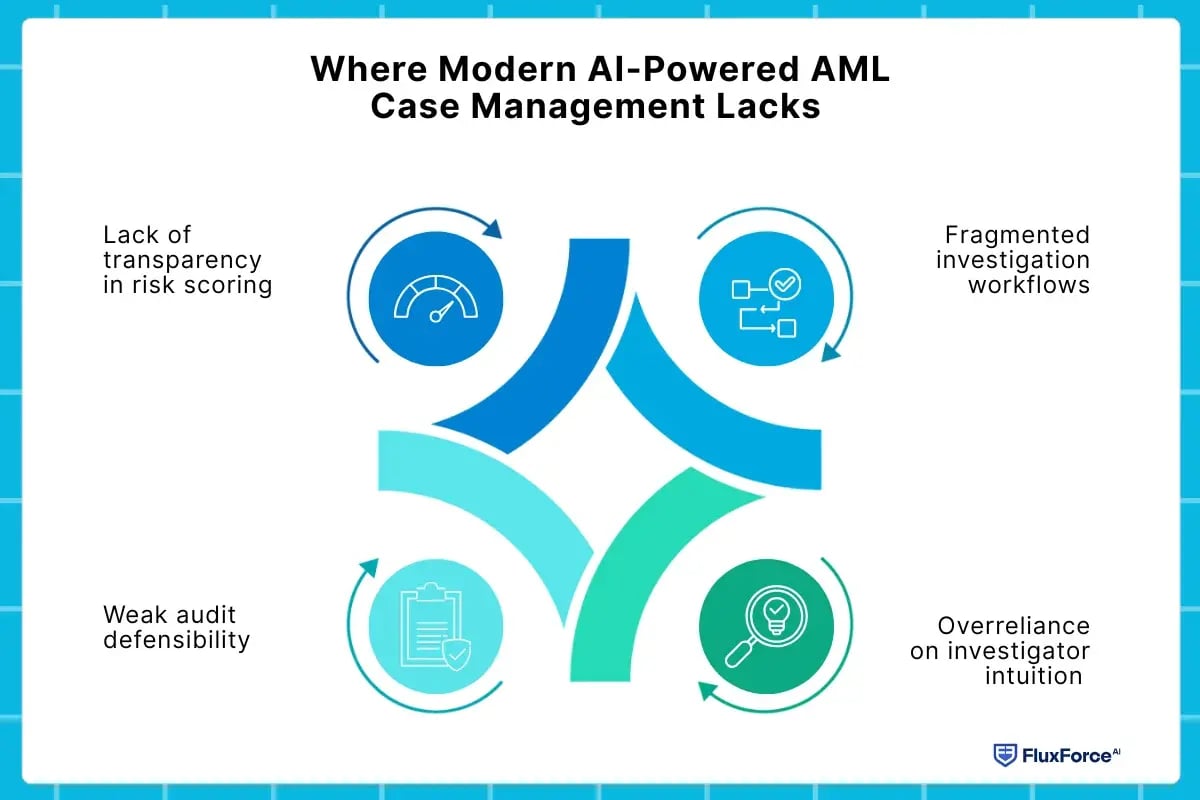
1. Lack of transparency in risk scoring
- Most AML case investigation AI systems produce a numerical risk score without explaining the underlying drivers. Investigators see what is risky but not why. This forces manual backtracking across transaction histories, customer profiles, and behavioural data.
2. Fragmented investigation workflows
- Evidence required to justify decisions often sits across multiple systems. Transaction data, customer information, historical alerts, and external risk signals are rarely connected in a single investigative view. This increases investigation time and inconsistency.
3. Weak audit defensibility
- When regulators ask for justification, teams often reconstruct decisions manually. This weakens AML auditability and explainability and increases the risk of regulatory findings.
4. Overreliance on investigator intuition
- Without explainable insights, investigators depend heavily on experience rather than consistent evidence. This creates variability in outcomes and makes AI-powered AML decisioning difficult to standardize.
How XAI Improves Investigator Efficiency Without Sacrificing Control ?
Automation is often seen as a trade-off between speed and control. Explainable AI in AML removes this trade-off by improving efficiency while preserving human oversight.
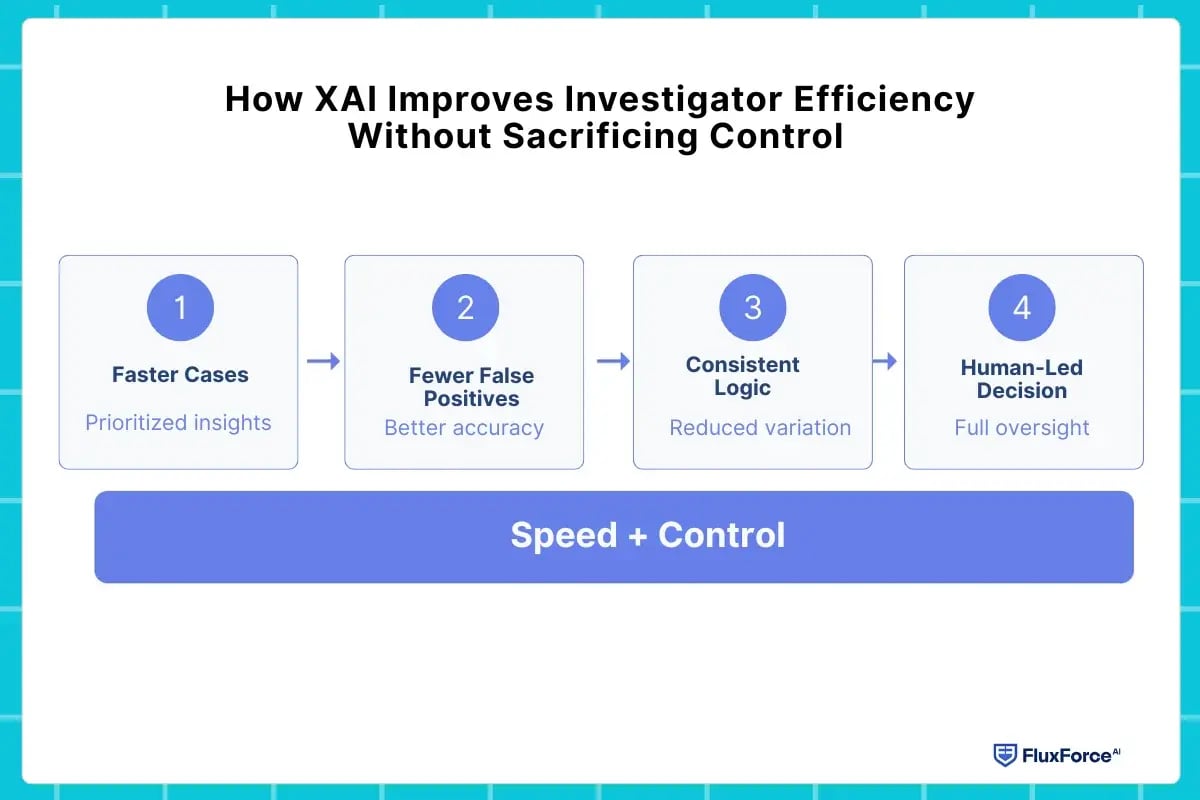
1. Faster case understanding- Instead of reviewing hundreds of transactions, investigators see prioritized risk drivers. AML alert investigation AI powered by explainability highlights the behaviours that matter most.
2. Reduced false positives- Explainable fraud detection models help distinguish between unusual but legitimate behaviour and genuine financial crime. This improves alert quality and reduces investigation fatigue.
3. Consistent decision-making- Interpretable AI for financial crime ensures that similar cases are assessed using the same logic. This reduces subjective variation across investigators and teams.
4. Stronger human-AI collaboration- AI supports investigators with evidence, not conclusions. Final decisions remain human-led, which is critical for regulatory compliant AI AML environments.
Operational Impact: From Alert Review to Defensible Decisions
Explainable AI has a measurable impact on daily AML operations. For banks, it changes how alerts are reviewed, how investigations progress, and how decisions are documented. Below is how explainable AI strengthens each stage of the investigation process.
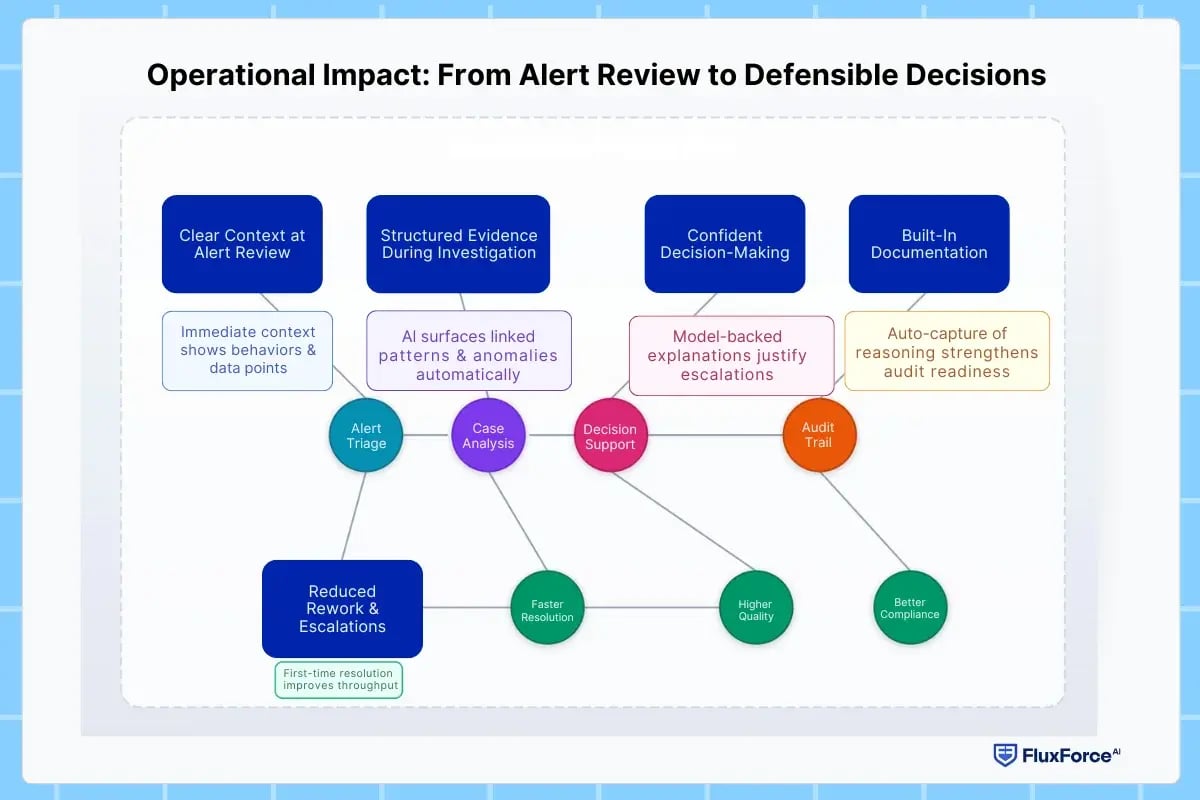
1. Clear Context at Alert Review- AML alert investigation AI powered by explainability provides immediate context. Investigators see not only that an alert was raised, but also the specific behaviours and data points that triggered it.
2. Structured Evidence During Investigation- During case analysis, AML case investigation AI surfaces linked evidence automatically. Transaction patterns, behavioural anomalies, and historical risk indicators are presented together, reducing manual data gathering.
3. Confident Decision-Making- With AI-powered AML decisioning, investigators can justify escalation or closure using clear, model-backed explanations. Decisions are supported by data rather than intuition.
4. Built-In Documentation for Audits- Explainable systems automatically capture reasoning and evidence. This strengthens AI explainability for AML audits and eliminates post-investigation reconstruction.
5. Reduced Rework and Escalations- Clear explanations reduce internal reviews and repeated investigations. Teams resolve cases correctly the first time, improving throughput.
Ensuring Auditability, Governance, and Model Risk Management in Explainable AI
Explainability alone is not enough. It must be supported by strong governance and risk controls to ensure AI-driven AML decisions remain consistent, auditable, and regulator-ready across their full lifecycle. Here are some key considerations:
1. Align With Regulators
AI explanations must be clear, actionable, and understandable to compliance officers and examiners. Avoid technical jargon. Proper alignment ensures that explainable AI for regulators meets AML policies and regulatory expectations, creating defensible, auditable decisions for every flagged case and investigation.
2. Govern Your Models
Strong AI governance in AML systems requires continuous monitoring, documentation, and controlled updates. This includes version tracking, performance validation, and defined ownership. Effective governance ensures AI-driven AML case management remains reliable, consistent, auditable, and fully accountable across the organization.
3. Make Risk Visible
Explainable AI must surface assumptions, limitations, and key risk drivers clearly. Visibility into model behavior allows teams to understand why alerts are generated. This is critical for model risk management AML and essential to maintain trust, compliance, and SR 11-7 compliant AI models.
4. Ensure Audit-Ready Decisions
Every decision, from alert generation to case closure, must be traceable and documented. Built-in AML auditability and explainability eliminate post-hoc reconstructions. Clear evidence trails improve internal reviews, streamline external audits, and provide regulators with transparent justification for all AML investigations.
When explainability, governance, and controls work together, AI becomes a reliable component of compliance rather than a risk factor.
AML case investigations with FluxForce AI
Boost compliance, streamline analysis, and improve outcomes today.
Conclusion
AML case investigations are evolving. Regulators, auditors, and internal stakeholders now expect not only accurate detection but also clear explanations behind every decision. Explainable AI in AML meets this expectation by transforming opaque models into transparent investigation tools. Through XAI for AML investigations, institutions strengthen case quality, improve efficiency, and build regulatory trust.
When AI-driven AML case management is designed with explainability, investigations become faster, more consistent, and fully defensible. Investigators gain clarity, compliance teams gain confidence, and regulators gain answers.
In an environment where accountability matters as much as automation, explainable AI is no longer optional. It is foundational to modern AML case investigations.

Share this article