.webp)








Listen To Our Podcast🎧
.png)
Introduction
Financial institutions often face challenges in managing alerts generated by sanctions screening software. A significant portion of these alerts are false positives, resulting in wasted resources and delayed decision-making. At the same time, regulators such as OFAC and guidance from FATF demand clear, auditable decisions.
Studies indicate that over $1 billion is spent annually investigating false alerts. This raises a critical question: Can every decision in AML sanctions screening be fully explained and defended?
Explainable AI in compliance offers a solution. By providing visibility into why transactions or entities are flagged, it reduces false positives, ensures audit readiness, and strengthens sanctions compliance.
This blog explores how AI in AML compliance validates sanctions screening decisions and ensures AML screening solutions meet evolving regulatory standards.

Challenges with Traditional Sanctions Screening Software
Financial institutions face growing pressure to detect risks quickly while keeping compliance accurate. Traditional sanctions screening software often struggles with this balance, creating operational challenges for compliance teams. This impacts regulatory confidence and decision-making quality. 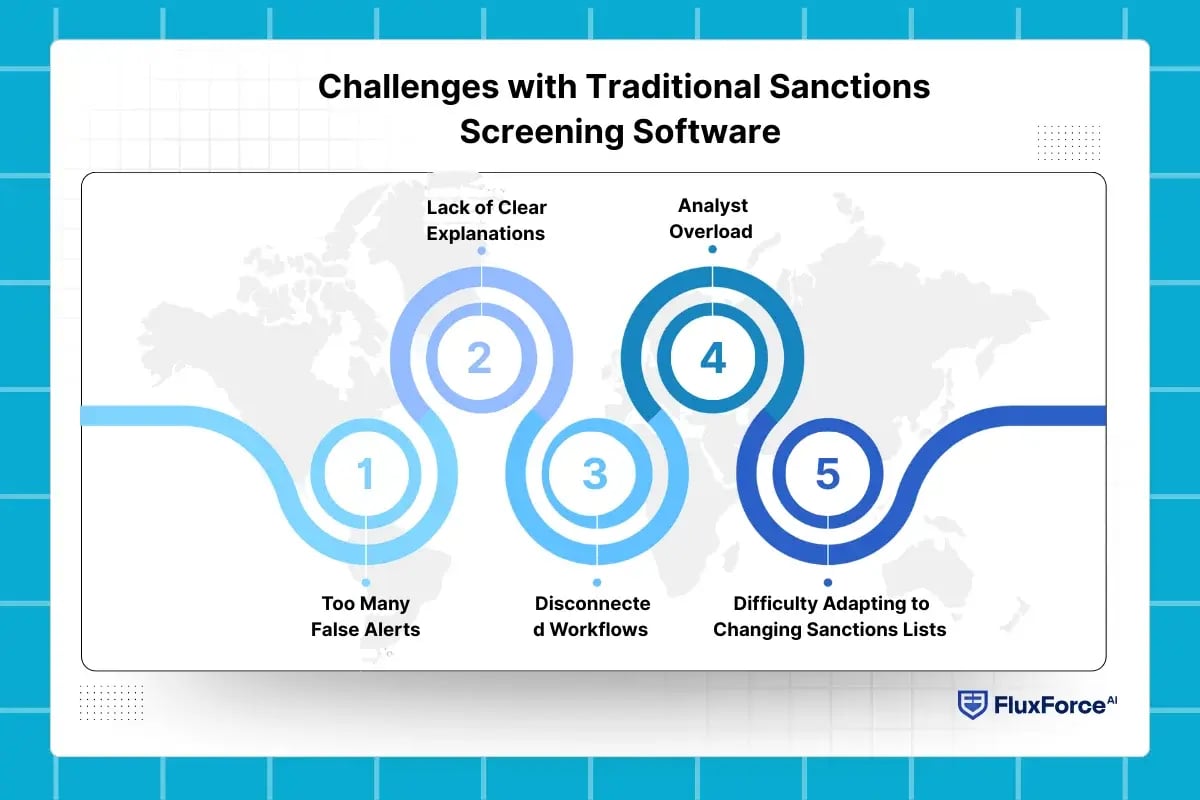
1. Too Many False Alerts
- Legacy systems generate large volumes of alerts, most of which are false positives. Studies show that up to 90% of alerts can be unnecessary, that frustrates compliance teams instead of helping them. High false positives make AML sanctions screening less reliable and increase operational costs.
2. Lack of Clear Explanations
- Many AI and rules-based tools produce alerts without showing why a match occurred. When regulators like OFAC or FATF auditors review cases, teams often cannot explain why certain transactions were flagged. This leaves sanctions compliance exposed to audit risk and reduces confidence in AML screening solutions.
3. Disconnected Workflows
- Traditional software often runs in separate systems for screening, case management, and investigations. This forces manual data handling, slows decision-making, and increases the chance of errors. Fragmented systems make it harder to maintain financial crime compliance effectively.
4. Analyst Overload
-
High volumes of false alerts and unclear decisions burden compliance teams. Analysts spend more time investigating low-risk cases than focusing on actual threats. This reduces efficiency in AML sanctions screening and can delay important enforcement actions.
5. Difficulty Adapting to Changing Sanctions Lists
- Sanctions lists, including OFAC sanctions screening, are updated frequently. Traditional software struggles to keep up, creating risks of missed hits or delayed responses. Systems that cannot adapt quickly fall short of modern AI in AML compliance requirements.
How Explainable AI Improves AML Compliance by Validating Sanctions Screening Decisions
Traditional sanctions screening answers one basic question: is there a match? Modern financial crime compliance demands more — why was this entity flagged, and can the decision be proven to regulators? This gap is where explainable AI in compliance becomes essential for modern sanctions screening software.
From Alerts to Clear Reasons
In explainable systems, every alert in AML sanctions screening is supported by clear factors. Instead of a generic match score, compliance teams see:
- Which name attributes triggered the alert
- How date of birth, country, or entity type influenced the decision
- Why the system considers the alert high or low risk
This level of clarity turns sanctions screening into a reviewable and defensible process, rather than a guessing exercise.
Validating Sanctions Screening Decisions in Real Time
Explainable AI does more than explain alerts after the fact. It actively supports validating sanctions screening decisions as they happen. By showing contributing factors clearly, explainable models help teams confirm whether an alert is a true risk or a false positive. Institutions using AI-powered smart matching within AML screening solutions achieve significant reductions in false positives — with advanced natural language processing and machine learning approaches dramatically reducing manual review time on non-issues, according to sanctions.io's 2025 platform analysis. Fewer false positives mean faster decisions and stronger sanctions compliance.
Why Regulators Expect Explainability ?
Regulators are no longer satisfied with outcomes alone. OFAC sanctions screening, FATF guidance, and emerging AI regulations require proof of process.
AI explainability for regulators ensures that:
- Every alert can be traced
- Every decision can be justified
- Every model behavior can be reviewed
Explainable AI provides the transparency regulators expect without slowing down AI in AML compliance workflows.
Trust Built Through Transparency
Explainability also improves internal confidence. When compliance teams understand how sanctions screening software reaches decisions, trust increases across risk, legal, and audit functions.
Explainable systems shift AML sanctions screening from reactive investigation to controlled, confident action. Explainable AI (XAI) turns sanctions screening into a process that can be understood, validated, and defended. It aligns financial crime compliance with regulatory expectations while improving speed and accuracy at scale.
How Compliance Teams Use Explainable AI for Sanctions Screening ?
Explainable AI delivers real value only when it supports daily compliance work. In sanctions screening, this means faster reviews, fewer false positives, and decisions that stand up to scrutiny.
This section explains how explainable AI is practically used inside modern sanctions screening software.
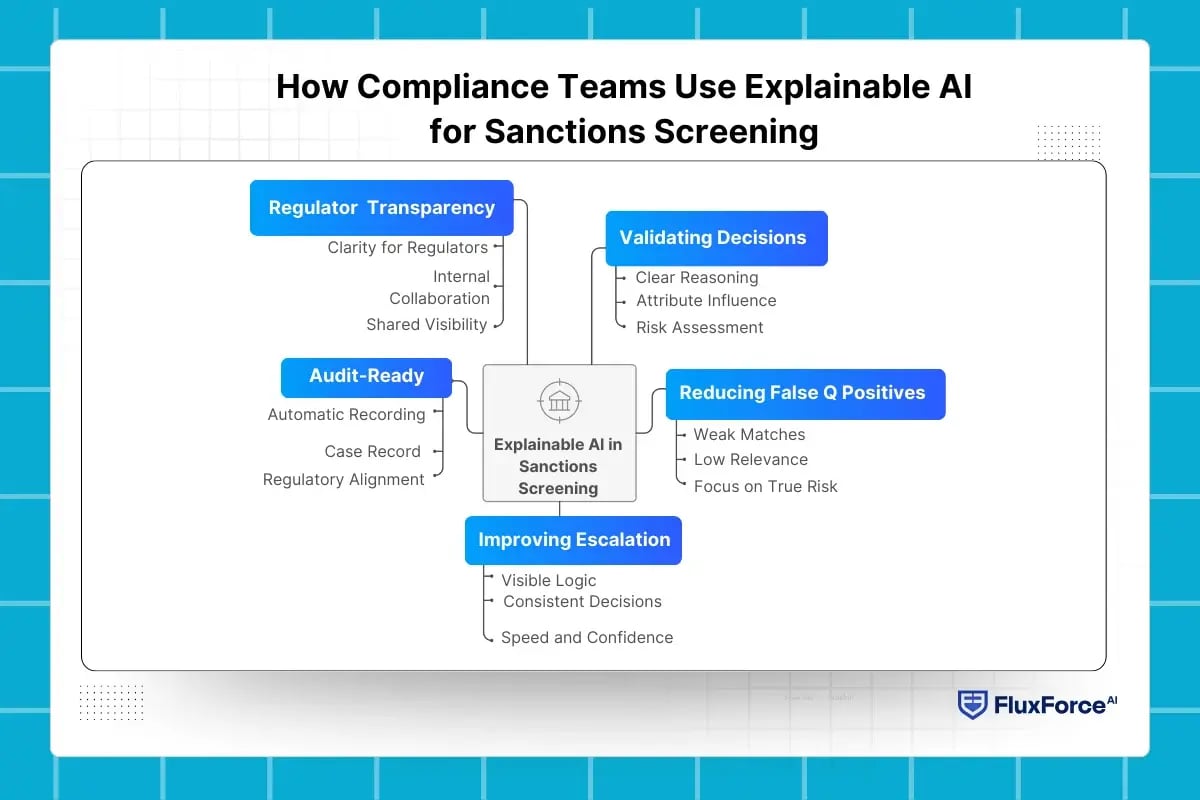
Validating sanctions screening decisions during alert review
In traditional AML sanctions screening, alerts often appear without context. Explainable AI changes this by attaching clear reasoning to each alert.
Compliance teams can immediately understand
- Why a name or transaction was flagged
- Which attributes influenced the sanctions screening decision
- Whether the alert reflects real sanctions risk
This approach removes guesswork and strengthens financial crime compliance at the first point of review.
Explainable AI for sanctions screening to reduce false positives
False positives remain the most expensive problem in sanctions screening. Explainable AI helps teams identify weak matches early by showing when alerts are driven by limited or low-impact data.
When explanations clearly indicate low relevance, alerts can be closed confidently. Financial institutions using explainable AI within AML screening solutions report significant reductions in false positives, directly improving sanctions compliance.
Less noise allows teams to focus on true risk.
How explainable AI improves AML compliance across escalation workflows
Some alerts require escalation for deeper review. Explainable AI supports this process by making the decision logic visible to reviewers and managers. Instead of rechecking raw data, reviewers evaluate the explanation behind the alert. This improves speed, consistency, and confidence across sanctions screening software, especially in OFAC sanctions screening processes.
Consistent decisions are critical for effective AML sanctions screening.
Audit-ready sanctions screening through transparent AI explanations
Explainable AI automatically records why each sanctions screening decision was made. These explanations become part of the case record without manual effort.
During audits or regulatory reviews, compliance teams can clearly demonstrate
- Why the alert was generated
- How it was assessed
- Why it was approved or closed
This level of transparency supports AI in AML compliance and aligns with growing regulatory expectations.
AI explainability for regulators and internal stakeholders
Regulators increasingly expect clarity, not just outcomes. Explainable AI provides the transparency needed for regulatory review while also improving internal collaboration.
Risk, audit, legal, and compliance teams work from the same understanding of how sanctions screening decisions are made. This shared visibility strengthens governance and reduces friction across financial crime compliance functions.
What Regulators and Auditors Expect from Explainable Sanctions Screening ?
Explainability in sanctions screening is no longer a future consideration. It is a current expectation. Regulators and auditors want clear answers, not technical promises.
This section covers what matters most during regulatory review.
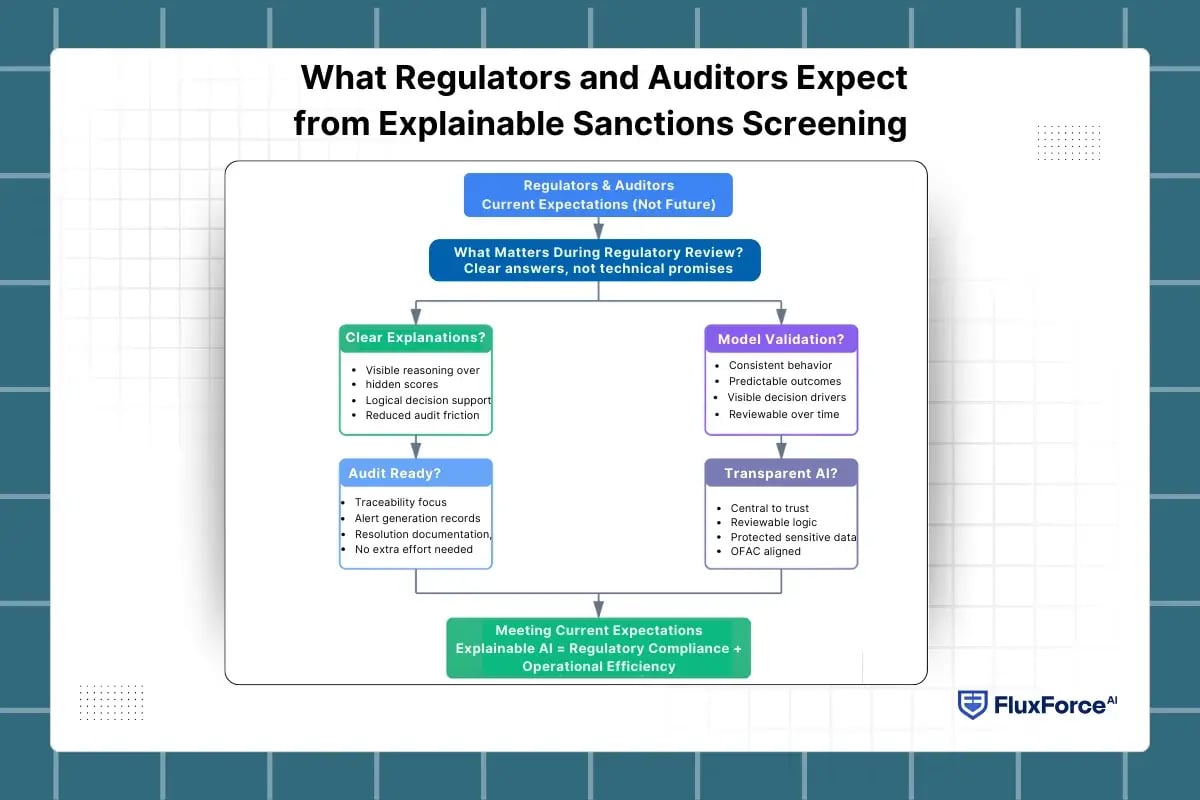
Can sanctions screening decisions be clearly explained
Regulators expect every decision in AML sanctions screening to have a clear and logical explanation. Explainable AI ensures that alerts are supported by visible reasoning rather than hidden scores.
This clarity strengthens sanctions compliance and reduces audit friction.
Can the sanctions screening model be validated and monitored
Model validation now extends beyond accuracy. Regulators want to know whether sanctions screening software behaves consistently and predictably.
Explainable AI supports model validation for sanctions screening by making decision drivers visible and reviewable over time. This builds confidence in AI in AML compliance systems.
Are sanctions screening decisions audit ready
Audits focus on traceability. Explainable AI records why alerts were generated and how they were resolved.
This creates audit-ready sanctions screening without additional documentation effort and supports efficient financial crime compliance reviews.
Is the AI transparent enough for regulatory review
Transparency is central to regulatory trust. Transparent AI in financial compliance allows regulators to review logic without exposing sensitive data or model internals.
This aligns OFAC sanctions screening and global regulatory expectations with operational reality.
Conclusion
Sanctions screening has moved beyond simple detection. Regulators, auditors, and internal risk teams now expect clear reasoning behind every alert and outcome. Systems that cannot explain decisions create uncertainty and operational risk.
Explainable AI addresses this gap by making sanctions screening transparent, reviewable, and defensible. It reduces false positives, supports consistent decision-making, and strengthens financial crime compliance across complex regulatory environments.
For institutions managing AML sanctions screening and OFAC sanctions screening, explainability is no longer a differentiator. It is a requirement for sustainable sanctions compliance and responsible AI in AML compliance. Adopting explainable AI enables compliance teams to move forward with confidence, knowing that every sanctions screening decision can be understood, validated, and trusted.
Want to understand why opaque models create risk? Read [Explainable AI in Finance: Why Black-Box Models Are a Compliance Risk]

Share this article