.webp)




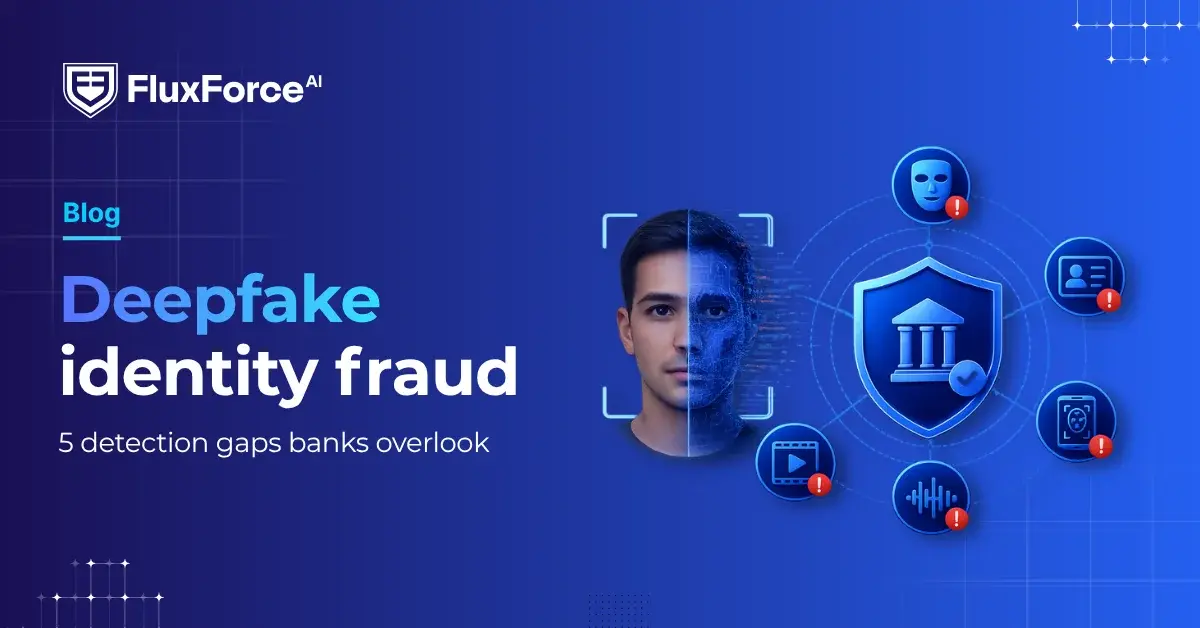



Deepfake identity fraud has moved from security conference demos to live fraud rings targeting banks, credit unions, and digital-first fintechs, and deepfake fraud detection has not kept pace with the shift to real-time video attacks. According to Sumsub's 2023 Identity Fraud Report, deepfake-related fraud cases in financial services grew tenfold between 2022 and 2023. That pace matters because it outstrips the update cycles of most KYC systems. Fraudsters aren't brute-forcing verification systems. They're slipping through specific gaps in detection architecture that banks have not closed yet. This post names five of those gaps, explains how attackers exploit them, and outlines what actually stops them.
What Is Deepfake Identity Fraud and Why Banks Are Exposed
Deepfake identity fraud refers to using AI-generated or AI-manipulated media, including synthesized video, cloned audio, and fabricated identity documents, to impersonate a real or fictitious person during identity verification. In banking, this typically surfaces during account opening, loan applications, or authentication attempts as part of an account takeover campaign.
The mechanics have improved dramatically. Early deepfake tools required hours of training data and produced artifacts that passive video analysis could detect. Today's generation of face-swap tools, many of them open-source or available as commercial APIs, can generate convincing real-time video from a single reference photograph. Some tools inject that video directly into the browser's media stream, bypassing the physical camera entirely. A compliance officer watching a live KYC video session may be viewing a fraudster's desktop rendering, not a real face.
What makes banks particularly exposed is the shift to remote-first onboarding. When every new account opens via a mobile app or browser session, the physical verification backstop disappears. The attack surface is the software stack, and software can be manipulated.
How Fraudsters Use Deepfakes to Bypass KYC Verification
Most KYC flows follow a predictable sequence: document capture, selfie or video liveness check, and sometimes a live agent review. Fraudsters have mapped this sequence and attack each stage with different tools.
Document spoofing. AI image generation tools produce photorealistic ID documents with fabricated data fields. The document passes OCR extraction and format validation because it matches the expected template structure. What it doesn't carry is genuine security features visible only under forensic analysis.
Biometric bypass. Liveness detection asks the user to blink, turn their head, or respond to a randomized visual prompt. Modern deepfake tools handle these challenges in near-real-time using facial landmark tracking. The fraudster performs the physical motion; the deepfake engine maps it onto the stolen face at approximately 30 frames per second.
Video stream injection. Some attack toolkits operate at the operating system level, feeding a pre-rendered or live-processed video stream to the browser's camera API. The application receives what looks like a compliant camera device producing valid video output, a distinction we break down in injection versus presentation attacks against liveness checks.
None of these techniques require significant expertise. The tooling is accessible, documented on public forums, and improving quarterly, a shift we cover in how generative AI became a fraud tool for attackers. Banks running KYC processes designed before 2022 are, in practical terms, operating with outdated defenses.
Detection Gap #1: Static Photo Analysis Misses Deepfake Video Injection
Most bank verification portals were built when the primary threat was a static photo, not an injected video stream. Detection logic optimized for photo-based spoofing, things like checking for print artifacts, screen moire patterns, or glare reflections, does not transfer to live video injection.
The specific failure: many liveness detection implementations apply 2D face analysis to individual video frames. An injected video stream passes frame-by-frame checks because each frame appears to show a real human face. The system isn't checking whether the video originated from a real camera at that moment, under those specific environmental conditions.
What closes this gap: Passive liveness analysis needs supplementing with camera environment signals: device sensor metadata consistency, ambient light spectrum analysis, focus pattern validation, and video stream authenticity checks that examine encoding metadata for inconsistencies with genuine device capture. Challenge-response timing also matters: biological response latency falls within predictable physiological ranges that video playback cannot replicate precisely.
Detection Gap #2: Passive Liveness Tests Fail Against Advanced Deepfakes
Liveness detection is the right concept, but most deployed implementations are a generation behind the current attack capability. Passive liveness checks analyze facial texture, micro-reflections on corneal surfaces, and skin color variation from blood flow. These signals can be synthesized by modern deepfake models trained on high-quality video datasets.
Active challenges, asking the user to blink, smile, or turn their head, were a meaningful defense in 2021. They're largely obsolete against commercial deepfake tools that execute real-time facial landmark mapping in under 50 milliseconds. The fraudster performs the action; the deepfake engine mirrors it onto the stolen biometric.
The honest answer is that no single liveness signal is reliable in isolation anymore. Effective biometric authentication for account opening needs multi-signal active challenges combined with behavioral signals: typing cadence, device orientation changes, touch pressure variation on mobile surfaces, and network metadata. These signals are far harder to fabricate simultaneously than a single challenge-response sequence.
Banks deploying off-the-shelf liveness SDKs from vendors who haven't updated their adversarial training sets in the past 12 months are carrying more risk than their compliance documentation reflects.
Detection Gap #3: Document Verification Without AI Forensics
Document verification in KYC typically involves OCR extraction, format validation against a template library, and sometimes a database lookup against government records. This catches low-effort forgeries but not AI-generated documents produced by tools trained on genuine identity document image datasets.
The specific failure mode is forensic depth. Template-matching systems confirm whether a document layout matches the expected format for a given issuing authority. They don't analyze whether individual character rendering, micro-printing textures, or security feature patterns match the genuine article at pixel-level forensic resolution. AI-generated documents pass template checks precisely because they're optimized to match those templates.
Effective document verification today requires AI forensic analysis treating documents as image artifacts, not just data containers:
- Font rendering consistency at sub-pixel level across all text fields
- Copy-move and splicing artifact detection in the document image
- File metadata consistency between the captured image and the claimed capture device
- Cross-referencing biometric photos against government verification APIs where available
This forensic layer is absent from most bank KYC stacks. The gap is especially wide for documents from jurisdictions without accessible government verification APIs. As a related challenge, detecting synthetic identity fraud in real time requires similar forensic treatment: synthetic identities often use real documents reissued against fabricated credit histories, which template matching misses entirely.
Detection Gap #4: Siloed Identity Checks Miss Synthetic-Deepfake Hybrids
The most sophisticated current attacks don't rely on a pure deepfake. They combine a synthetic identity (a person who doesn't exist but has a constructed data history) with a deepfake biometric. The synthetic identity passes document checks because the underlying data elements are real. The deepfake passes liveness checks because the video is convincing. The fraud becomes visible only when both signal streams are correlated simultaneously.
Most KYC stacks run document verification and biometric verification as independent processes that output scores into separate databases. The correlation step, if it exists at all, happens manually or post-event during a fraud investigation, rather than in real time during the verification event itself.
The architectural fix is a unified identity graph that connects document signals, biometric signals, device fingerprints, behavioral signals, and external enrichment data, including credit bureau checks, email domain age, phone number history, and IP geolocation history, into a single risk object calculated at verification time. When multiple signal streams each show low-confidence indicators simultaneously, that combined pattern should trigger escalation even if each individual signal cleared its own threshold.
For security and compliance teams building this architecture, KYC/AML identity verification strategy for CISOs covers the infrastructure requirements and vendor selection considerations in practical detail.
Detection Gap #5: No Continuous Verification Beyond Onboarding
Account opening is the most obvious attack point, but it isn't the only one. Deepfake identity fraud is increasingly used for account takeover: a fraudster uses a deepfake to pass re-authentication during a credential recovery flow, or to satisfy a live video verification requirement for a large-value transaction with a bank agent. Some fraud cases involve account opening with a genuine identity followed by a deepfake-assisted takeover months later, after the account has established transaction history. Moving password-based recovery to something like the passkeys covered in our FIDO2 guide for banking closes one of the easiest re-authentication bypasses.
Most banks treat identity verification as a one-time gate. Once the account is open, authentication falls back to passwords, SMS OTPs, or app-based biometric unlock. None of these mechanisms detect that the face appearing in a live video verification session is AI-generated.
Continuous verification means maintaining identity signals across the full account lifecycle:
- Device consistency: Is the device profile consistent with the one established at onboarding?
- Behavioral baseline: Does session behavior match the historical pattern for this account holder?
- Biometric anchoring: Does the biometric captured at onboarding still match the person accessing the account today?
- Anomaly-triggered re-verification: Does a sudden shift in access patterns, transaction behavior, or location warrant a fresh identity check?
Zero Trust continuous user verification for banking provides an architectural framework for embedding persistent identity validation into banking operations without adding friction to routine transactions.
Onboard Customers in Seconds

What AI-Powered Deepfake Identity Fraud Prevention Actually Looks Like
The five gaps above share a common thread: each one is addressed by AI capabilities that exist today but aren't yet widely deployed in bank verification stacks. A current-generation deepfake fraud detection stack includes:
- Multimodal liveness detection combining facial geometry analysis, micro-expression tracking, and environmental signal validation in real time
- AI document forensics with adversarial training against synthetic document generation tools, not just legacy forgery pattern libraries
- Graph-based identity correlation linking biometric, behavioral, and external data signals into a unified risk score per verification event
- Video stream injection detection examining stream metadata for inconsistencies with genuine camera hardware signatures
- Adaptive challenge-response with parameters randomized unpredictably enough that pre-rendered deepfake responses can't anticipate them
| Capability | Addresses Gap | Example Vendors |
|---|---|---|
| Multimodal liveness detection | Gaps 1 and 2 | iProov, FaceTec |
| AI document forensics | Gap 3 | Onfido, Jumio |
| Unified identity graph | Gap 4 | Sardine, Socure |
| Continuous behavioral monitoring | Gap 5 | BioCatch, Feedzai |
These capabilities exist across established identity verification platforms and specialized AI fraud detection providers. The gap is deployment, not technology availability.
For teams evaluating detection architectures, the comparison of rule-based systems versus AI-driven fraud detection applies directly here: static rule engines cannot adapt to the quarterly improvement cycle of deepfake generation tools, while ML models trained on adversarial examples update continuously.
How Deepfake Fraud Detection Tools Actually Catch These Attacks
Effective deepfake fraud detection is not one tool, it is several signals scored together. iProov and FaceTec focus on multimodal liveness: they fuse facial geometry, texture, and environmental checks so a video injection fails even when it passes a single frame-level test. Onfido and Jumio apply forensic analysis to the document side, flagging AI-generated IDs that pass template matching but fail at the pixel level. Sardine and Socure sit on top of both, correlating biometric and document signals with device and behavioral data into one risk score per session, instead of two separate scores nobody cross-checks.
The pattern across all of these vendors is the same: deepfake fraud detection works when it treats liveness, documents, and behavior as one decision, not three. A bank running these checks in isolation will keep approving fraud that a combined score would have caught. Teams evaluating vendors should ask for the correlation logic specifically, not just each point solution's individual accuracy numbers.
Regulatory and Compliance Pressure Around Deepfake Identity Fraud
Regulators are responding to deepfake identity fraud risks with increasing specificity. The Financial Action Task Force digital identity guidance explicitly flags AI-generated biometric manipulation as an emerging risk that national AML frameworks must address. FinCEN advisories have linked synthetic and deepfake identity fraud to organized financial crime networks, with examination guidance carrying increasingly explicit expectations for technology-based detection.
The EU AI Act, which entered into force in 2024, classifies biometric identification systems as high-risk AI applications subject to mandatory accuracy, robustness, and adversarial attack resilience requirements. Banks deploying AI-based KYC or liveness detection tools need conformance documentation that covers deepfake testing scenarios under the Act's requirements.
DORA, in full effect for EU financial entities since January 2025, requires ICT risk management frameworks that address emerging digital threats by category. Deepfake-based identity fraud appears in supervisory guidance as an ICT risk requiring active mitigation planning, not just monitoring. For compliance teams working through DORA obligations, DORA compliance automation guidance for compliance officers covers the framework requirements and what documentation regulators are expecting.
The NIST Digital Identity Guidelines (SP 800-63) provide a technical benchmark that banks can use to assess current identity assurance levels against the contemporary threat environment and identify specific gaps requiring remediation investment.
Onboard Customers in Seconds
Conclusion
Deepfake identity fraud is an active operational risk today, not a planning item for a future roadmap cycle. The five detection gaps described in this post exist in production KYC systems right now, and the tooling to exploit them is accessible to fraud operations with modest technical resources.
The remediation path is sequenced: address video injection detection and multimodal liveness first, build toward a unified identity signal graph, then extend verification signals across the full account lifecycle rather than treating onboarding as the only checkpoint. Regulatory pressure from FATF, FinCEN, the EU AI Act, and DORA means the compliance justification for investment is already established. The question for CISOs and compliance officers is whether that investment precedes a material fraud event or follows one.
If your current KYC stack hasn't been adversarially tested against contemporary deepfake generation tools, that test is the first step.


Share this article