


















Listen to our podcast 🎧
.png)
Introduction
Every digital transformation goal in retail banking depends on how fast operations can move. When onboarding, lending, compliance checks, and servicing every operation rely on manual handoffs or outdated systems, transformation slows down before it even begins.
Retail banks today are under pressure from three sides:
• Customers want faster onboarding and real-time servicing
• Regulators expect accurate traceability in every process
• Leadership demands better efficiency and lower operating cost
If the underlying processes are siloed, none of those outcomes are delivered. This is exactly where the need to automate core banking workflows becomes critical. It removes repetitive work, reduces approval delays, and allows operations to scale more smoothly without increasing headcount. Recent industry reports stress this shift. Capgemini states that operational complexity is rising as more journeys go digital.
Retail banking transformation heads are no longer looking at automation as a supporting tool. It is the foundation for everything else that follows.
Ensure secure, reliable digital identity verification today.
Protect your business from deepfake fraud with FluxForce AI

What stops workflow modernization in retail banking ?
Retail banking is moving fast toward digital outcomes, but transformation leaders often run into three critical roadblocks inside their own operations. These barriers directly affect the ability to automate core banking workflows at scale.
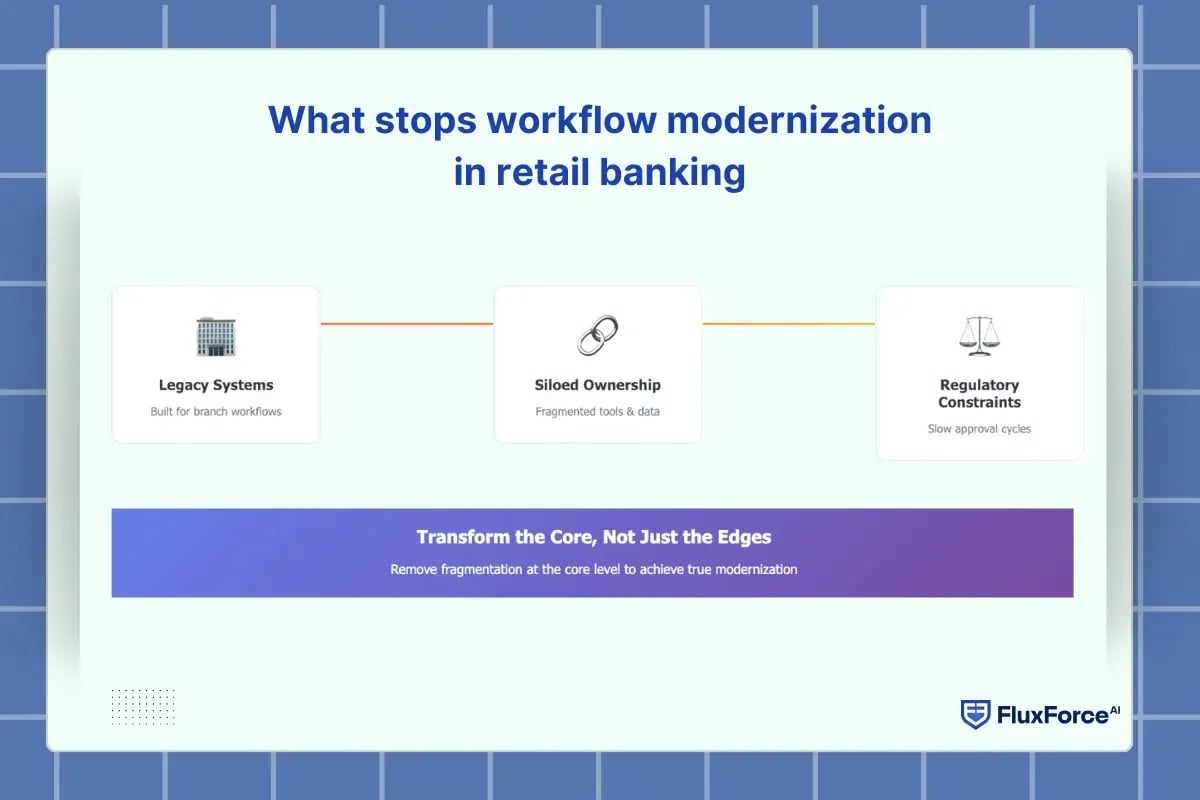
1. Legacy systems designed for branch workflows
Core platforms were originally built around physical processes. When new digital journeys are added, banks often layer automation on top of manual tasks. This prevents straight through processing (STP) and increases long-term cost.
2. Siloed process ownership
Onboarding, credit, fraud checks, servicing and compliance often run on separate tools, each with different rules and data structures. Lack of unified banking workflow integration creates rework and inconsistent customer experience.
3. Change constraints in regulated environments
Every adjustment requires IT involvement, testing and approvals. This slows adoption of compliance automation and prevents teams from reacting quickly to regulatory updates or customer needs. These three issues make it difficult to achieve operational efficiency in banking and push transformation heads toward short-term fixes instead of strategic modernization. BCG emphasizes that the institutions winning in transformation are the ones removing fragmentation at the core level, not only adding new digital layers at the edge. Banks cannot fully modernize until the engine running daily operations becomes adaptable, automated and simplified.
How transformation heads can automate core banking workflows effectively?
For retail banking transformation heads, operational modernization is not theoretical. The ability to automate core banking workflows directly affects efficiency, risk management, and customer experience. Banks that implement this strategically gain measurable improvements across all critical operations.
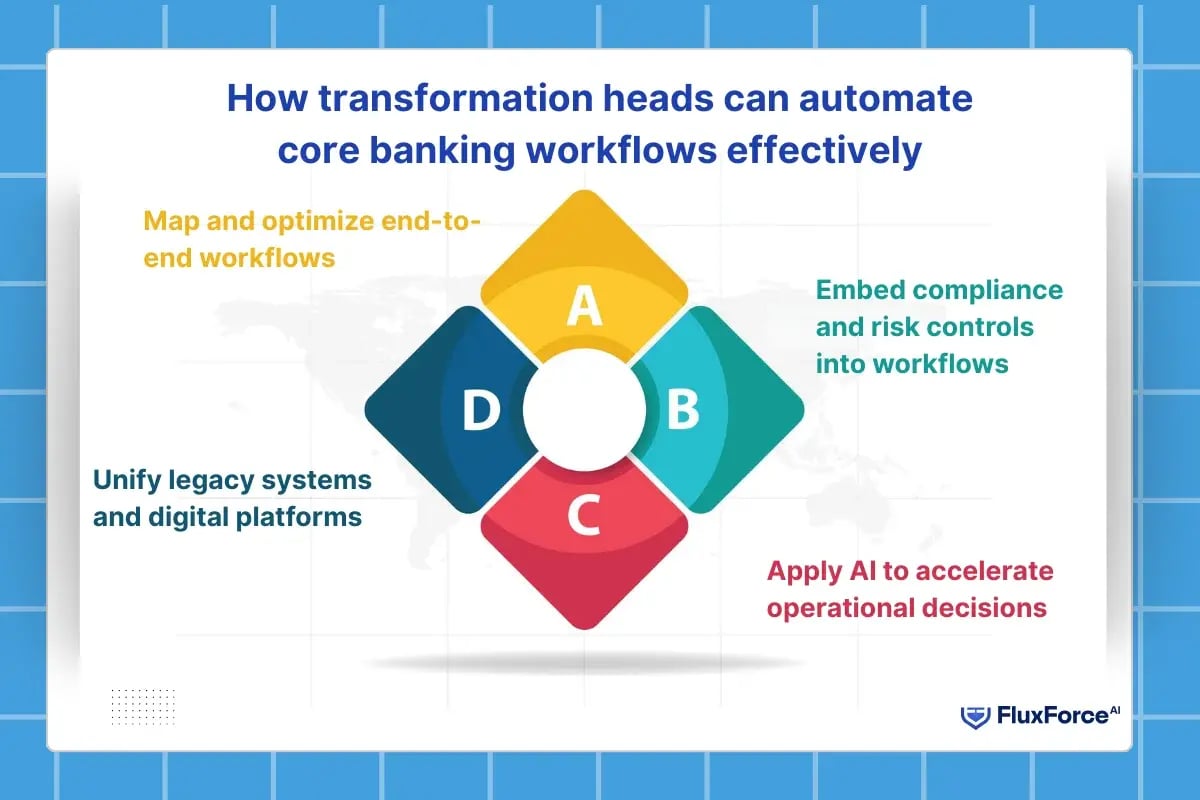
1. Map and optimize end-to-end workflows
Every process, from onboarding and lending to payments and KYC, must be mapped and analyzed. Identify repetitive manual tasks, approval bottlenecks, and slow handoffs. Applying banking process automation at these points ensures consistent execution. Transformation leaders know that a clear workflow map is the foundation for effective automation.
2. Unify legacy systems and digital platforms
Fragmented IT systems prevent true workflow efficiency. Consolidating core banking systems, legacy platforms, and digital channels allows banking workflow integration. Once systems are unified, banks can implement intelligent workflow orchestration and automated customer lifecycle workflows that operate more reliably across touchpoints. This approach eliminates silos and strengthens operational governance.
3. Embed compliance and risk controls into workflows
Integrating compliance automation and automated risk checks directly into workflows helps ensure consistent regulatory adherence while reducing operational errors and operational risk. Straight-through processing (STP) can now be achieved safely with full auditability.
4. Apply AI to accelerate operational decisions
Advanced AI models enhance fraud detection, credit assessment, and task routing. Banks that automate core banking workflows with AI can reduce manual dependency, speed processing, and improve customer experience. AI allows staff to focus on exceptions and high-value decisions while routine tasks execute automatically and accurately.
Industry evidence confirms these benefits. Accenture reports that banks implementing core workflow automation achieve faster onboarding workflows and measurable gains in operational efficiency. Capgemini highlights that digital core banking upgrades deliver the most value when workflows are optimized end-to-end and aligned with operational strategy.
How to embed compliance and risk governance into automated workflows?
Once core banking workflows are automated, the next priority for transformation heads is to integrate compliance and risk governance directly into those workflows. Doing this in a structured, stepwise manner ensures operations remain efficient, auditable, and low risk.
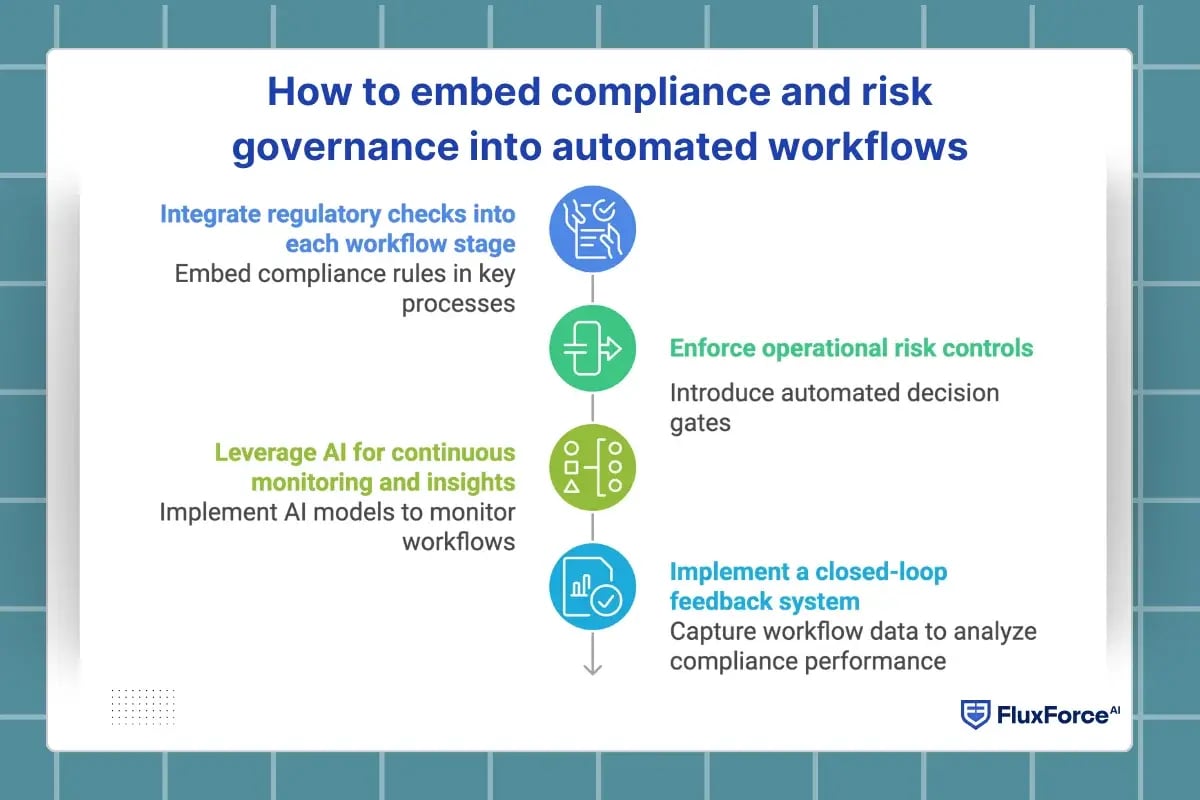
step 1: Integrate regulatory checks into each workflow stage
Begin by embedding compliance rules in key processes such as onboarding, lending, payments, and servicing. Compliance automation ensures KYC verification, , AML screening, and policy enforcement happen automatically. This reduces manual intervention and ensures regulatory adherence from day one.
step 2: Enforce operational risk controls
Next, introduce automated decision gates to replace manual reviews. Each workflow step applies pre-defined policies to manage exceptions, helping minimize errors and reduce operational risk. This approach also supports straight-through processing (STP) without compromising oversight.
step 3: Leverage AI for continuous monitoring and insights
Once controls are in place, implement AI models to monitor workflows in real time. AI can flag anomalies, identify compliance risks, and generate actionable insights. Banks that automate core banking workflows with AI strengthen governance while improving customer experience modernization and efficiency.
step 4: Implement a closed-loop feedback system
Finally, capture workflow data to analyze compliance performance and exceptions. Use these insights to refine policies, optimize workflow rules, and respond to evolving regulatory requirements. This helps keep banking workflow integration efficient, compliant, and adaptable.
For transformation heads, following these steps provides a clear roadmap to integrate governance seamlessly while keeping automated workflows scalable and resilient.
How to achieve cost efficiency and faster onboarding through automated workflows ?
After embedding compliance and risk governance, the next priority for transformation heads is to realize measurable operational impact. Automating workflows should directly drive cost reduction, accelerate onboarding, and elevate customer experience while sustaining regulatory adherence.
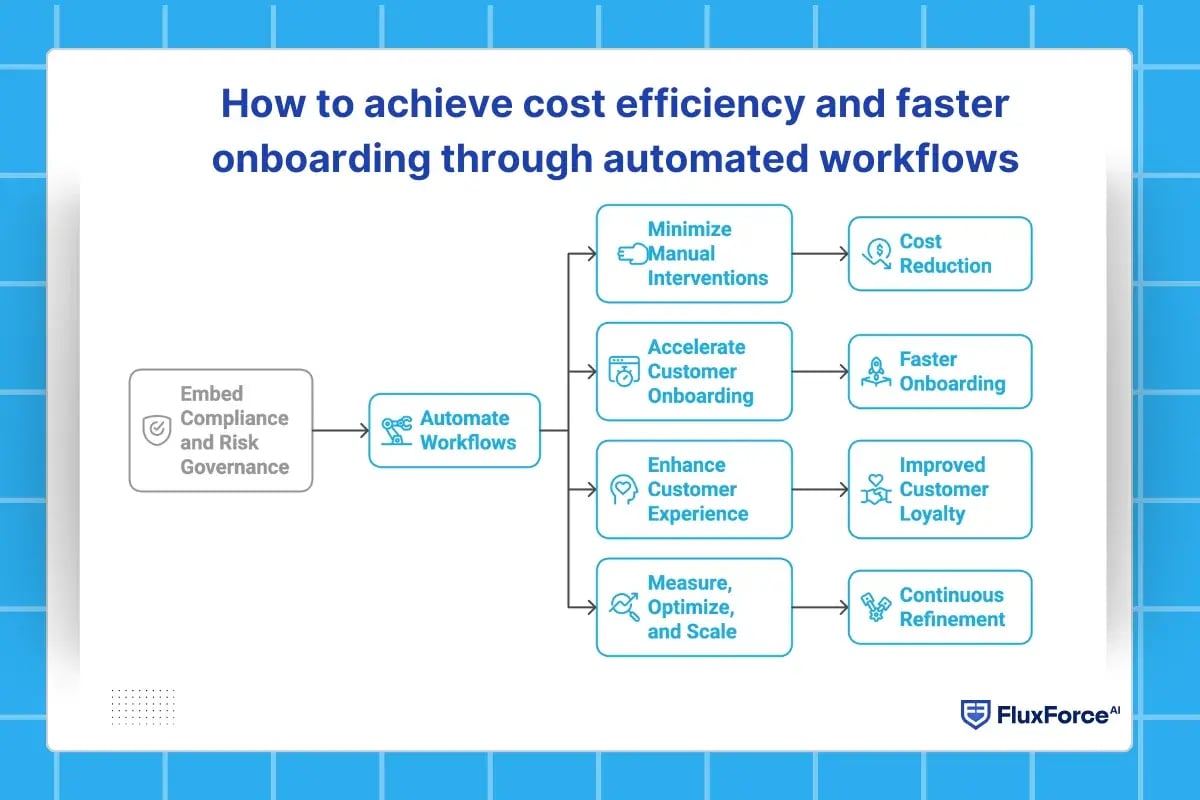
step 1: Minimize manual interventions and operational costs
With core workflow automation and integrated compliance, repetitive manual steps in back-office processes, approvals, and reconciliations are reduced or removed. This can deliver cost optimization in banking and free staff for higher-value work, improving overall operational efficiency.
step 2: Accelerate customer onboarding
Automated workflows streamline KYC, credit assessments, and account opening procedures. Embedding automated compliance checks ensures that straight-through processing (STP) is achieved without sacrificing regulatory controls. Banks that automate core banking workflows see significant improvements in faster onboarding workflows, reducing customer wait times and improving retention.
step 3: Enhance customer experience consistently
Efficiency gains translate directly into better customer journeys. Integrated automated customer lifecycle workflows ensure consistent, transparent service across branches, digital platforms, and contact centers. Customers experience frictionless banking, reinforcing trust and loyalty.
step 4: Measure, optimize, and scale
Workflow analytics provide actionable insights into cost savings, processing speed, and service quality. Transformation heads can continuously refine banking workflow integration, ensuring alignment with business goals, regulatory requirements, and evolving customer expectations.
Protect your business from deepfake fraud with FluxForce AI
Ensure secure, reliable digital identity verification today.
Conclusion
Retail banking faces pressure from customers, regulators, and internal targets. Leaders who embed automation, compliance, and monitoring into daily workflows gain better control over operations. A solid banking transformation strategy reduces operational errors, lowers costs, and creates a strong foundation for growth. Banks that act decisively today will be better prepared for future challenges. To explore how banks can automate compliance without slowing customer onboarding, read: Agentic AI for KYC AML – Onboard Customers in Minutes .
Share this article