.webp)







Listen To Our Podcast🎧
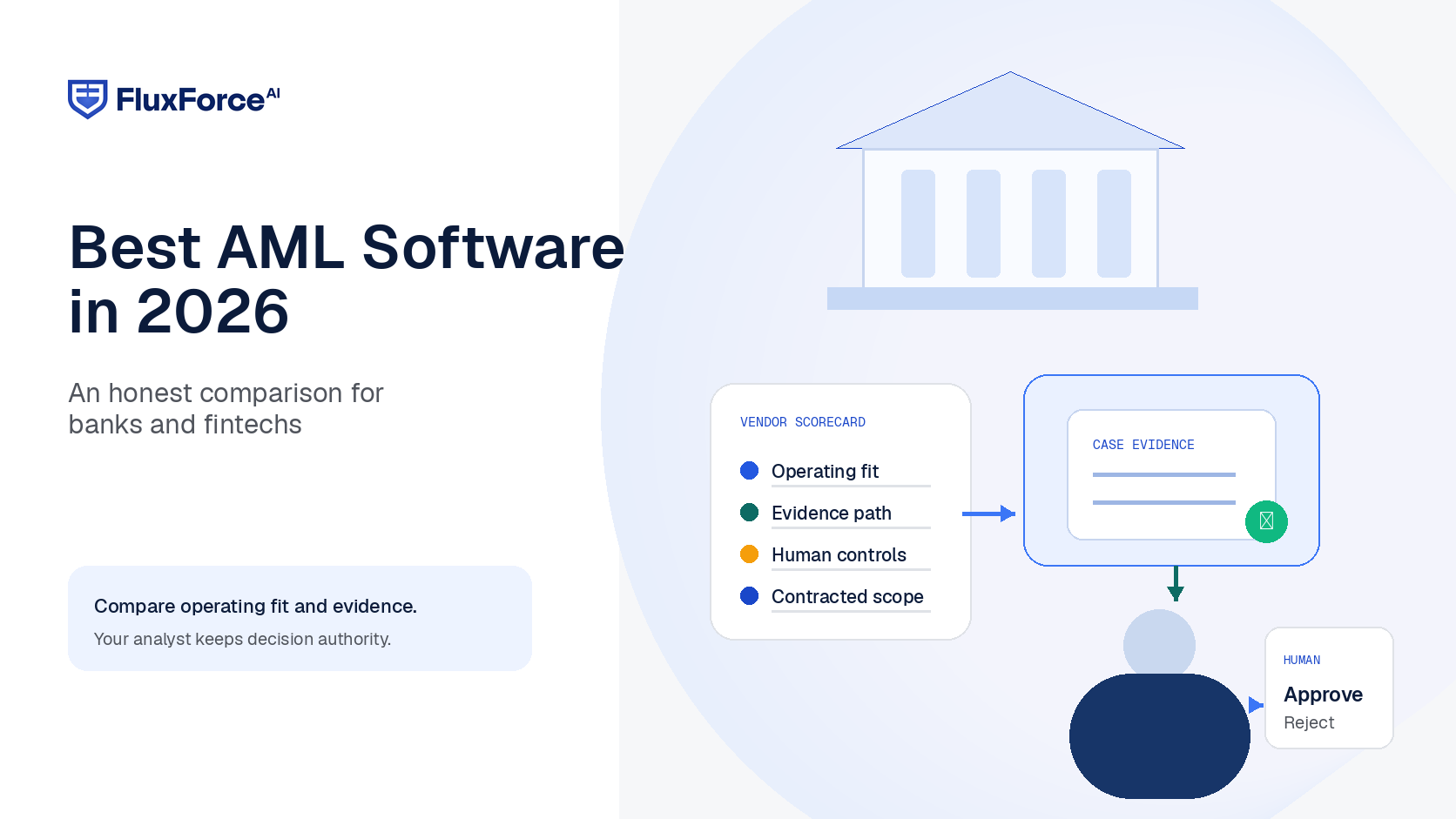
How did we choose the AML software in this comparison?
The best AML software is the system that fits your institution's risk model, data, alert volume, investigation process and decision controls. There is no credible universal winner. A large bank replacing several monitoring tools needs a different product from a fintech that wants configurable rules and one case queue.
This comparison covers seven options: FluxForce, Napier AI, NICE Actimize, Unit21, Flagright, Lucinity and Tookitaki. They are ordered by use case, not by a hidden score. Product statements reflect official public materials checked on October 3, 2026. Vendor claims are not independent performance findings, and every buyer should test them with its own data.
 Sahil Kataria | Founder and CEO of FluxForce | Draft prepared 2026-10-03. Publication date pending.
- Define a fair AML software shortlist.
- Compare seven operating models using current official public materials.
- Assess detection, investigation, reporting and governance as one control.
- Design an equal-case proof of concept.
- Build a weighted AML vendor scorecard.
Request the AML vendor scorecard and workflow review

The best AML software is the system that fits the institution risk model, data, alert volume, investigation process and human decision controls. There is no credible universal winner.
How did we choose the AML software in this comparison?
The shortlist uses five inclusion rules. Each vendor had an active official product page on October 3, 2026. Each marketed transaction monitoring or a broader AML operating product. Each addressed banks, fintechs or financial institutions. Each published enough detail to identify a practical use case. Each had a public route for a buyer to request more information.
This method excludes products that focus only on identity verification, sanctions data or consulting. It also excludes products whose current official materials did not support a useful comparison. Exclusion is not a judgment about product quality.
The phrase "best for" means the product's public description appears especially relevant to that operating model. It does not mean the vendor has been independently ranked above the others.
What should AML software do in 2026?
AML software should connect detection to investigation and decision evidence. Rules, models and screening results matter, but an MLRO also needs to know what triggered an alert, which data the system used, who reviewed the case, what that person decided and what was sent to the reporting process.
The Bank for International Settlements says institution-level transaction monitoring often relies on fragmented data and systems. Its Project Aurora page describes siloed monitoring as ineffective where investigators need a network view of payment data. In a simulated proof of concept, the project reported detection of potentially up to three times more complex money-laundering schemes and a false-positive reduction of up to 80 percent. Those figures do not predict the result of a commercial AML product. They do show why buyers should test data connection and network context rather than compare rule counts alone.
A buying team should assess seven connected capabilities.
| Capability | Buyer test | Decision owner |
|---|---|---|
| Data intake | Can the product accept the required customer, account, payment and reference data with clear lineage? | CTO and data owner |
| Detection | Can the compliance team configure scenarios, thresholds and risk logic for its own products and markets? | MLRO and model owner |
| Alert prioritization | Does the product explain why one alert deserves attention before another? | Financial-crime operations |
| Investigation | Can an analyst gather related activity, documents and prior decisions in one case? | Investigator |
| Human control | Are approval, rejection, override, escalation and kill-switch points explicit? | MLRO and control owner |
| Reporting support | Does the case preserve the facts and rationale needed for a filing-ready report? | MLRO or reporting officer |
| Governance | Can the institution test changes, retain versions and replay a decision for audit or examination? | Compliance, risk and internal audit |
A product can be strong in one area and still require other systems. The RFP should state whether you want a full AML operating product, a monitoring component, an investigation layer or a product that connects to tools you plan to keep.
AML software comparison at a glance
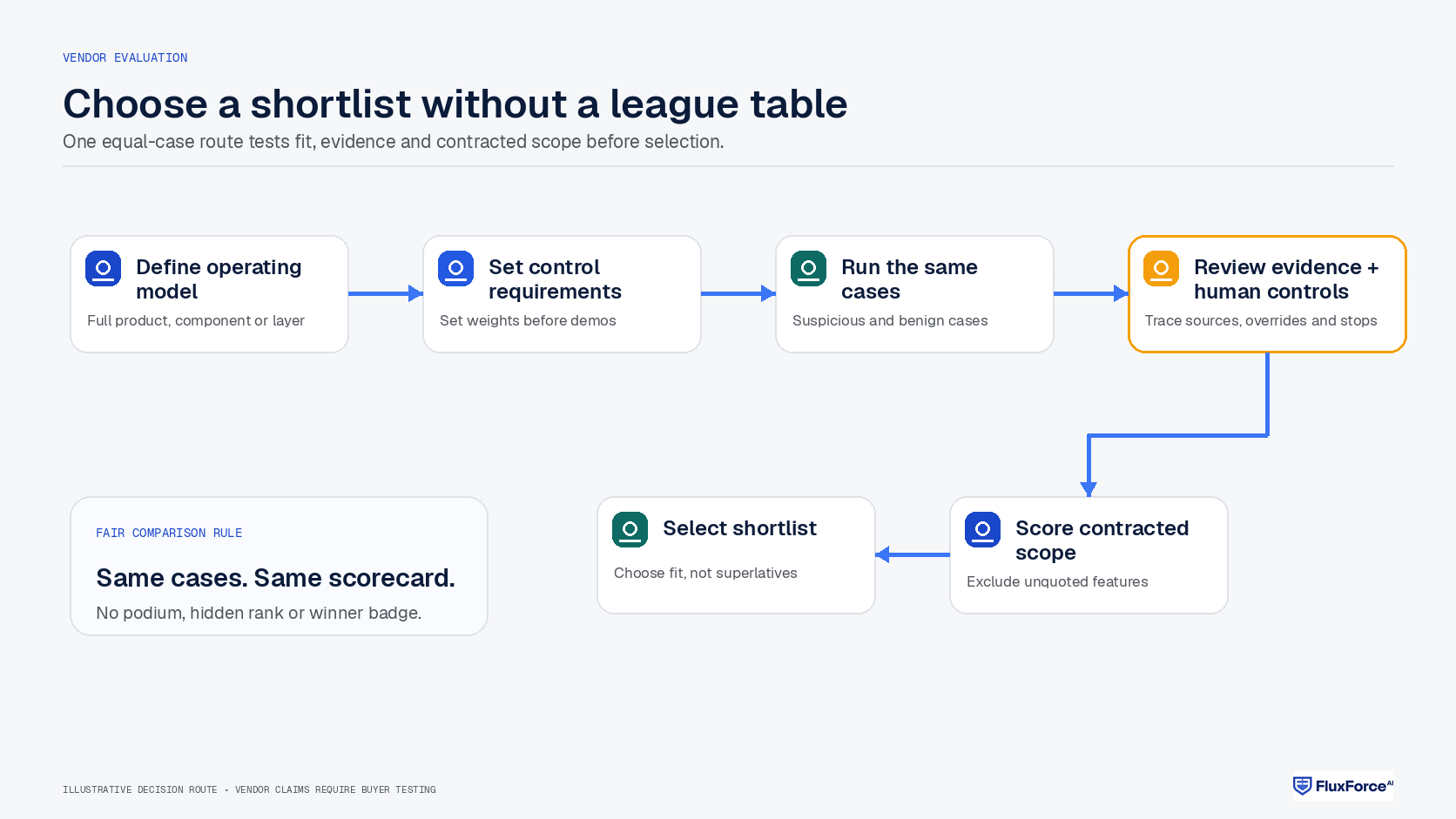
- Define the operating model, set controls, test the same cases, review evidence and human authority, score only contracted scope, then choose the shortlist.
Source context: https://www.bis.org/about/bisih/topics/fmis/aurora.htm
| Product | Best-fit use case based on public materials | Publicly described focus | What to test in a demo |
|---|---|---|---|
| FluxForce | Banks and fintechs that want AI agents to investigate alerts and prepare evidence for a human decision | Transaction Monitoring with agent-led case preparation, configurable autonomy and a kill switch | Exact data connections, permitted agent actions, evidence trace and analyst controls |
| Napier AI Continuum | Institutions seeking monitoring and screening on one platform with configurable workflows | Client screening, transaction screening, transaction monitoring and case workflow | Rule migration, workflow fit, explanation quality and deployment path |
| NICE Actimize SAM | Large or complex institutions seeking entity-centred suspicious activity monitoring | Customer risk context, layered detection and suspicious activity monitoring | Data model, scenario coverage, tuning governance and investigation handoff |
| Unit21 | Fintechs and financial institutions seeking a combined fraud and AML operations product | Real-time fraud prevention, AML monitoring, case management, screening and filings | Scenario controls, investigator experience, model oversight and regional reporting fit |
| Flagright | Teams prioritizing quick rule configuration and real-time API-based monitoring | No-code scenario building, monitoring, risk scoring, cases, screening and filing support | Complex rule behavior, latency under your load, change control and case evidence |
| Lucinity | Operations teams that want alerts, investigations and reporting in one workspace with AI assistance | Case management, transaction monitoring, customer context and an AI investigation agent | Source traceability, human review, case migration and report workflow |
| Tookitaki FinCense | APAC banks and payment firms seeking an AML and fraud operating product | Monitoring, screening, onboarding risk, customer risk, alert prioritization and case management | Market coverage, local rule packs, tuning, data residency and reporting requirements |
Napier AI Continuum: best fit for a connected monitoring and screening platform
Napier describes Continuum as a platform spanning client screening, transaction screening and transaction monitoring. Its official page says risk teams can adjust rules and thresholds in a no-code sandbox, and it describes a workspace that carries an alert from a queue through investigation to a regulatory report.
Napier also says more than 150 financial institutions use its products. Treat that as a vendor-reported adoption claim, not proof that the product fits your institution.
This option belongs on a shortlist when the buyer wants monitoring and screening under one operating model, with a choice between a larger platform deployment and connection to an existing technology stack. The demo should use one case that crosses monitoring, screening and investigation. Check whether data, ownership and rationale remain visible throughout.
Questions to ask:
- Can our compliance team change a threshold without bypassing model and change-control policy?
- How are rule versions, test results and approvals retained?
- Which investigation and reporting steps are native, and which depend on another product?
- What happens to open cases during rule or workflow migration?
NICE Actimize SAM: best fit for entity-centred monitoring in a large institution
NICE Actimize presents Suspicious Activity Monitoring, or SAM, as a transaction-monitoring product that uses customer risk and an entity-centred approach. The official page describes multiple detection layers and advanced analytics alongside retained rules.
That makes SAM relevant to a bank that has many products, customer types and existing data feeds. The attraction is not a generic claim that more analytics is always better. It is the chance to compare transactions in the context of the customer and connected activity.
The proof belongs in the institution's test set. Ask the vendor to run known suspicious cases, benign lookalikes and difficult edge cases. Review what evidence an investigator sees, how the product groups entities and how model-driven findings are explained. A strong detection result with a weak investigation trail creates a new control problem.
Questions to ask:
- Which customer and entity relationships are required for the proposed design?
- How does the product separate a known typology rule from an analytics-based finding?
- Can investigators reproduce the data and logic that supported an alert?
- How are scenario tuning and model changes approved and monitored?
Unit21: best fit for fintech fraud and AML operations in one product
Unit21 markets an AI risk infrastructure product for fraud and AML. Its public site lists transaction monitoring, case management, payment screening, sanctions screening, customer risk rating and regulatory filings. It also says AI agents investigate and improve across the lifecycle.
That breadth may suit a fintech or sponsor-bank program that wants fewer handoffs between fraud and AML teams. The claim still needs careful testing. Buyers should define which decisions an agent may prepare, recommend or execute, then verify the approval and stop controls for each action.
Use a demo case that begins as possible fraud and develops into an AML investigation. Check whether the product preserves the original signals, later findings, reviewer comments and final decision without rewriting the history.
Questions to ask:
- Which agent actions are configurable, and which always require a person?
- Can the institution stop an agent without losing the case state?
- How are false-negative testing and investigator feedback governed?
- Which reporting formats and jurisdictions are supported in the proposed scope?
Flagright: best fit for teams that want fast scenario configuration
Flagright describes a real-time transaction-monitoring product with a no-code scenario builder. Its official page says users can create AML and fraud rules in 60 seconds. That is a vendor claim about configuration speed, not evidence that a useful, tested and approved control can be deployed in one minute.
The product may be relevant to a payment firm or digital bank that needs frequent rule changes and API-based monitoring. The main buying question is governance. Speed helps only when the team can test the rule, compare expected and unexpected outcomes, record approval and roll back safely.
Ask the vendor to build a scenario during the demo, but do not stop at the visual builder. Feed it boundary cases, change a threshold, route the alert into a case and export the decision record. That exercise will show whether configuration speed and control discipline can coexist.
Questions to ask:
- How are draft, tested, approved and retired rule states separated?
- Can we reproduce the exact rule version that generated an old alert?
- What performance and availability terms apply to our expected volume?
- Which case and filing functions are included in the proposed package?
Lucinity: best fit for investigation-centred AML operations
Lucinity describes a platform that combines alerts, investigations and reporting. It also markets an AI agent for financial-crime investigations, plus transaction monitoring, customer context and workflow configuration.
This option is relevant when the main problem is fragmented investigation work. A buyer may have detection tools already but still lose time moving between alert data, customer records, prior cases and report preparation.
The demo should reveal whether the AI assistance is traceable. Ask the product to summarize a case, identify linked activity and draft an investigation step. Then have an analyst challenge the result. The reviewer should be able to find the source for each statement, correct it and retain the final rationale.
Questions to ask:
- Does every AI-generated case statement link back to source data?
- Can an investigator reject or edit a recommendation while preserving the audit history?
- How does the product connect to an existing monitoring product?
- What information is retained when a case is exported or migrated?
Tookitaki FinCense: best fit for APAC-focused AML and fraud programs
Tookitaki describes FinCense as an operating product for AML and fraud prevention. Its public site lists transaction monitoring, screening, onboarding risk, customer risk scoring, alert prioritization and a centralized case manager.
The APAC focus may be useful to a bank or payment firm that wants regional experience in its vendor discussion. Geographic marketing is not the same as confirmed regulatory fit. Buyers still need to verify the countries, data requirements, reporting formats and local typologies included in the proposed scope.
Run one local-market case from detection through case closure. Ask which parts come from global product logic, which come from jurisdiction-specific content and which must be configured by the institution.
Questions to ask:
- Which of our target jurisdictions are supported under the proposed contract?
- How are local typologies sourced, reviewed and updated?
- Can the institution tune alert prioritization without losing the original detection record?
- How does the case manager preserve reviewer decisions and unresolved issues?
FluxForce: best fit for evidence-led AI-agent investigations with human control
FluxForce's relevant solution is Transaction Monitoring. The operating idea is that AI agents investigate AML alerts and prepare the case. Your analyst makes the call, with evidence an examiner can replay. You decide how much each agent does on its own, and every one has a kill switch.
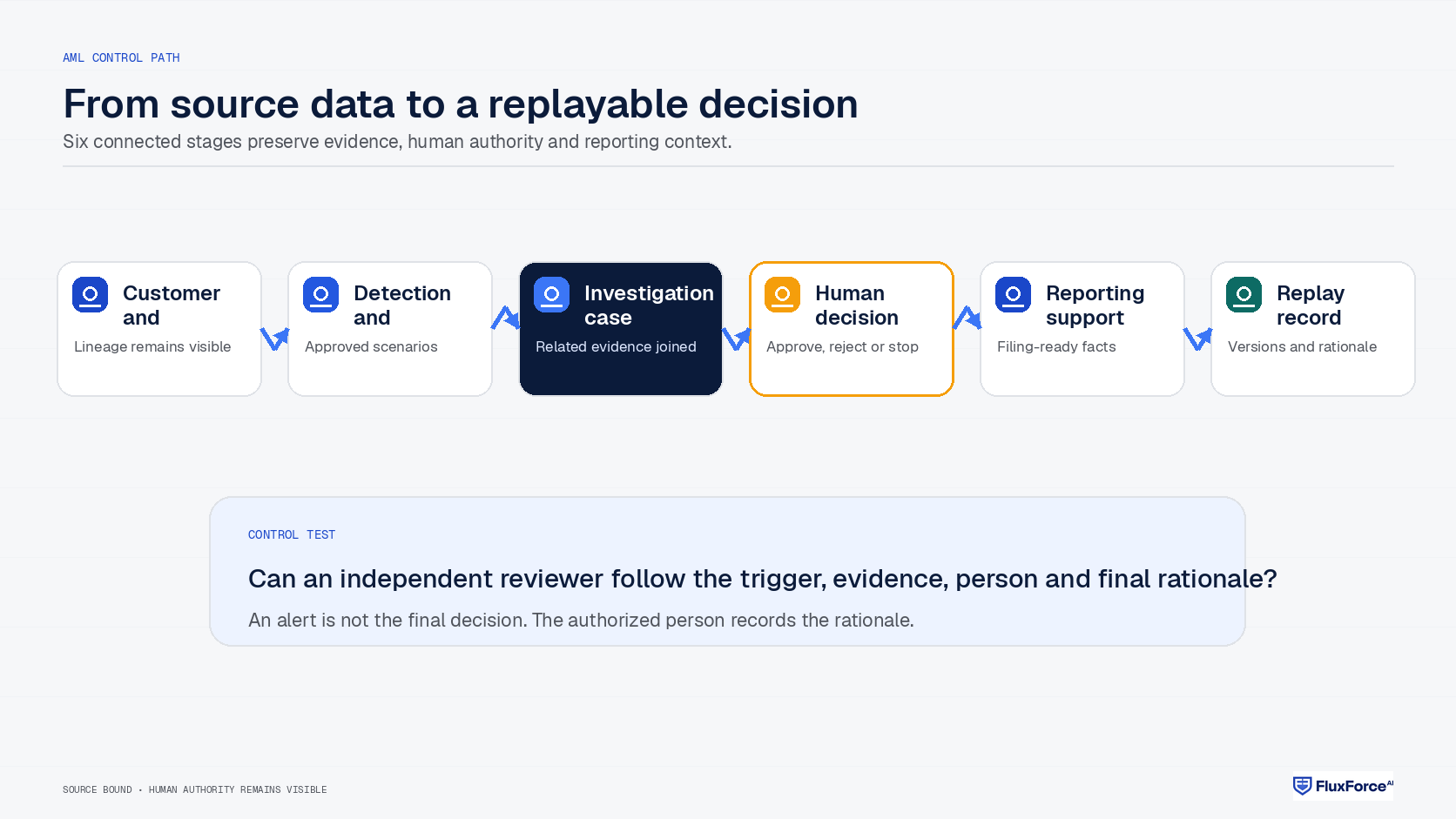
- Data feeds detection, alerts become investigation cases, a person decides, and the system retains reporting evidence and a replay record.
Source context: https://www.bis.org/about/bisih/topics/fmis/aurora.htm
The useful comparison point is the investigation workflow. A bank may already have rules or models that create alerts. The harder problem is collecting customer context, related transactions, prior decisions and policy evidence without hiding the reviewer who accepted, rejected or escalated the case.
FluxForce should be evaluated on that full path. The demo should show the alert input, each evidence source, the agent's work, the analyst's decision and the replay record. It should also show what happens when the analyst disagrees or stops the agent.
FluxForce does not determine legal applicability, replace the MLRO, guarantee an outcome or prove that a bank's existing data is ready. The institution must validate the exact product scope, deployment fit, integration route, controls and references during procurement. Public marketing copy is not a substitute for technical and compliance review.
The FluxForce alternatives hub, AML tools library and comparison centre can support the wider vendor review.
Questions to ask:
- Which alert and customer data sources can be connected in our proposed scope?
- What may the agent do automatically, and what always routes to an analyst?
- Can the reviewer trace every prepared statement to evidence?
- How are overrides, rejected recommendations and kill-switch events retained?
How should a bank score AML vendors?
Use the same weighted scorecard for every vendor. Change the weights before the demos, not after a preferred product emerges.
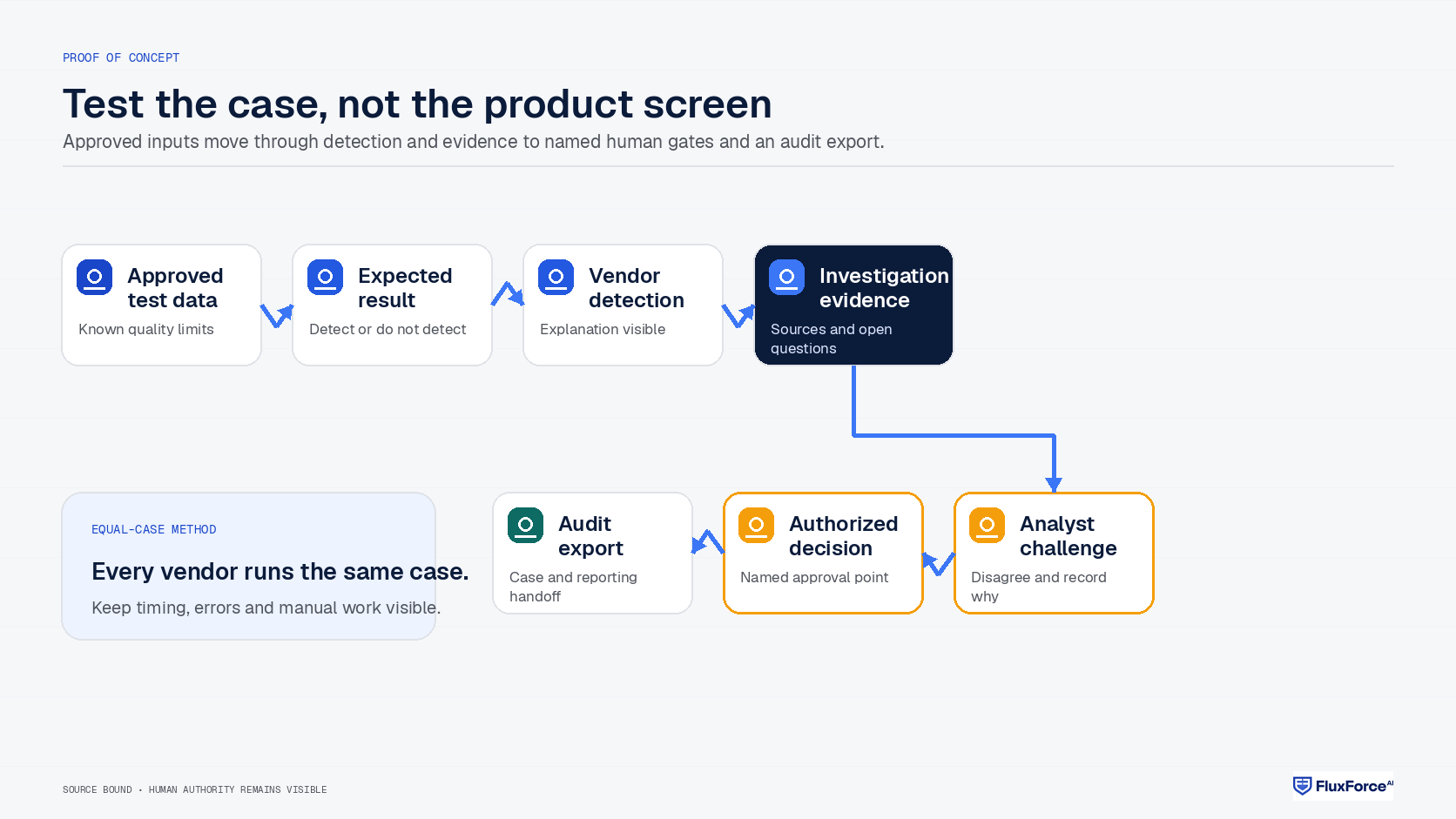
- Approved data and expected results feed the vendor test. Investigators challenge the evidence, an authorized person decides, and the case is exported for review.
Source context: https://www.bis.org/about/bisih/topics/fmis/aurora.htm
| Evaluation area | Suggested weight | Evidence to request |
|---|---|---|
| Risk and typology fit | 20% | Test results against institution-approved cases and benign controls |
| Data and integration fit | 15% | Data mapping, lineage, error handling and operating dependencies |
| Investigation workflow | 15% | End-to-end case demonstration with source evidence |
| Human authority and explainability | 15% | Approval matrix, override path, explanation and replay record |
| Governance and testing | 15% | Versioning, test environment, change approval and monitoring |
| Security and deployment | 10% | Architecture review, access controls, residency and recovery evidence |
| Commercial and delivery fit | 10% | Contract scope, implementation plan, support model and total cost assumptions |
The percentages are an editorial starting point, not a regulatory formula. A bank replacing an established monitoring product may put more weight on migration and detection testing. A fintech may put more weight on API behavior and compliance-team configuration.
Do not award points for a feature that is outside the quoted scope. Mark it as unconfirmed until the vendor ties it to the contract, deployment and acceptance test.
What should happen in an AML software proof of concept?
A useful proof of concept starts with cases, not product screens. Select several approved scenarios that cover known suspicious activity, ordinary customer behavior, incomplete data and investigator disagreement.
For each case, record:
- the input data and known quality limits;
- the expected detection or non-detection result;
- the alert explanation and evidence path;
- the investigator's steps and unresolved questions;
- the human decision and approval point;
- the case export, reporting handoff and audit record; and
- the observed time, errors and manual work.
Keep the same cases for every vendor. A product should not receive a better score because it was shown an easier scenario.
Illustrative scenario: cross-channel mule activity
Illustrative example, not a customer result. A new retail account receives payments from several unrelated senders. The money moves out quickly through another rail. The customer profile is low risk, but the transaction pattern and device links raise concern.
The monitoring product should identify the relevant activity and explain the trigger. The investigation workflow should join the account, device, counterparties, prior alerts and available customer records. An agent may collect evidence and prepare a case summary. An investigator tests the explanation, records any contradiction and decides whether to escalate. The MLRO or authorized officer owns any filing decision.
Run the scenario with missing device data and one benign lookalike. That exposes whether the product handles uncertainty or simply produces a confident answer.
Illustrative scenario: cross-channel mule activity
Illustrative scenario, not a customer result.
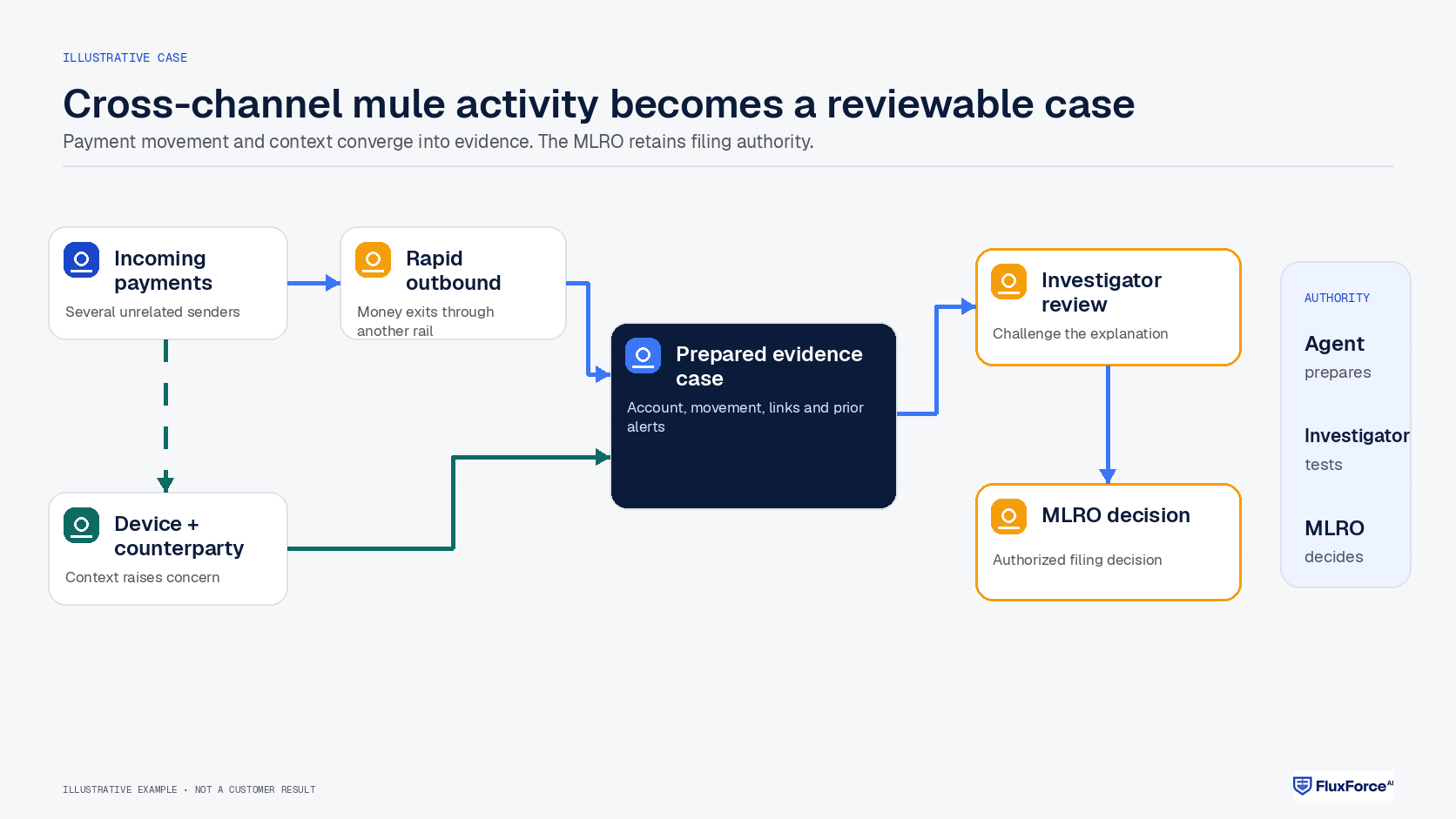
- Payments and context feed a prepared evidence case. An investigator challenges it, and the MLRO or authorized officer owns the filing decision.
Source context: https://www.bis.org/about/bisih/topics/fmis/aurora.htm
A new retail account receives payments from unrelated senders and moves the money out through another rail. Device links and the transaction pattern raise concern.
- Detect the relevant activity.
- Join account, device, counterparty and prior-alert evidence.
- Prepare a source-linked case.
- Have an investigator challenge the explanation.
- Route the filing decision to the MLRO or authorized officer.
Which implementation metrics matter after selection?
| Metric | Definition | Guardrail |
|---|---|---|
| Data acceptance rate | Share of required records accepted without mapping or quality failure | A high rate can still hide missing fields |
| Alert stability | Change in alert volume and composition after an approved rule or model change | Lower volume is not proof of better detection |
| Investigation completion time | Time from alert creation to a decision-ready case | Separate waiting time from analyst work |
| Evidence completeness | Share of required evidence fields present at decision | Presence does not prove accuracy |
| Human override rate | Share of recommendations changed or stopped by reviewers | Overrides are a control signal, not automatic failure |
| Replay success | Share of sampled cases that an independent reviewer can reconstruct | Test the evidence, version and named decision owner |
| Unresolved integration defects | Open defects that can affect detection, cases or reporting | Do not hide defects inside project status averages |
Measure quality before speed. A fast process that cannot explain the decision will not satisfy an examiner or an internal model-risk reviewer.
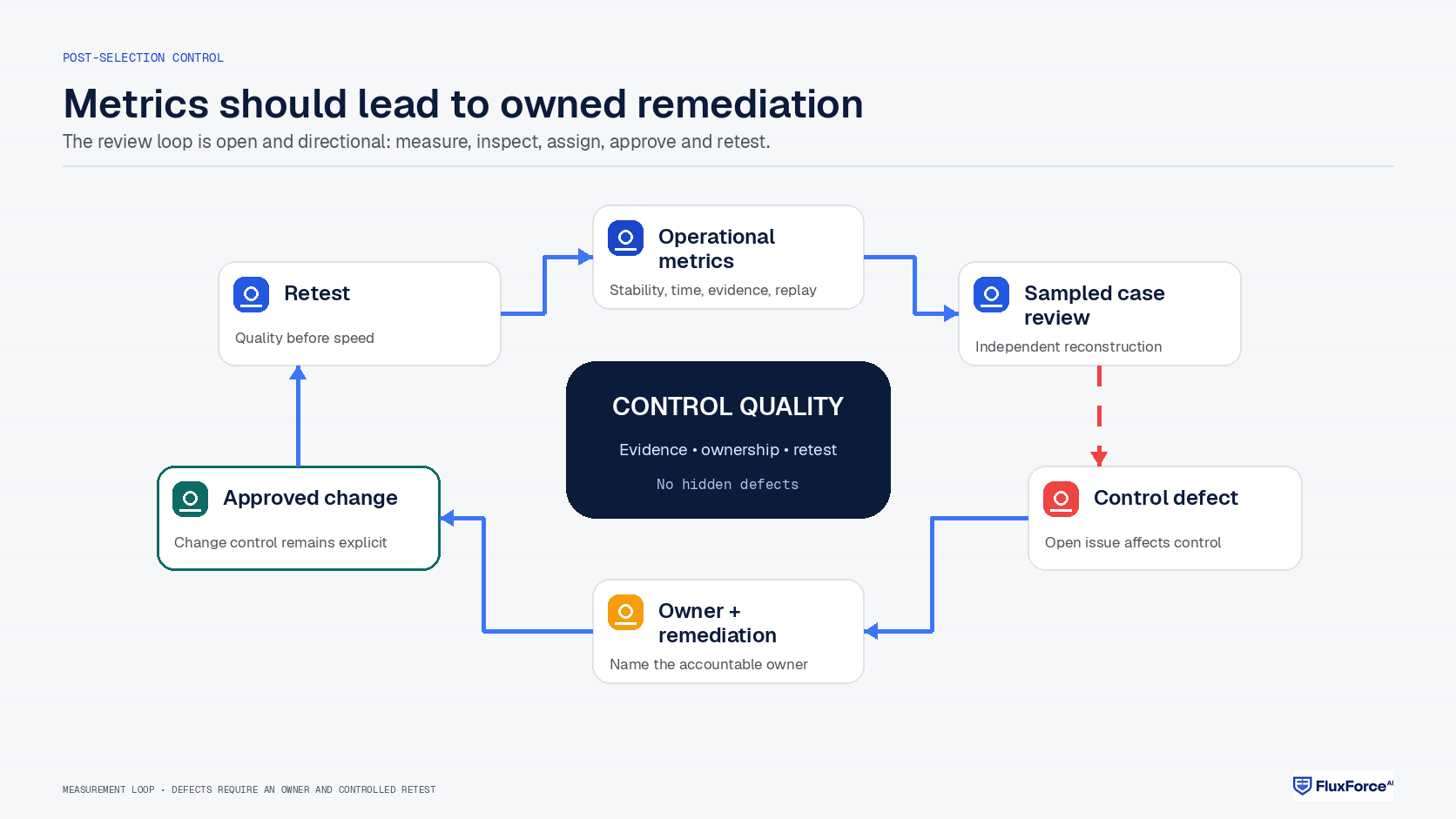
- Metrics trigger sampled reviews. Defects receive an owner and remediation, changes are approved, and the control is retested.
Source context: https://www.bis.org/about/bisih/topics/fmis/aurora.htm
- Order vendors by use case, not a hidden league table.
- Test the same approved cases with every vendor.
- Score only the functions included in the quoted scope.
- Keep analyst or MLRO authority explicit.
- Require source evidence and a replay record for every consequential decision.
Conclusion
Choose the product that performs best on your approved cases, fits the systems you will keep and preserves human accountability. Product breadth matters only when the included functions work together in the purchased scope.
A sensible shortlist can include a large enterprise suite, a configurable monitoring product and an investigation-led option. That gives the buying team three different operating models to test instead of seven similar demos.
Request the AML vendor scorecard and workflow review
Request the AML vendor scorecard and workflow review
Turn the tables in this guide into an RFP worksheet, set the weights with compliance and technology, then require every vendor to run the same cases. To review how FluxForce prepares AML alert evidence for an analyst decision, request a demo. The session should confirm fit and limitations. It cannot certify compliance or replace procurement, legal, security and model-risk review.
Frequently Asked Questions
About the author
Sahil Kataria is the Founder and CEO of FluxForce. View Sahil Kataria's author profile.
About the author

Sahil Kataria
Founder and CEO of FluxForce

Share this article