





Listen to our podcast 🎧
Introduction
How can banks stay ahead under Basel IV in 2025? For CROs, compliance becomes central to capital planning, risk oversight, and reporting. Basel IV compliance affects every aspect of risk strategy, from risk-weight calculations to capital buffers.
The rules limit the benefits of internal risk models through the output floor, forcing banks to hold sufficient capital even if models show lower risk. This shift makes Basel IV risk management a strategic priority not just a regulatory checkbox.
CROs must focus on smarter risk measurement, better data governance, and automation to handle complexity efficiently. Adopting AI for Basel IV reporting and automated risk data aggregation is becoming essential to stay compliant and agile.
How AI Transforms Basel IV Reporting and Risk Management
How can AI make Basel IV compliance faster and smarter for CROs? For CROs, managing Basel IV compliance manually is no longer practical. AI in regulatory reporting helps banks automate repetitive tasks, improve accuracy, and provide deeper insights into risk.
Key benefits of AI for CROs
- Automated Reporting: AI can handle Basel IV reporting automation, collecting and verifying data from multiple systems, so reports are accurate and ready on time.
- Faster Risk Calculations: Using Basel IV risk-weight calculations AI, banks can quickly model different scenarios, understand capital impacts, and balance internal models with the standardized approach.
- Better Data Management: AI-driven automated risk data aggregation ensures that all risk data is consistent, traceable, and easy to audit.
- Proactive Compliance: AI tools can spot potential compliance issues early, helping CROs prevent errors before regulators notice.
How CROs should approach AI
1. Choose the Right Tools: Invest in regulatory reporting software for banks that supports end-to-end automation.
2. Govern AI Carefully: Ensure clear audit trails and accountability. Use AI responsibly in line with regulatory expectations.
3. Use AI Strategically: Beyond compliance, AI can improve risk intelligence, making CROs more agile in managing credit, market, and operational risks.
Integrating AI for Basel IV is not just about compliance, it’s about giving CROs the tools to make smarter, faster decisions while reducing manual workload.
AI for Basel IV Reporting: Regulatory Compliance Automation Strategy for CROs in Banking
Protect your data—read now!

Basel IV reporting: regulatory compliance automation strategy for CROs in banking
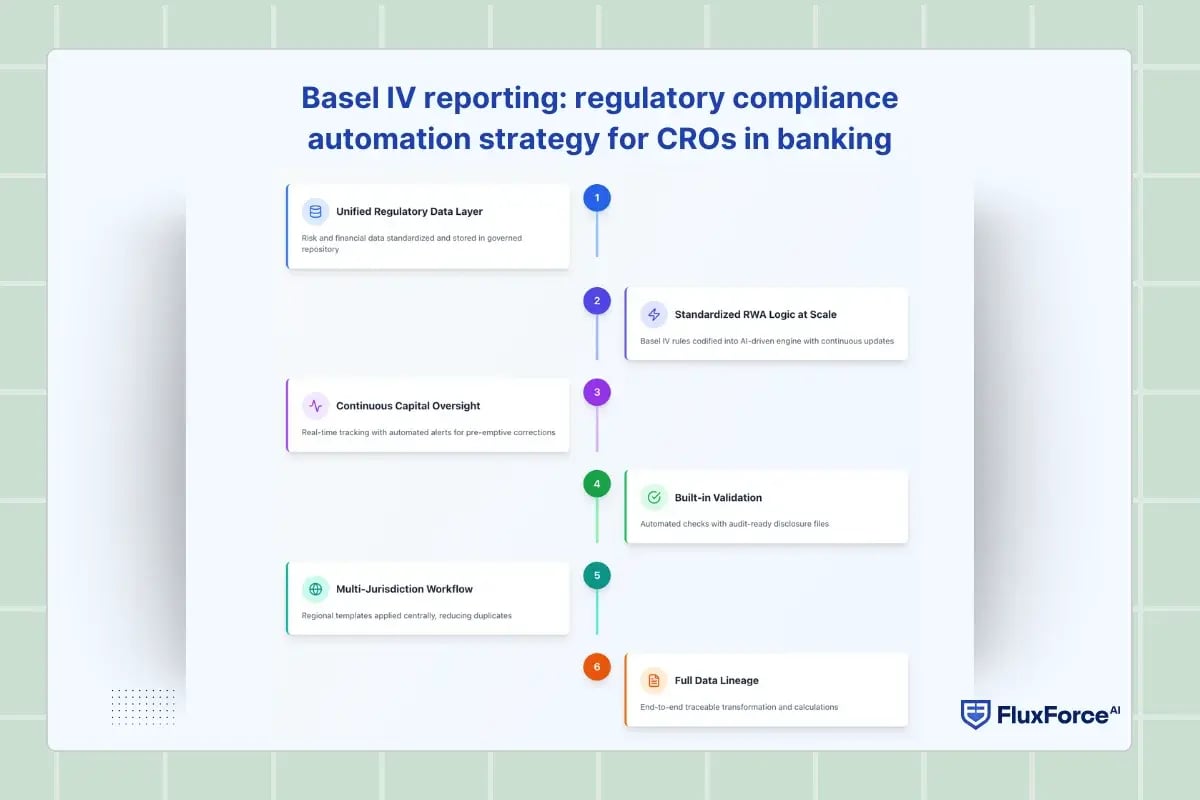
Create a unified regulatory data layer
Risk and financial data are standardized and stored in a governed repository to eliminate inconsistencies across disclosure outputs and portfolios.
Standardized RWA logic execution at scale
Basel IV standardized approach rules are codified into an AI-driven engine.
Risk-weight outcomes update continuously as exposure details or supervisory parameters change.
Continuous capital and ratio oversight
Capital and liquidity measures are tracked in real time with automated alerts on threshold proximity, enabling pre-emptive corrections instead of post-report remediation.
Built-in validation and evidence generation
Every metric passes automated eligibility, data quality, and classification checks. Validated results are auto-packaged into audit-ready disclosure files.
Multi-jurisdiction workflow automation
Regulatory templates and rule variations for different regions are applied centrally. This reduces duplicated submissions and eliminates manual formatting tasks.
Full data lineage and governance visibility Transformation steps, calculation logic, and control results remain traceable end-to-end, streamlining supervisory reviews with verifiable compliance evidence.
Operational gains observed after implementation
- Reduction in reporting rework cycles
- Stronger capital accuracy and stability
- Faster response to regulatory queries
- Higher confidence in disclosure governance
- Automation transitions Basel IV reporting from deadline-driven activity to ongoing compliance assurance.
How to integrate AI automation into Basel IV compliance operations
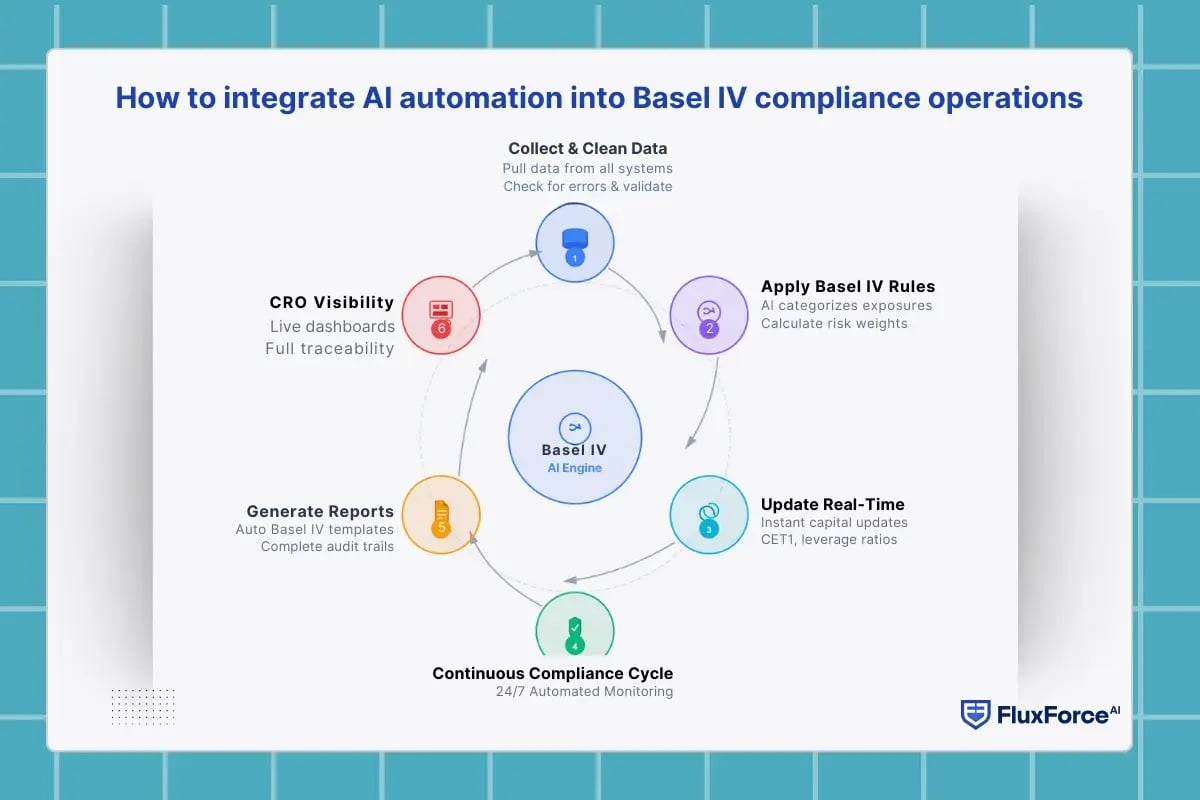
Step 1: Collect and clean all data needed for Basel IV
Information from lending, trading, treasury and finance systems is pulled into one place. Key details such as product type, rating, collateral, guarantees, and maturity are checked for mistakes, missing fields, or outdated entries before moving forward.
Step 2: Automatically apply Basel IV rules to every exposure
AI checks each record against Basel IV rule conditions to decide its correct category. Risk weights are calculated instantly based on counterparty type, collateral value and allowed risk reductions, so there is no room for manual judgment errors.
Step 3: Update capital numbers whenever something changes
If a rating moves up or down, collateral value changes or a client defaults, capital percentages update right away. This keeps CET1, leverage and liquidity ratios fresh and aligned to the true risk position at all times.
Step 4: Check every number for correctness before reporting
Built-in controls verify that exposure categories follow rules, information is complete, and nothing breaks regulatory guidance. Any issues are flagged, assigned to responsible teams and fixed early, removing last-minute corrections.
Step 5: Build regulatory reports automatically
All approved results are placed into required Basel IV templates with correct formats, breakdowns, and supporting notes. Proof of how the numbers were created attaches automatically, so no manual document collection later.
Step 6: Give CROs full visibility into reporting status
Clear dashboards show live progress, pending issues, and areas needing attention. Every number can be traced back to where it came from, helping respond quickly to any supervisor queries.
How CROs measure Basel IV automation success (KPIs and oversight improvements)
.webp?width=1200&height=800&name=How%20CROs%20measure%20Basel%20IV%20automation%20success%20(KPIs%20and%20oversight%20improvements).webp)
Step 1: Track accuracy of Basel IV capital results
CRO teams monitor fewer reporting corrections and more “first-time-right” filings. Stable outcomes in Basel IV risk management show capital numbers are calculated consistently by automation rather than manually adjusted at period-end.
Step 2: Measure reporting cycle speed improvements
The time taken to produce disclosure-ready submissions shortens. With Basel IV reporting automation, late-night reconciliation and spreadsheet checks disappear, proving efficiency gains across regulatory cycles.
Step 3: Monitor reduction in rule violations and exceptions
Automated controls highlight where compliance misalignments occur. A steady drop in flagged issues validates that Basel IV compliance automation and governance rules are being followed accurately.
Step 4: Confirm audit and supervisory inquiry readiness
Supervisors ask fewer questions because data lineage and audit trail automation AI provides immediate proof of how numbers were created. This demonstrates stronger intelligent compliance frameworks for banks.
Step 5: Observe improvements in RWA stability
Lower swings in RWA (risk-weighted assets) AI after controls are implemented show that credit risk modelling automation and validation logic are working properly.
Step 6: Validate stress scenario responsiveness
During capital stress evaluations, results update quickly using stress testing automation AI. Supervisors gain confidence when stressed ratios reflect real exposure positions without reruns.
Stay Ahead of Regulations
Keep compliance under control with automation that eliminates manual errors, speeds up reporting, and ensures you’re always audit-ready.
AI Governance and Model Risk Controls for Basel IV
AI automation brings major benefits, but regulators expect full oversight and accountability. CROs must ensure that Basel IV risk calculations and reporting powered by AI remain transparent, accurate, and fully governed. AI governance and model risk management become a core part of the CRO digital compliance strategy.
Explainable Basel IV capital calculations
Every risk-weight and capital number needs to show how it was generated. Explainable AI for capital reporting lets CROs trace each value back to data sources and rule logic, giving supervisors confidence that outcomes are fair and compliant.
Model risk governance aligned to regulations
Basel IV model risk controls ensure AI engines are tested, validated, and continuously monitored. This prevents unwanted model drift and keeps standardized and internal model calculations aligned with supervisory expectations.
Human oversight for critical decisions
Automation handles volume, but human checks remain in place for exposures that carry major capital impact. CROs decide when expert judgment is required, ensuring accountability and compliance stay intact.
Bias and fairness monitoring for exposure classification
Controls check the fairness of risk data and capital outputs to avoid biased exposure categorization or unjustified changes in risk weights. This supports transparent and ethical regulatory reporting automation.
Continuous control improvement as rules evolve
Basel IV compliance automation needs ongoing updates as new regulatory guidance arrives. CRO teams track rule changes and feed them into AI models so that compliance does not weaken over time.
Stronger governance helps CROs benefit from innovation without creating new risks. With AI oversight embedded, Basel IV risk management becomes smarter, safer, and fully defensible.
Conclusion
Basel IV is reshaping how banks prove capital sufficiency and risk discipline. The institutions that succeed will be those that replace static reports with intelligent compliance frameworks for banks. AI and automation create transparency from source data to supervisory submission, eliminating uncertainty in control results and exposure calculations.
This progression ensures CRO digital compliance strategy is no longer dependent on manual heroics but on reliable, scalable systems. As reporting friction reduces, leadership gains faster decision support and regulators receive cleaner, more confident disclosures. The result is a stronger, more predictable compliance posture that grows stronger with every iteration.



Share this article