
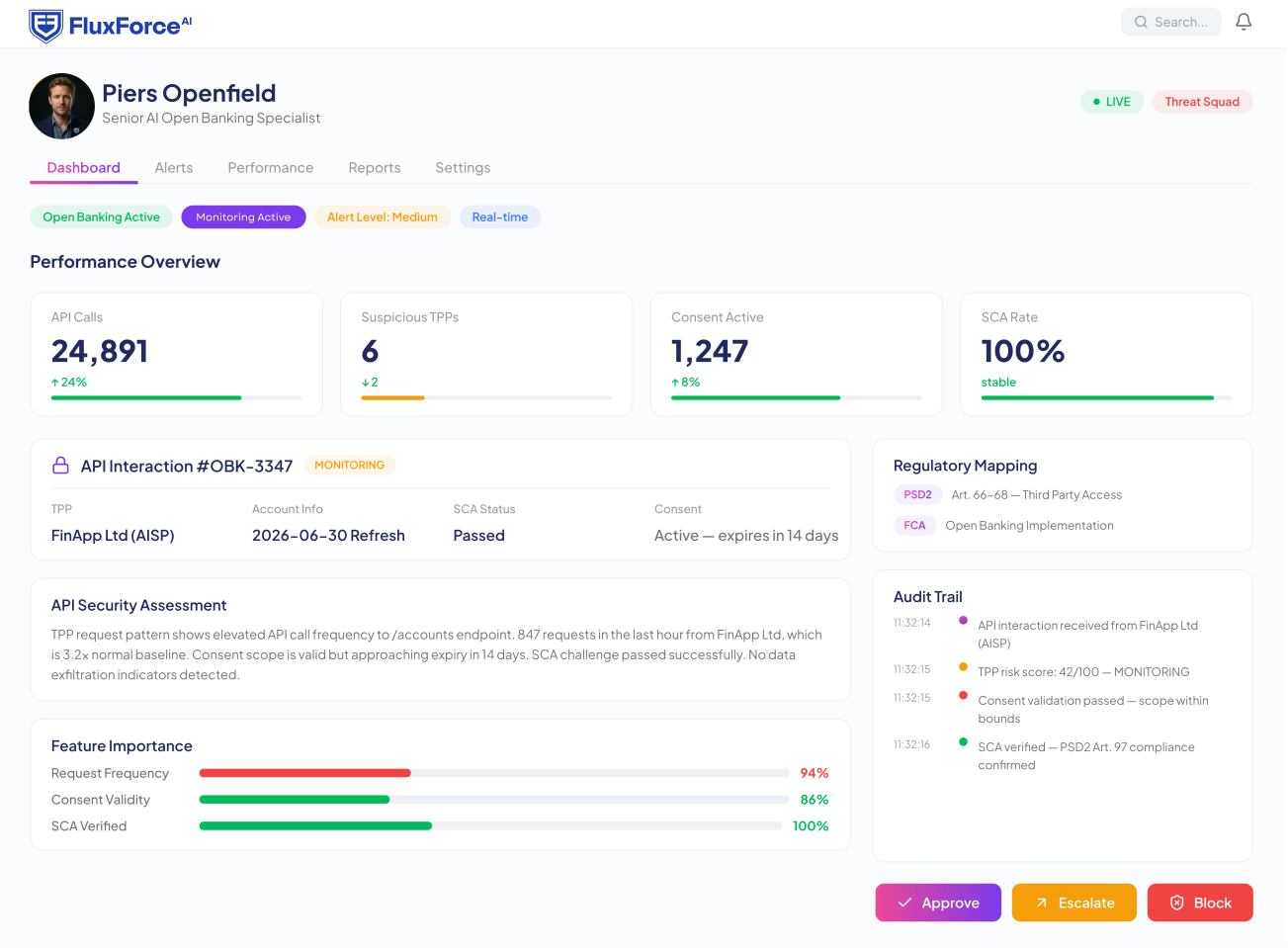
Open banking APIs expose your customer data to third parties — by regulation.But PSD2 compliance gaps, consent management complexity, and TPP onboarding risk create attack surfaces your current tools cannot monitor. Piers Openfield detects API abuse per endpoint, enforces 100% SCA compliance, and monitors consent violations in real time. Join the early access waitlist.
.png?width=2000&height=2000&name=11%20Piers%20Openfield_Hero%20section_superhuman%20image%20(1).png)
Senior AI Open Banking Specialist

Endpoint API Abuse Detection
SCA Enforcement Compliance
Consent Violation Detection
TPP Risk Scoring
Report Generation
Your open banking team manages dozens of third-party provider connections, each accessing customer data through APIs that must comply with PSD2 regulations. According to Gartner, API attacks increased by 300% in 2024 — and open banking APIs are prime targets.
Meanwhile, consent management complexity grows with every new TPP connection, and your team cannot verify in real time whether data access stays within consented boundaries.
Open banking mandates expose customer data through APIs. According to Gartner, API attacks increased 300% in 2024.Traditional perimeter security does not protect against authorized TPPs that abuse their API access — rate violations, screen scraping, and out-of-scope data requests.
Under PSD2, every data access must be within explicit customer consent scope and duration. According to the European Banking Authority, consent violations are a top enforcement priority. Manual consent tracking cannot scale with the volume of API calls across multiple TPP connections.
Every new TPP connection introduces risk. According to the FCA, financial institutions must conduct ongoing due diligence on registered TPPs. Manual risk assessment at onboarding misses behavioral changes over time — a TPP that was compliant at registration may not stay compliant.
JOB DESCRIPTION
Piers Openfield is a Senior AI Open Banking Specialist that operates inside your open banking infrastructure as a dedicated API security and consent management analyst.

Senior AI Open Banking Specialist | FF-BNR

Reports To
Your CTO / Head of Open Banking
Works With
Existing API gateways, consent management, and TPP onboarding
Deployed In
Phase 4 (development target Q1 2027)
KEY RESPONSIBILITIES
Detect API abuse per endpoint in real time using behavioral analysis and traffic pattern matching
Score third-party provider risk dynamically based on registration, behavior, and compliance
Enforce 100% SCA compliance for every regulated transaction and account access request
Monitor consent violations in real time — scope, duration, and purpose boundaries
Generate open banking compliance reports automatically for regulatory submissions
AUTONOMY MODEL
Low risk — Acts autonomously (allow, log)
Medium risk — HITL by default (configurable)
High risk — ALWAYS human review (non-negotiable)
You configure the threshold per TPP, per endpoint
Kill switch : Disable instantly
These metrics represent the production targets for Piers Openfield. Development begins Q1 2027.
Primary Layer: API gateway layer + Data access layer | Architecture : Designed and documented | Development : Planned Q1 2027
HOW IT WORKS
Piers Openfield connects to your existing open banking API gateway — no data migration, no core system changes. Here is how every API interaction flows:
Every API call from registered TPPs, aggregators, and internal services is ingested in real time. Piers Openfield reads API traffic logs, consent records, TPP registration data, regulatory configurations, and SCA challenge logs.
Each API request is scored against multiple risk dimensions: TPP authorization status, consent scope and duration boundaries, rate limit compliance, SCA requirements, and behavioral baselines.Third-party providers receive dynamic risk scores updated with every interaction.
Based on risk scores, Piers Openfield takes action:
• Low risk → Allows and logs autonomously
• Medium risk → Flags for review (configurable)
• High risk → Blocks and escalates to human team (always)
Consent violations are detected and alerted in real time.SCA enforcement is maintained at 100% for all regulated transactions.
Every decision — allow, flag, or block — produces:
• A plain-English explanation of the risk assessment
• Regulatory mapping (PSD2, PSD3, FCA, EBA, OBIE)
• Evidence chain with full API request/response context
• An immutable, tamper-evident audit trail
Compliance reports are generated automatically for regulatory submissions — minutes instead of days.
Piers Openfield is in architecture design. Join the waitlist to receive documentation, influence feature priorities, and be first to deploy when shadow mode testing begins.
AI open banking security requires deep regulatory integration across multiple jurisdictions and standards. Every decision Piers Openfield makes is mapped to the regulatory framework that applies.
Payment Services Directive 2, API access and SCA requirements
Upcoming Payment Services Directive 3 enhancements
UK Financial Conduct Authority open banking standards
European Banking Authority technical standards on SCA
Open Banking Implementation Entity standards (UK)
Explainable AI requirements for automated decisions
YOUR ANALYST'S VIEW
Every API call monitored. Every consent tracked. Every decision explained.
BEFORE vs AFTER
BEFORE PIERS OPENFIELD
AFTER PIERS OPENFIELD

ROI — AI OPEN BANKING SECURITY vs HIRING vs LEGACY TOOLS
How does Piers Openfield compare to hiring API security analysts or using legacy API management tools?
| Criteria | Hire 3 Analysts | Legacy API Management | Piers Openfield |
|---|---|---|---|
| Annual cost | $450K-$900K (salary + benefits) | $150K-$400K (license + maintenance) | TBD (Phase 4) |
| Deployment time | 3-6 months (recruit + train) | 3-6 months (integration) | 30 days (target) |
| API abuse detection | Manual log review | Basic rate limiting | Per-endpoint behavioral analysis |
| TPP risk scoring | Manual assessment at onboarding | Static risk categories | Dynamic, continuous scoring |
| Consent monitoring | Spreadsheet-based | Basic consent logs | Real-time violation detection |
| SCA enforcement | Manual validation | Partial automation | 100% automated enforcement |
| Explainability | Verbal, inconsistent | Limited API logs | Plain-English + regulatory mapping |
| Audit trail | Manual, scattered | Partial | 100% automated, immutable |
| Scales with TPPs | Hire more ($$) | License more ($$) |
Auto-scales |
| Regulatory reporting | Weeks of manual work | Semi-automated | Minutes, fully automated |
Key insight: According to Gartner, API attacks increased 300% in 2024, and open banking APIs are prime targets. The cost of an API security breach — regulatory fines, customer impact, and reputation damage — far exceeds the investment in continuous API security monitoring. Piers Openfield pricing will be announced during Phase 4 development.
Piers Openfield delivers maximum impact when paired with these FluxForce SuperHumans:
Secures the payment transactions that flow through the open banking APIs Piers monitors

Verifies identity and access for every user and TPP accessing open banking endpoints

Provides broader API security coverage beyond open banking endpoints that Piers monitors
Low risk: Piers acts autonomously (allow trusted TPPs, log standard calls).
Medium risk: HITL by default (configurable). High risk: Always human
review. You set the threshold per TPP, per endpoint, per consent scope.
Disable Piers Openfield instantly. No system impact. No downtime.One click.
Run Piers Openfield on your live API traffic for 30 days. Observation only — no blocking, no action. Validate accuracy before going live.
Every API security decision includes plain-English reasoning explaining the risk assessment, consent check results, and regulatory mapping. Your compliance team and regulators can read it directly.
Every decision logged with immutable, tamper-evident evidence chain. API call → consent check → TPP risk → action → outcome.
Gateway integration. Piers Openfield reads your existing API traffic. Your open banking infrastructure stays untouched.
Keep up with the latest AI trends, insights, and conversations.
Read Insights