.webp)








Listen to our podcast 🎧
Introduction
As an IT Security Director, how confident are you that least-privilege enforcement covers every privileged account in your bank, so no one could misuse it to move laterally or escalate privileges?
Today, this question has never been more critical. Banks are facing increasingly sophisticated attacks, and internal misuse remains one of the riskiest vulnerabilities. According to Kaspersky’s 2025 Security Bulletin, more than 1.3 million banking‑trojan attacks were detected across the financial sector worldwide—underscoring the sector’s continued exposure to large‑scale external malware threats, alongside growing risks from insider access abuse and supply‑chain compromise.
That’s why moving beyond perimeter security is essential. A zero trust security mindset ensures that trust is never assumed and when combined with least-privilege enforcement, it drastically reduces the risk of both external and insider-driven breaches. By giving users and systems only the access they absolutely need, and automating enforcement wherever possible, banks can strengthen their defenses while maintaining operational agility. FluxForce AI’s Zero Trust Security Solutions for Finance Cloud shows how continuous verification and adaptive access policies can support this approach.
Implementing least privilege zero trust automation is about rethinking how your teams interact with sensitive systems, how privileges are granted, and how risk is continuously monitored. For IT Security Directors, this shift can mean the difference between preventing an insider-driven breach and reacting after it happens.
Discover Zero Trust strategies for IT Security
Strengthen your bank’s security with least-privilege enforcement

Understanding Least-Privilege Enforcement in Banking
It usually starts with a simple question. Who actually needs access to what in your bank’s environment? When every user has more permissions than required, the risk surface expands overnight. This is where the principle of least privilege (POLP) becomes the foundation of modern security.
In the banking world, least-privilege enforcement ensures that each employee only gets the exact level of access needed to perform their tasks. Nothing extra that could potentially be misused. It sounds straightforward, yet for many financial institutions this shift from legacy permission models is a major cultural and operational upgrade.
Why IT Security Directors Focus on POLP ?
Artificially broad access creates two major concerns: security and accountability. Applying a structured Zero Trust least-privilege model for banks delivers measurable improvements across all three threat vectors:
• Strengthen insider threat mitigation by controlling what users can reach
• Improve privilege escalation detection because unexpected access becomes visible instantly
• Boost lateral movement prevention if credentials are compromised
Banks cannot afford silent access creep. A security director’s job becomes far easier when access decisions align with identity-centric security principles.
Implementing Zero Trust Architecture with Least-Privilege Enforcement in Banking
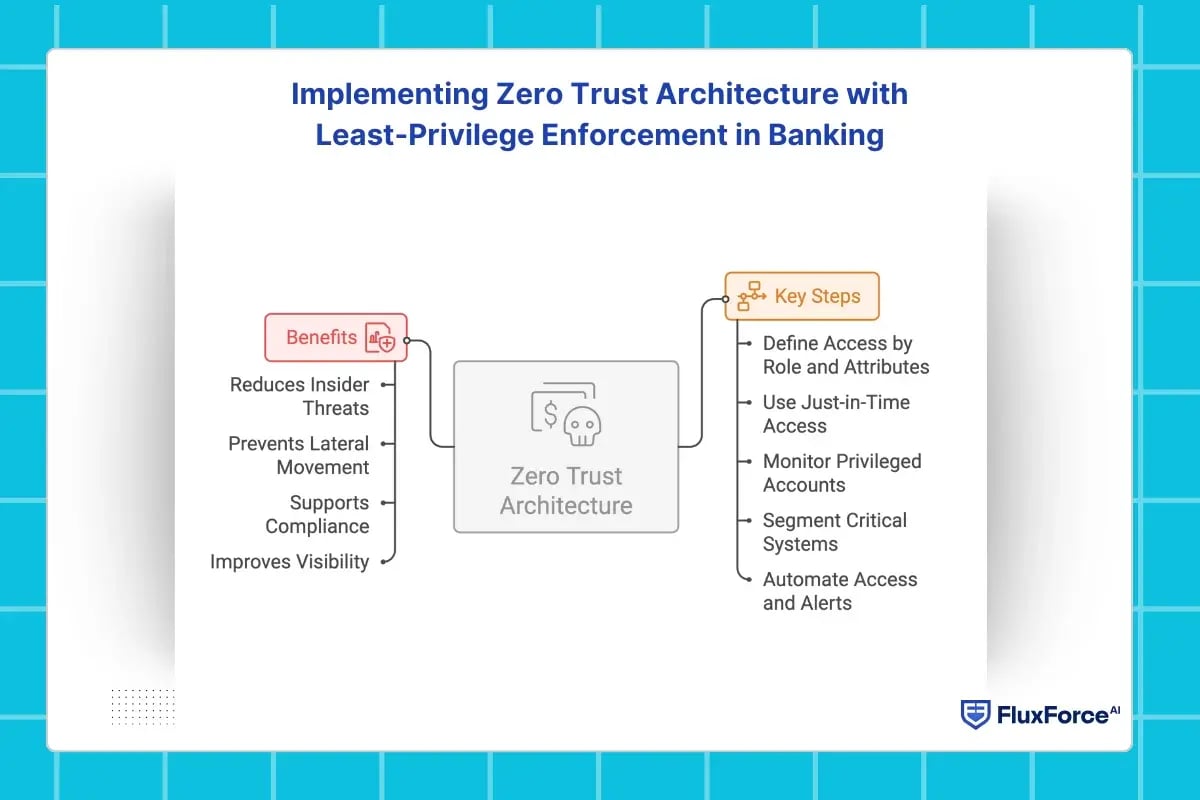
In today’s banking environment, protecting sensitive data and critical systems requires more than a strong perimeter. The focus has shifted to controlling access at every level. This is the essence of a Zero Trust architecture banking strategy combined with least-privilege enforcement. For IT Security Directors, this strategy ensures that only the right people can access the right resources at the right time, reducing risk while maintaining operational efficiency.
Zero Trust operates on a simple but powerful idea: no user or system is trusted by default. Every access request is verified before granting permission. By adding least-privilege zero trust automation, banks can automatically manage access, limit unnecessary privileges, and monitor user activity to prevent misuse. This approach strengthens security and supports regulatory compliance.
Breaking Zero Trust into Practical Steps for Banks
Even complex banking systems can adopt Zero Trust in manageable ways. Here are key steps simplified for practical use:
1. Define Access by Role and Attributes: Use Role-based access control (RBAC) and Attribute-based access control (ABAC) to assign permissions based on actual job responsibilities rather than assumptions.
2. Use Just-in-Time Access: Implement JIT access to provide temporary privileges only when needed. Once the task is done, access is removed automatically.
3. Monitor Privileged Accounts: With Privileged access management (PAM), IT teams can continuously track high-level accounts and quickly detect unusual activity.
4. Segment Critical Systems: Apply Zero Trust network segmentation to separate sensitive systems. Even if an attacker gains access, they cannot move freely across the network.
5. Automate Access and Alerts: Combine automated access provisioning, behavioral access analytics, and continuous authentication. This ensures policies are enforced consistently and unusual behavior is detected quickly.
Benefits for IT Security Directors
When applied effectively, this strategy provides multiple benefits:
- Reduces insider threats and privilege escalation
- Prevents lateral movement within the network
- Supports financial services access governance and compliance with regulations like SOC 2 access control or RBI cybersecurity framework .
- Provides clear visibility for audits and improves incident response times
Adopting a Zero Trust least-privilege model for banks allows IT Security Directors to focus on real threats while routine access management is automated and secure. This approach balances safety with operational efficiency and makes compliance easier to maintain.
How IT Security Directors Can Manage Threats and Risks ?
Implementing least-privilege enforcement within a Zero Trust strategy addresses the most critical risks banks face. Insider threats, privilege escalation, and credential misuse represent ongoing challenges that directly compromise sensitive systems. By applying behavioral access analytics, monitoring high-risk accounts, and enforcing Zero Trust network segmentation, IT Security Directors limit access to only what is necessary and detect unusual activity significantly faster.
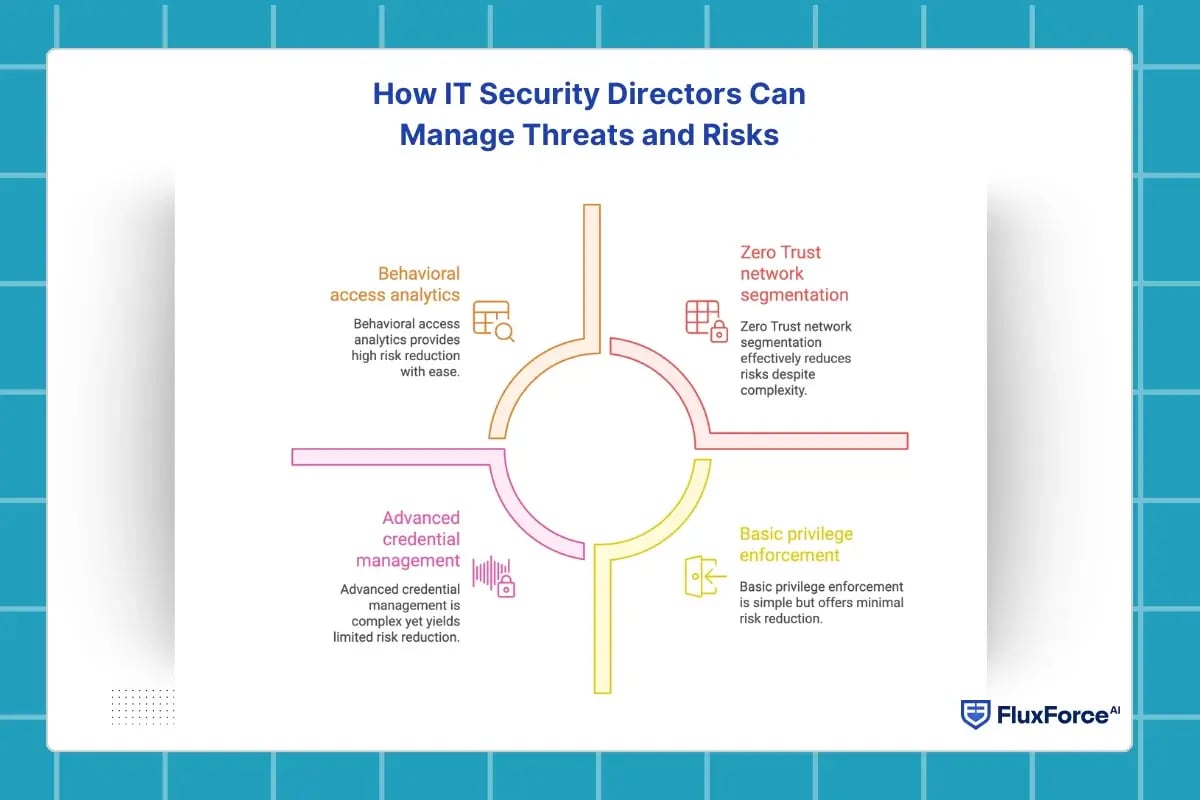
This strategic approach not only reduces the chance of internal and external breaches but also simplifies compliance with frameworks like SOC 2 access control and PCI DSS access management, while allowing security teams to focus on real threats rather than managing excessive privileges.
How IT Security Directors Can Implement Least-Privilege Zero Trust Effectively ?
Planning a least-privilege Zero Trust strategy is one thing — executing it requires a structured approach. IT Security Directors make the process manageable by focusing on implementation steps rather than theory.
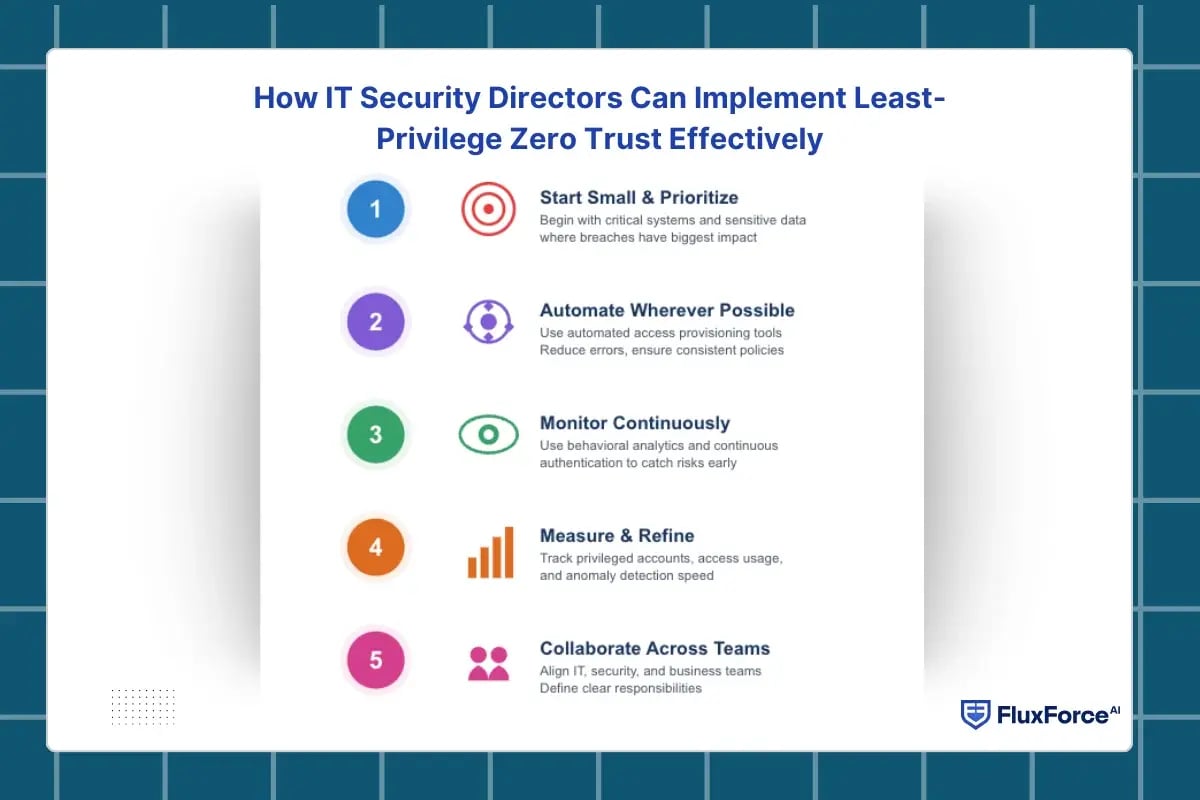
Start small and prioritize critical systems: Begin with the most sensitive applications and data, where a breach would have the biggest impact. Apply least-privilege enforcement there first, then gradually expand across the bank.
Automate wherever possible: Use tools that allow automated access provisioning, so permissions are granted and removed without manual intervention. This reduces errors and ensures policies are consistently applied.
Monitor continuously: Even after access rules are set, use behavioral access analytics to spot unusual activity, and continuous authentication to confirm users remain who they say they are. This makes the system proactive, catching risks before they escalate.
Measure and refine: Track metrics like how many privileged accounts exist, how often temporary access is used, and how quickly anomalies are detected. Use this information to improve policies and tools over time.
Collaborate across teams: Implementation works best when IT, security, and business teams are aligned. Define responsibilities clearly, so everyone knows who approves access, monitors activity, and responds to alerts.
With this practical approach, IT Security Directors can turn a Zero Trust least-privilege strategy into a working system that protects critical banking systems while keeping operations efficient.
Conclusion
Basel IV is reshaping how banks prove capital sufficiency and risk discipline. The institutions that succeed will be those that replace static reports with intelligent compliance frameworks for banks. AI and automation create transparency from source data to supervisory submission, eliminating uncertainty in control results and exposure calculations.
This progression ensures CRO digital compliance strategy is no longer dependent on manual heroics but on reliable, scalable systems. As reporting friction reduces, leadership gains faster decision support and regulators receive cleaner, more confident disclosures. The result is a stronger, more predictable compliance posture that grows stronger with every iteration.
Related guidance from FluxForce’s Zero Trust Security Architecture Strategy for Risk Head in Banking expands on how banks can operationalize this model at scale.


Share this article