.webp)







Listen To Our Podcast🎧
Introduction
How can security leaders trust AI decisions when 68% of access denials don’t provide a clear reason, per CSA 2025 report?
Companies rely on continuous authentication and identity and access management (IAM) to keep systems safe. When an AI system denies a privileged user access mid-session or flags a routine API call as high-risk, security teams need more than a risk score. They need a reason. Without it, SOC analysts override decisions blindly, audit trails collapse, and Zero Trust becomes a liability rather than a control.
Explainable AI closes that gap. It does not change how Zero Trust enforces access — it changes whether the people responsible for security can understand, defend, and improve those decisions. That distinction matters most when regulators ask questions that a risk score cannot answer.
XAI enhances biometric authentication in digital banking
boosting security and trust with FluxForce AI

Zero Trust Access Management with Explainable AI
Why Zero Trust Access Management Fails Without AI Transparency ?
Zero trust access management ensures every user, device, and session is verified before access is granted. Traditional AI-based access control returns a risk score — approved or denied — with no explanation attached. For CISOs presenting to boards or responding to regulators, that is not a defensible position. One unexplained denial during an audit can trigger a full model review. .webp?width=1200&height=800&name=zero%20trust%20security%20(2).webp)
AI-Powered Access Decisions
Modern AI-based access control systems analyze billions of signals in real time. By using zero trust authentication frameworks with explainable AI (XAI), organizations can enforce dynamic policies while making decisions understandable. Industry case studies and vendor research suggest that explainable AI can significantly reduce false positives and speed up alert resolution in Zero Trust environments.
Interpretabl e AI for Continuous Authentication
XAI supports continuous authentication by explaining why access is granted or revoked in real time. For instance, if a session is blocked, XAI highlights the risk factors that triggered the denial, allowing teams to act confidently and reduce unnecessary overrides. This strengthens zero trust security with AI explainability and ensures compliance with regulatory requirements.
Practical XAI Use Cases in Zero Trust
With XAI, AI-driven access decisions gain traceable audit trails. Security teams can use real-time dashboards to see the reasoning behind approvals and denials. These XAI use cases in zero trust architecture help reduce blind spots, improve decision-making, and maintain trust in AI-powered security.
Let’s explore how continuous authentication and XAI together prevent lateral movement and enhance enterprise-wide security.
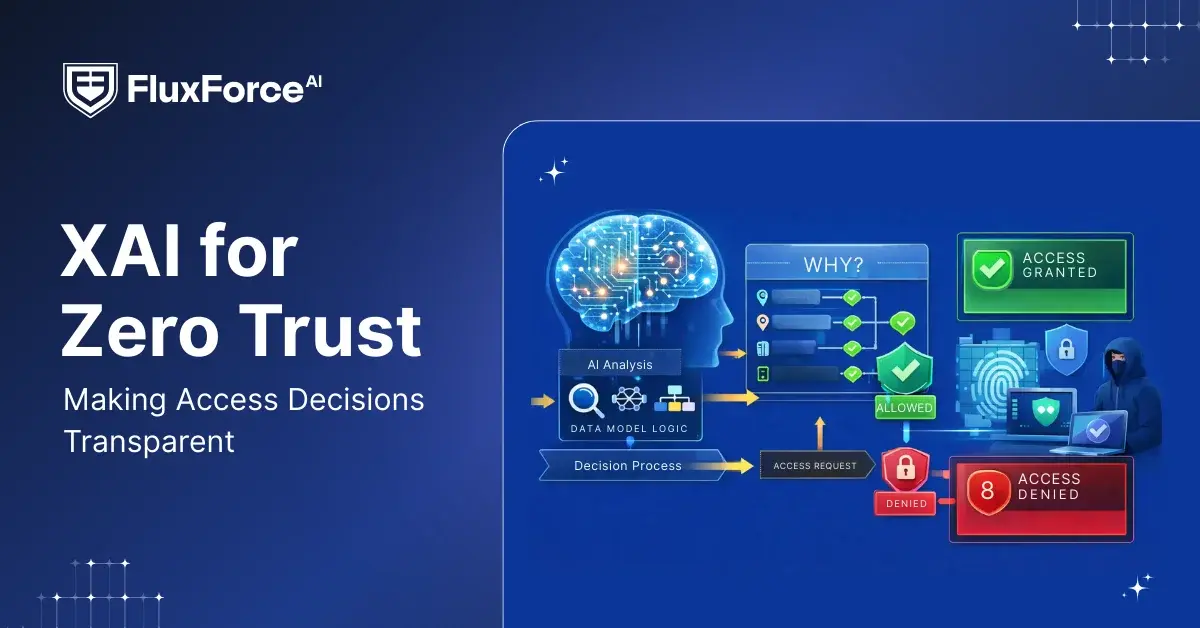
How XAI Makes Zero Trust Access Decisions Transparent ?
If Zero Trust decides access every second, who explains those decisions?
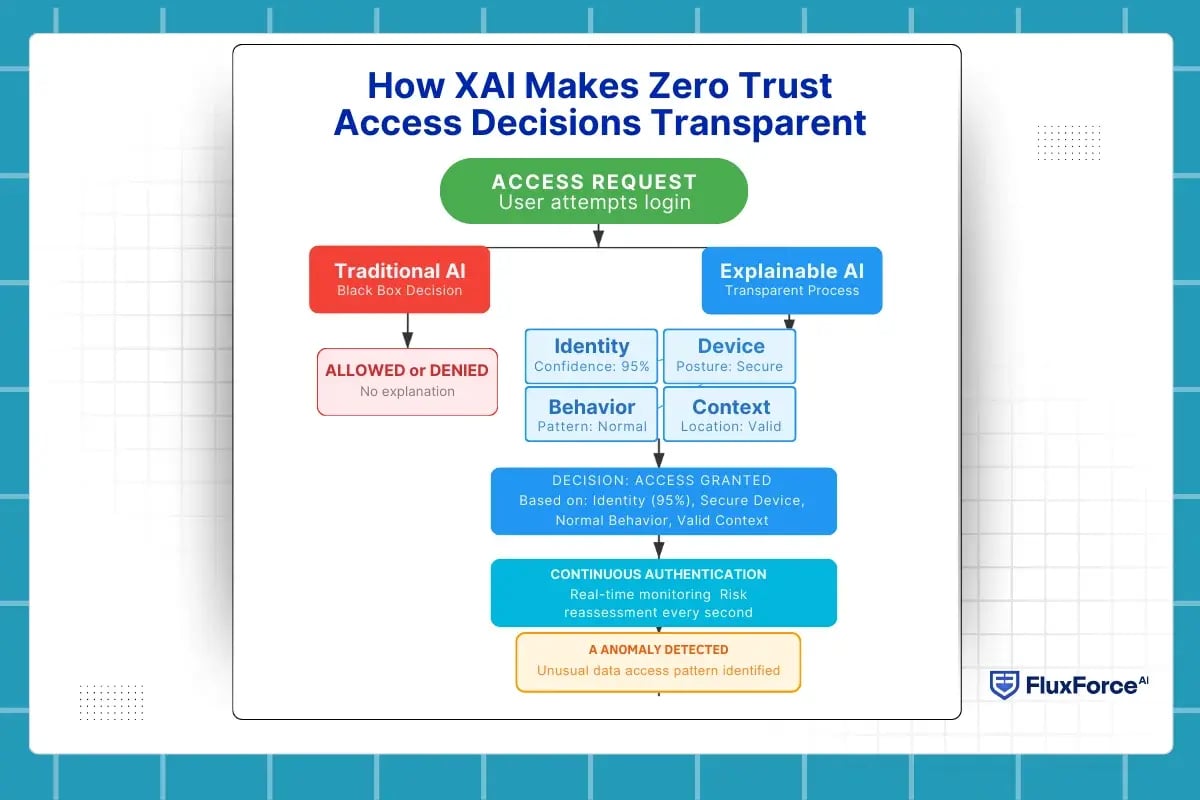
In a zero trust architecture, access is never permanent. Every request is evaluated in real time using AI in cybersecurity, across identity, device, behavior, and context. This makes enforcement scalable, but it also introduces a visibility gap.
Zero trust access control systems are designed to answer one question — was access allowed or denied? But that is never the question that matters during an incident review, an compliance audit, or an SOC escalation. The question that matters is why. Without that answer, security teams are enforcing rules they cannot explain.
From Black-Box Decisions to Transparent Access Control
Traditional AI-based access control relies on complex models that output risk scores. These scores drive decisions but rarely explain themselves.
With explainable AI in cybersecurity, access decisions are no longer opaque. XAI breaks down each decision into clear contributing factors, such as:
- Identity confidence level
- Device posture changes
- Abnormal session behavior
- Policy thresholds crossed during evaluation
This shift enables transparent AI decision making, where security teams can clearly see what influenced an access outcome.
That transparency is foundational to zero trust security, because decisions are made continuously, not just at login.
Transparency Across Continuous Authentication
In the zero trust model, access decisions evolve throughout a session. Continuous authentication constantly reassesses risk, often revoking or limiting access mid-session.
Without explanation, mid-session revocations look like system errors to analysts — and get overridden as such, even when the underlying risk signal was genuine.
XAI brings visibility to continuous authentication, showing:
- What changed during the session
- Which risk signals increased
- Why access was downgraded or revoked
This level of insight strengthens AI transparency in identity access management (IAM) and ensures that access enforcement remains understandable and defensible.
Why Transparent Access Decisions Define Zero Trust Maturity ?
When access decisions are transparent: Security teams respond faster because they understand what triggered the alert, not just that it fired. False positive rates drop as analysts can distinguish genuine risk signals from model noise. Manual overrides decrease because decisions are backed by visible reasoning teams can trust. Compliance reviews become simpler because every access decision carries its own audit trail by default.
The Future of XAI in Zero Trust: Core Innovations and Strategic Impact
The future of zero trust security depends on integrating AI in cybersecurity not just for enforcement but for transparency and insight. Today, AI makes millions of access decisions across users, devices, and sessions. But without AI transparency, organizations risk blind enforcement, audit failures, and eroded trust in their zero trust architecture.
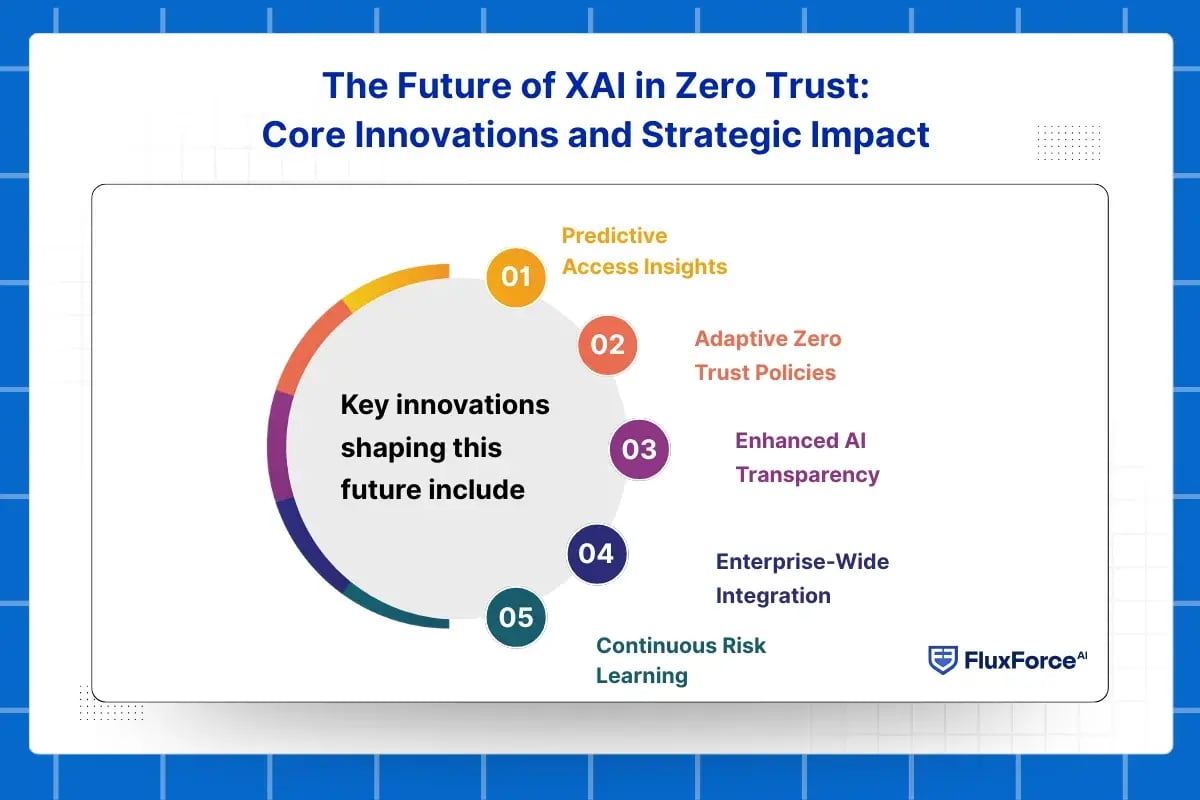
Explainable AI (XAI) is set to redefine the zero trust model by embedding clarity into every decision. Instead of just approving or denying access, future XAI-driven systems will show exactly why a request was flagged, tying it to identity confidence, device posture, behavioral signals, and policy thresholds. This level of insight strengthens security teams’ ability to act decisively while maintaining compliance.
Key innovations shaping this future include:
- Predictive Access Insights: Using AI in cybersecurity, XAI will predict high-risk access attempts before they happen, allowing proactive interventions within zero trust security frameworks.
- Adaptive Zero Trust Policies: By analyzing access patterns continuously, XAI will guide dynamic tuning of zero trust architecture, ensuring policies are optimized without manual intervention.
- Enhanced AI Transparency: Every decision within the zero trust model will be interpretable, giving security teams, auditors, and executives confidence in automated enforcement.
- Enterprise-Wide Integration: Future XAI systems will unify cloud, endpoint, and operational environments, making AI transparency standard across zero trust access management.
- Continuous Risk Learning: XAI will support learning from anomalous behaviors, enabling security teams to refine rules and detect emerging threats before breaches occur.
By focusing on the core of transparent, explainable AI in Zero Trust, organizations can transform enforcement into an intelligent, auditable, and adaptive system. Making AI access decisions transparent ensures that the zero trust model scales securely while maintaining trust across users, teams, and stakeholders.
XAI enhances biometric authentication in digital banking
boost security and trust with FluxForce AI
Conclusion
The future of zero trust security relies on AI transparency and explainable access decisions. XAI use cases in zero trust architecture are transforming enforcement into proactive risk management. Organizations implementing AI-driven access control can anticipate threats, optimize zero trust authentication frameworks, and maintain scalable, auditable, and transparent security. In future, explainable AI will be the cornerstone of resilient, trusted Zero Trust systems —paving the way for Zero Trust Construction using Agentic AI Agents, where security becomes autonomous, adaptive, and continuously evolving.
Share this article