.webp)




.webp)
Listen To Our Podcast🎧
.png)
Introduction
The Chief Risk Officer can't defer responsibility for a decision the model made at 2:47am on a Tuesday. That's the operational reality banks accepted the moment they put AI in the credit approval path.
Statistical correctness at validation doesn't equal operational reliability at 3 million transactions a day. A model that passed every validation test can start treating similar customers differently as conditions shift.
|
Observation |
Traditional Governance |
Real-Time Reality |
|
Decision Speed |
Weekly/Monthly review |
Milliseconds per transaction |
|
Accountability |
Risk committee |
CRO on the line immediately |
|
Data Change |
Stable historical data |
Dynamic, multi-source feeds |
Approval is not immunity
Models get validated and approved. Then conditions move. Post-campaign, new customer segments arrive with spending patterns that don't match the training data. Merchants enter and exit card networks. Credit bureau attributes update on feeds the model never saw during validation. Statistical correctness at validation doesn't equal operational reliability at 3 million transactions a day. A model that passed every validation test can start treating similar customers differently as conditions shift.
Outcomes without explainability create exposure
Banks typically monitor aggregate metrics: fraud rates, false positive ratios, approval volumes. None of those numbers show why a specific transaction was flagged at 11:23pm last Thursday. When regulators or internal audit request reasoning, the institution must trace the path. Without AI explainability, the bank can't show an examiner why the model made a specific decision. That's not a theoretical risk. It's a model risk management finding, and under SR 11-7, it's been a compliance expectation since 2011.
Fragmented ownership, unified accountability
- Risk sets appetite and thresholds.
- Technology runs pipelines and feature logic.
- Business manages customer relationships and remediation.
Drift often emerges at the intersection of these responsibilities. The CRO is accountable for outcomes, yet the evidence is dispersed across functions, systems, and logs.
The hidden early warning
A model can pass every accuracy test while treating similar customers differently. Headline metrics stay green. Operational risk accumulates in the background. By the time a regulator or internal audit asks "why did this customer get flagged and that one didn't," the answer has to come from somewhere. SR 11-7 and the EU AI Act both require that answer to exist before the question is asked.
Understanding drift requires moving beyond symptoms. Next, we are going to dissect how to detect model drift in real time, separating concept drift vs data drift, and explaining why early detection is critical before operational risk escalates.

How to Detect Model Drift in Real Time ?
Model drift doesn't announce itself. A fraud model can hold its aggregate detection rate while quietly missing an entire category of synthetic identity fraud that emerged six months after training. The headline metric looks fine. The exposure is growing.
That's what makes real-time drift detection hard: you're not watching for a model to fail. You're watching for it to succeed at the wrong thing.
Catching it early is the difference between a threshold adjustment that takes an afternoon and a model retraining cycle that takes six weeks.
-1.webp?width=2400&height=1600&name=ai%20regulation%20future%20(3)-1.webp)
Two types of drift
Drift generally occurs in two ways:
- Data drift – shifts in the distribution of input features. For example, during a regional festival, transaction volumes and amounts increase, altering patterns the model expects.
- Concept drift – changes in the relationship between features and outcomes. Fraudsters adopting new tactics can render historical patterns less predictive, even if feature distributions remain stable.
Practical detection strategies
Effective detection combines three practices:
Tracking input feature distributions on a rolling 30-day window — when a feature like transaction amount or device type shifts materially from its training distribution, that's the first signal.
Setting PSI (Population Stability Index) thresholds at 0.1 for warning and 0.25 for action. These are the thresholds most model risk teams use, though calibration depends on portfolio volatility.
Comparing model output score distributions to baseline daily. A shift in the score distribution's mean or variance is often visible before prediction errors appear in outcomes data.
|
Drift Type |
What to Monitor |
Banking Example |
|
Data drift |
Input feature distributions |
Sudden spike in small-value transactions during a festival |
|
Concept drift |
Feature-to-outcome relationships |
Fraud detection model flags atypical transaction sequences |
Real-world application
To illustrate: during a regional retail event, a fraud monitoring engine started scoring low-value transactions as higher risk than expected. Aggregate detection rates were unchanged, which is why standard reporting missed it. Real-time distribution monitoring caught the shift — transaction amounts for that merchant category had moved outside the model's trained range. The team adjusted risk thresholds within the event window rather than after it closed.
Regulatory perspective
The OCC, Fed, and FCA have been asking for decision-level traceability for years. What's changed is that AI-specific guidance — SR 11-7 model risk management, EU AI Act Article 13, DORA operational resilience requirements — now explicitly names explainability as a documentation standard, not just a best practice. Linking drift detection to a documented intervention procedure is what turns a technical capability into regulatory evidence.
Explainable AI for Regulatory Compliance
When an OCC examiner asks why the model declined a specific applicant, "our aggregate approval rate is within policy" isn't an answer. That's the compliance gap aggregate metrics create. SR 11-7 has required model-level documentation since 2011. The EU AI Act adds documentation requirements for high-risk systems that went into effect in 2024. Explainable AI for regulatory compliance allows institutions to demonstrate why a specific decision occurred, providing transparency to internal audit, boards, and supervisory authorities.
In AML monitoring, an alert without an explanation forces the investigator to start from scratch on every case. With explainability, the investigator sees: transaction amount is 340% above the account's 90-day average, counterparty is a jurisdiction flagged under FATF guidance, and this is the third structuring-pattern transaction in 72 hours. That's a case narrative, not a score. The investigator confirms or dismisses in minutes rather than hours, and the rationale is already documented for SAR filing.
Explainability also changes how governance works in practice. When every decision has a traceable rationale, risk committees aren't reviewing aggregate dashboards — they're reviewing specific decisions that deviated from expected behavior. That's a fundamentally different oversight conversation. For internal audit and for regulators, it means the evidence exists before the request arrives, not after.
Preventing AI Model Drift in Production
Drift prevention is something that should be designed into production from day one. The three components that make it work in practice: continuous monitoring that doesn't depend on human-initiated review cycles, intervention thresholds defined before deployment (not negotiated after an anomaly appears), and a governance chain that knows who acts when an alert fires.
Continuous Monitoring in Practice
Banks running production monitoring typically track three things in parallel: input feature distributions (to catch data drift), output score distributions (to catch model behavior changes before outcome errors appear), and decision consistency across similar customer profiles (to catch fair treatment issues). Alerts fire when PSI or KS statistics exceed defined thresholds. The team that receives the alert needs to know their role before the alert arrives — not figure it out when it does.
For instance, a payments fraud detection model may start flagging low-risk transactions at unusual rates. Early detection allows threshold adjustments or targeted retraining without compromising compliance or operational continuity.
Explainability as a Control Mechanism
Without explainability, you can see that outcomes changed. You can't tell whether the change is driven by a real behavioral shift in the customer base or by model drift. That distinction determines whether the right response is a threshold adjustment or a full retraining cycle — which is a six-week process in most banks. Getting it wrong wastes resources and potentially misses the actual problem.
Governance and Oversight
Drift prevention is embedded in the model risk framework. Oversight committees review alerts, approve interventions, and document remediation actions. This approach ensures that machine learning model monitoring is integrated into the institution’s control structure, linking operational decisions to policy, risk appetite, and compliance obligations.
Maintaining Model Stability in Dynamic Environments
The combination of continuous monitoring and explainability doesn't just catch drift faster. It changes what governance means in practice: from periodic review of whether models are performing to real-time visibility into why they're performing the way they are. That's a different standard of accountability — and one regulators are starting to expect by default.
Real-Time Risk Engines Using AI
Batch processing runs overnight. A card fraud decision happens in under 200 milliseconds. That gap isn't a technical preference — it's the operational reality that made real-time risk engines necessary. The question isn't whether to run AI in real time. It's how to govern it when you do.
-1.webp?width=2400&height=1600&name=ai%20regulation%20future%20(2)-1.webp)
Framework for Operational Integration
Production integration for a real-time risk engine typically involves four control layers:
- Data ingestion validation — checking input streams for missing fields, distribution shifts, or corrupted records before they reach the model. A bad input produces a confident wrong output. Catching it upstream is cheaper than explaining the decision downstream.
- Decision logic oversight — mapping model outputs to pre-approved policy thresholds so that an automated approval or block actually reflects current risk appetite, not the risk appetite from six months ago when the model was last calibrated.
- Performance monitoring loops — tracking score distributions and outcome rates in near real time, not at the next weekly review.
- Governance logging — recording every threshold change, override, and intervention with the reason, the approver, and the timestamp. This is what "audit trail" means in practice.
This framework ensures that AI engines are both high-speed and controlled, reducing operational and conduct risk.
Monitoring Drift in Live Models
Even in real-time operations, models are vulnerable to model drift in real-time machine learning systems. Banks monitor both data drift (changes in input feature distributions) and concept drift (changes in the relationship between features and outcomes). Metrics are continuously evaluated using sliding windows or statistical divergence measures. When deviation exceeds defined thresholds, risk teams analyze the source, recalibrate features, or retrain models.
To illustrate: during a seasonal surge in cross-border transfers, a payments monitoring engine flagged a higher-than-expected volume of low-risk transactions. The aggregate alert rate hadn't changed significantly. But real-time distribution monitoring showed that the transaction amount distribution for that corridor had shifted materially — a data drift signal, not a fraud signal. The team recognized it as a seasonal pattern and adjusted thresholds for that transaction type rather than escalating to a model retraining cycle.
Governance and Decision Assurance
Explainability is embedded within governance processes. Teams document why each automated decision is made, linking outcomes to model rationale, thresholds, and risk policies. This aligns with explainability in financial risk models, providing both operational teams and auditors a clear rationale for every decision.
Technical Oversight Framework
Banks often deploy layered monitoring for production models:
- Feature-level monitoring: Track input distribution shifts and missing values.
- Outcome-level monitoring: Evaluate model outputs against historical baselines.
- Alert management: Escalate anomalies to risk owners with documented analysis.
- Periodic retraining or recalibration: Ensure models adapt without violating governance rules.
These layers form a structured approach to managing real-time risk engines using AI, ensuring robustness, regulatory defensibility, and operational resilience.
How to Monitor AI Models for Accuracy and Compliance ?
Continuous Oversight
Model monitoring has one job: catch behavioral changes before they become compliance findings or financial losses. In credit scoring, fraud detection, and AML, the stakes are high enough that "we noticed it in the quarterly review" isn't an acceptable answer.
Key Areas to Monitor
Effective monitoring focuses on four main areas:
-
- Prediction Accuracy – Compare model results to actual outcomes or approved benchmarks. This quickly highlights when scores or classifications are off.
- Input Data Stability – Watch for changes in customer or transaction data, missing fields, or shifts in patterns, which could indicate data drift.
- Outcome Consistency – Check that model decisions align with the bank’s risk limits and policies. Sudden changes may show concept drift or unusual operational patterns.
- Operational Performance – Track processing speed, errors, and system performance to ensure decisions happen on time and without technical issues.
Banking Scenario
To illustrate: a retail credit scoring engine started approving thin-file applicants at a higher rate following a new marketing campaign targeting a previously underrepresented segment. The applicant profile was different enough from the training data to shift score distributions measurably. Monitoring caught the distribution shift within two weeks. The response was a threshold adjustment for that segment and a targeted retraining cycle — not a full model rollback. No examination findings, no credit losses from the affected cohort in the 90-day follow-up window.
Governance and Compliance
Monitoring is also about control and accountability. Risk, compliance, and model oversight teams need to see key performance numbers, understand any adjustments made, and keep records of why actions were taken. Combining monitoring with explainable AI for risk management helps auditors and supervisors see the reasoning behind each decision.
Structured Oversight Approach
Banks use a layered approach to make monitoring effective and reliable:
- Real-time alerts: Trigger notifications when predictions or input patterns deviate from expectations.
- Regular audits: Review outputs against past data and risk policies.
- Governance documentation: Record all model changes, approvals, and justifications.
- Feedback loops: Feed insights back into model updates to prevent AI model drift.
This approach ensures models remain accurate, traceable, and compliant, forming a strong foundation for AI risk management.
How Explainable AI Reduces Model Drift ?
Detecting drift is only part of the challenge. The harder part is knowing what to do about it — and whether what you're seeing is drift or just normal behavioral variation. Explainability answers that question directly. When you can see which features shifted and by how much, you can distinguish a threshold calibration problem from a model retraining problem. The difference in response time is measured in days versus weeks.
Early Identification of Emerging Risk Patterns
Explainability provides insights that metrics alone cannot:
- Feature contribution analysis: Identifies which variables most influence outcomes.
- Decision logic transparency: Shows why specific transactions or applications receive certain scores.
- Proactive alerts: Shifts in explanation patterns can signal emerging drift before prediction errors rise.
Governance and Compliance Benefits
The governance benefit is specific: when a risk committee reviews AI behavior, they shouldn't be looking at aggregate dashboards. They should be looking at a sample of decisions where the explanation diverged from expected behavior. That's the conversation that prevents regulatory findings — not the one that happens after them. For a practical framework on what that documentation looks like, see Decision Context Objects: The Artifact Regulators Actually Want.
Banking Scenario
A retail credit model began approving higher-than-expected thin-file applicants. Explainable AI revealed that a new customer attribute from a marketing campaign was influencing scores disproportionately. Risk teams recalibrated thresholds before any defaults occurred, preventing drift from impacting operations or compliance.
Regulatory Perspective
The regulatory direction is clear. SR 11-7, EU AI Act Article 13, and DORA's operational resilience requirements all point toward the same standard: decisions need explanations, not just outcomes. That standard was best practice five years ago. It's documentation requirement now.
Common Mistakes Banks Make When Managing AI Risk in Real-Time Systems
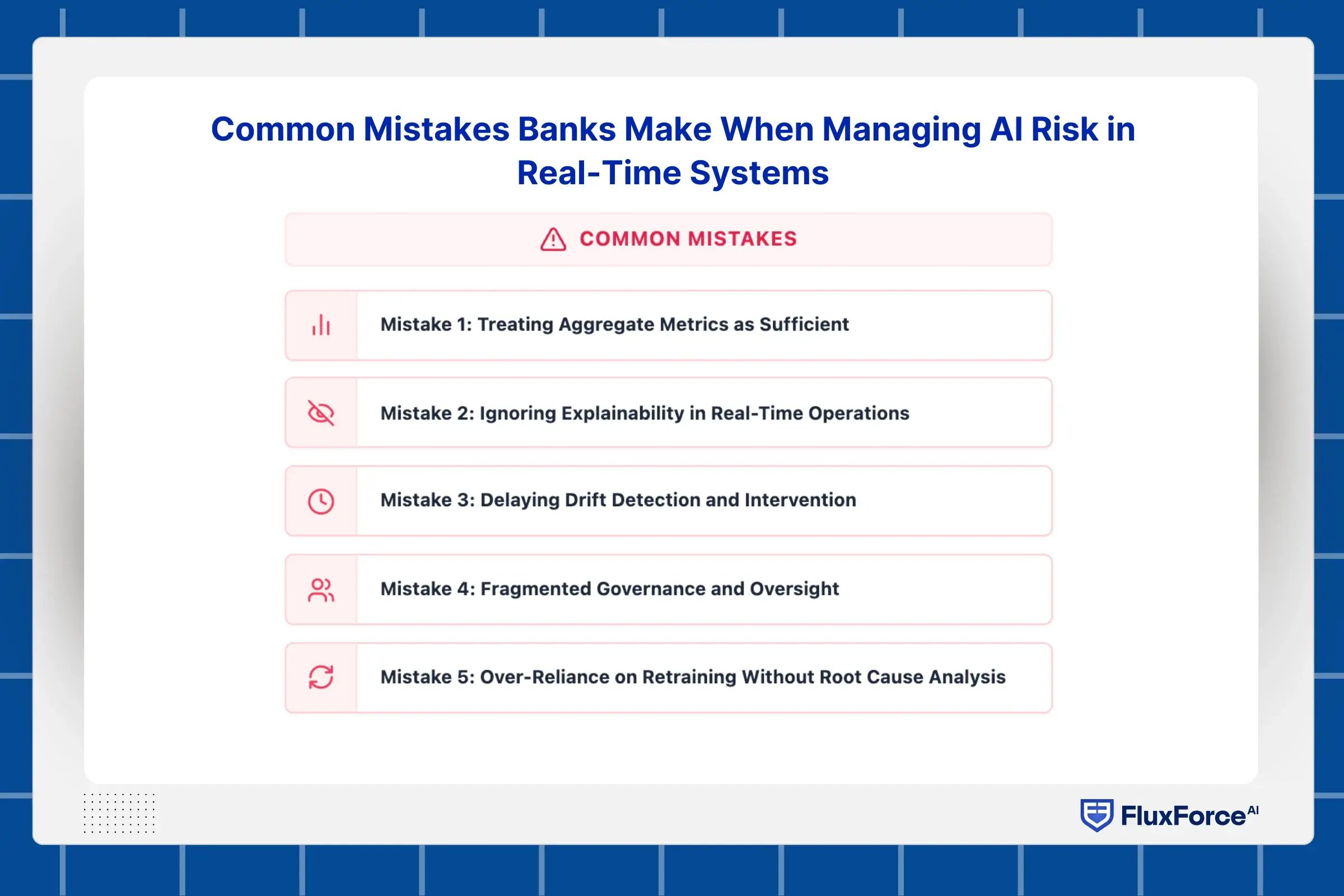
Mistake 1: Treating Aggregate Metrics as Sufficient
A model with a stable 94% detection rate can simultaneously be missing an entire fraud typology that emerged in the last 90 days. The aggregate metric looks fine. The exposure is growing. When the OCC examiner asks about specific declined transactions from that period, the aggregate dashboard won't answer the question.
Mistake 2: Ignoring Explainability in Real-Time Operations
When an auditor or examiner asks why a specific customer was flagged, "the model scored it high" isn't documentation. It's a gap. Under SR 11-7, model risk management requires that decisions be traceable to the inputs and logic that produced them. Building that traceability into the production workflow is less expensive than reconstructing it under examination pressure.
Mistake 3: Delaying Drift Detection and Intervention
Drift accumulates daily. A weekly review cycle means up to seven days of decisions made under a drifting model before anyone notices. In high-volume systems — a bank processing 500,000 card transactions daily — that's 3.5 million decisions between review cycles. Real-time monitoring doesn't eliminate review cycles. It means the review is investigating confirmed anomalies, not searching for them.
Mistake 4: Fragmented Governance and Oversight
Technology sees the monitoring alert. Risk owns the model. Compliance owns the documentation. Without a defined escalation path that names who acts and within what timeframe, alerts sit in inboxes. In practice, the most common governance failure isn't missing the drift — it's detecting it and then not acting on it because nobody's role was clear.
Mistake 5: Over-Reliance on Retraining Without Root Cause Analysis
Data drift usually calls for threshold recalibration. Concept drift usually calls for model retraining, a process that takes weeks and requires a full validation cycle. Treating every drift signal as a retraining trigger wastes months of model risk capacity annually and can introduce new instability into a model that only needed a threshold adjustment. The diagnosis matters as much as the detection.
XAI boosts ROI for AI investments in banking
by enhancing transparency, trust, and decision-making.
Conclusion
The banks that handle regulatory AI scrutiny well aren't necessarily the ones with the most sophisticated models. They're the ones whose models come with evidence — decision rationale, drift monitoring records, documented interventions. That's what SR 11-7 has always asked for and what the EU AI Act is now codifying.
Real-time risk engines don't change the standard. They raise the volume of decisions that need to meet it.
FluxForce is an Agentic OS for Regulated Industries. We built our financial security agents — fraud detection, AML monitoring, compliance reporting — with explainability and drift monitoring as defaults, not add-ons. If you're managing a model risk program at a mid-size bank and the gap between your monitoring capability and your regulatory obligations is keeping the CRO up at night, that's the specific problem we built for. Book a 30-minute session to see how the evidence layer works in practice.

Share this article