


















Listen To Our Podcast🎧
Introduction
In a recent regulatory and risk management survey, nearly 42% of financial institutions are still relying on spreadsheets and manual processes for compliance tracking.
Despite ongoing discussions about the transformative potential of AI technologies, many organizations continue to operate with outdated tools and disconnected workflows. The hidden costs of manual compliance not only drain resources but also lead to reporting delays, data errors, and huge regulatory fines.
With growing compliance demands, institutions operating with manual processes face increased business and security risk. This blog highlights the hidden costs that organizations continue to bear without adopting Agentic AI.

Why Manual Compliance Fails Modern Demands ?
Modern compliance frameworks demand speed, accuracy, and real-time adaptation of dynamic data and reporting rules. Manual methods, once reliable, now fall short to meet these demands. Common inefficiencies include:
1. Delayed Decision Cycles
Handling compliance reviews through spreadsheets and emails takes days to complete. With constantly changing nature of regulations, every manual update delays response and increases the risk of missed deadlines.
2. Inconsistent Record Management
Maintaining accuracy in data handling and reporting is difficult through human approaches. Small errors in entry or interpretation spread across reports, creating inconsistencies that may lead to regulatory penalties or audit challenges.
3. Reduced Operational Capacity
Manual compliance consumes significant staff hours that could be spent on prevention and strategic risk assessment. Teams remain trapped in repetitive verification and documentation tasks, rather than reacting proactively.
The Hidden Costs of Legacy Compliance Systems

Leveraging outdated legacy systems for compliance in 2026 adds unnecessary costs, slow coordination, and reduces accuracy across financial operations.
1. Maintenance Costs
Older compliance tools demand continuous patches, vendor updates, and security reviews. The maintenance burden consumes up to 20% of annual compliance budgets for large financial institutions.
2. Broken Collaboration
Multiple disconnected systems slow communication between audit, risk, and policy teams. Reporting slows down, and repeated data entries create inefficiency across departments.
3. Data Reporting Gaps
Legacy systems cannot consolidate records from multiple platforms. This disconnect prevents unified compliance analysis, increasing the risk of oversight and inconsistent reporting metrics.
4. Delayed Detection
Manual or static fraud checks rely on fixed thresholds that often miss behavioural anomalies and evolving patterns. Late detection often leads to massive losses and extended forensic reviews.
5. Inflexible Audit Processes
Legacy systems make audits slow and labour-intensive. Manual extraction, verification, and reformatting of reports for submission consume valuable time and human resources.
6. Staffing Expenses
Overreliance on manual oversight increases staff burnout and efficiency. Moreover, recruiting and training replacements further inflate annual compliance expenditures.
Agentic AI Integration in Financial Compliance Operations
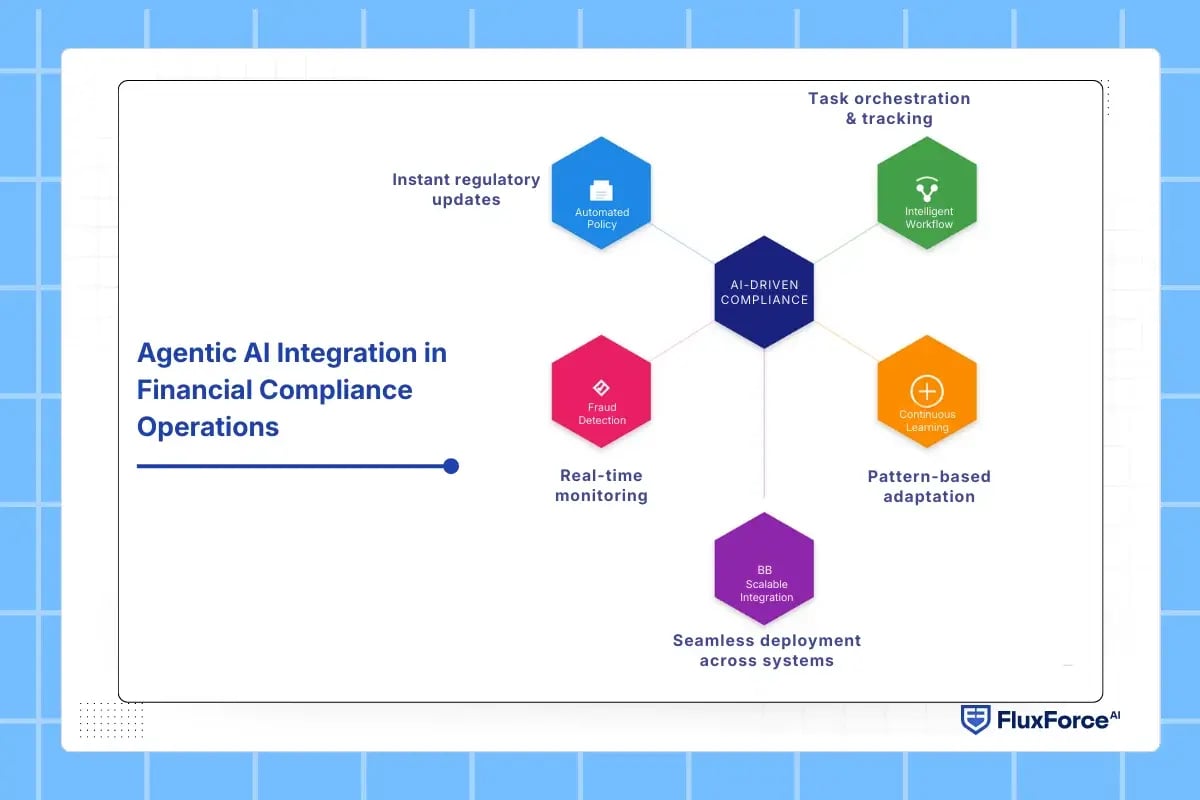
Agentic AI addresses compliance challenges through self-directed automation. It replaces a fragmented manual approach with systems capable of managing entire regulatory workflows autonomously.
Key transformations of intelligent automation in financial compliance:
1. Automated Policy Interpretation
Agentic AI reads new regulatory circulars and automatically updates relevant policies. It applies the latest compliance rules directly to workflows, closing the gap between policy release and on-ground implementation. This keeps financial operations aligned with current mandates.
2. Intelligent Workflow Orchestration
The system distributes verification, documentation, and approval tasks automatically. It tracks task status in real time and reassigns pending items when delays occur. This keeps reporting schedules intact and minimizes dependency on manual follow-ups.
3. Continuous Learning and Adaptation
Agentic AI studies every compliance outcome to refine its accuracy. It recognizes recurring patterns in data, adjusts to new transaction types, and reduces false alerts. The system improves monitoring efficiency with each review cycle.
4. Fraud Detection at the Source Level
By reviewing transactions as they occur, Agentic AI identifies irregularities early. It isolates suspicious patterns linked to identity misuse or fund movement and alerts teams for immediate action, lowering exposure to financial and reputational risk.
5. Scalable Integration
Agentic AI fits within existing compliance infrastructure. Institutions can adopt it gradually without pausing ongoing operations. Its compatibility with legacy and modern systems allows controlled automation across multiple departments and regions.
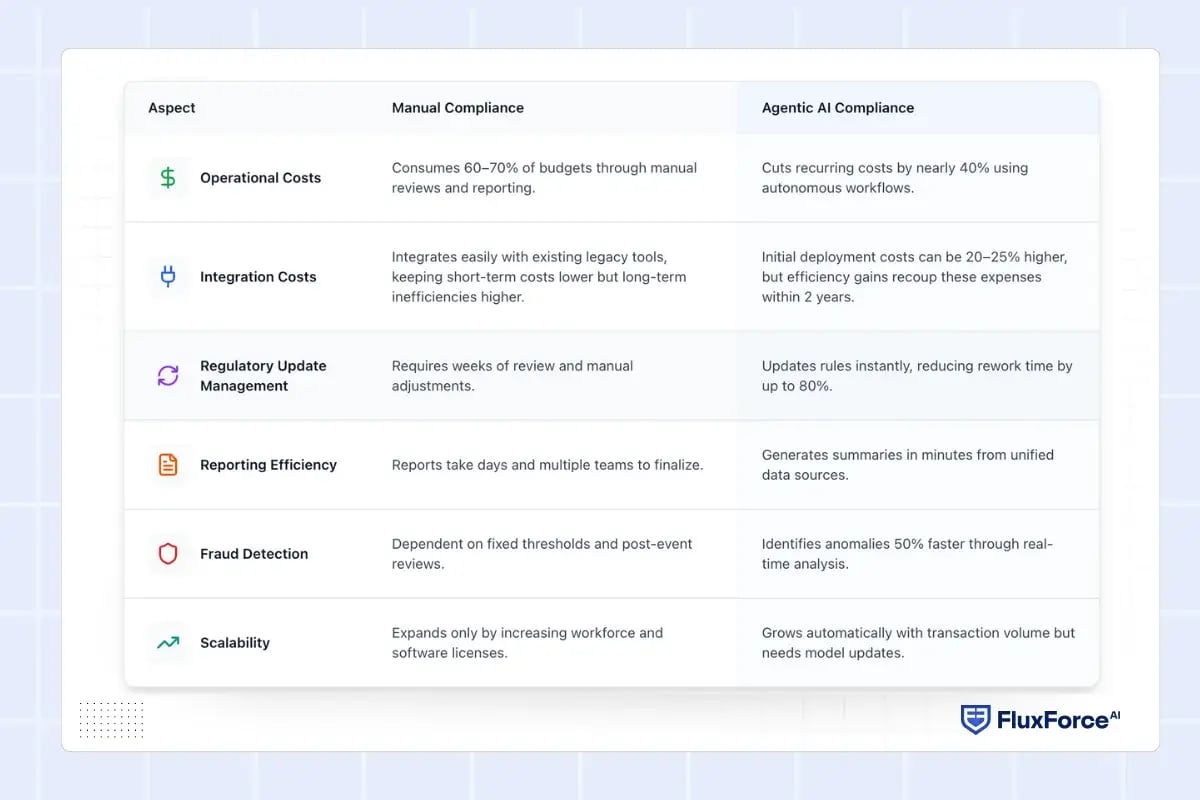
Manual vs. Agentic Compliance: The Cost Comparison
Agentic AI manages compliance proactively with real-time insights, while manual systems rely on delayed reviews. The table below highlights the key cost differences between both the approaches.
Real Businesses Transitioning from Manual to Agentic Compliance
Businesses across sectors are actively shifting from manual-led compliance to AI-powered, agentic systems. The transformative shift is helping them achieve faster workflows, fewer errors, and 24/7 monitoring via automation.
1. HCLTech (for a major European bank)
In a project published in late 2024/2025, HCLTech implemented a GenAI-enabled platform for a European financial services client to transform manual trade surveillance alerts.
Results: Shown an 87.5 % reduction in investigation time while standardizing documentation and boosting audit readiness.
2. Bank of Singapore
In October 2025, the Bank of Singapore announced the deployment of an agentic-AI tool (Source of Wealth Assistant, SOWA) to automate the drafting of Source of Wealth (SoW) reports.
Results: The process time was reduced from approximately 10 days to 1 hour, improving consistency and regulatory alignment.
3. Infosys (for a global electronics manufacturer)
In a compliance-digitisation case, Infosys helped its manufacturing client automate manual reviews of 30,000+ vendor reports (in multiple languages/formats).
Results: Using AI-driven solutions, Infosys helped them extract and analyse data in a unified space, consolidating previously manual workflows.
Strategies for Strengthening Risk Monitoring and Reporting with Agentic AI
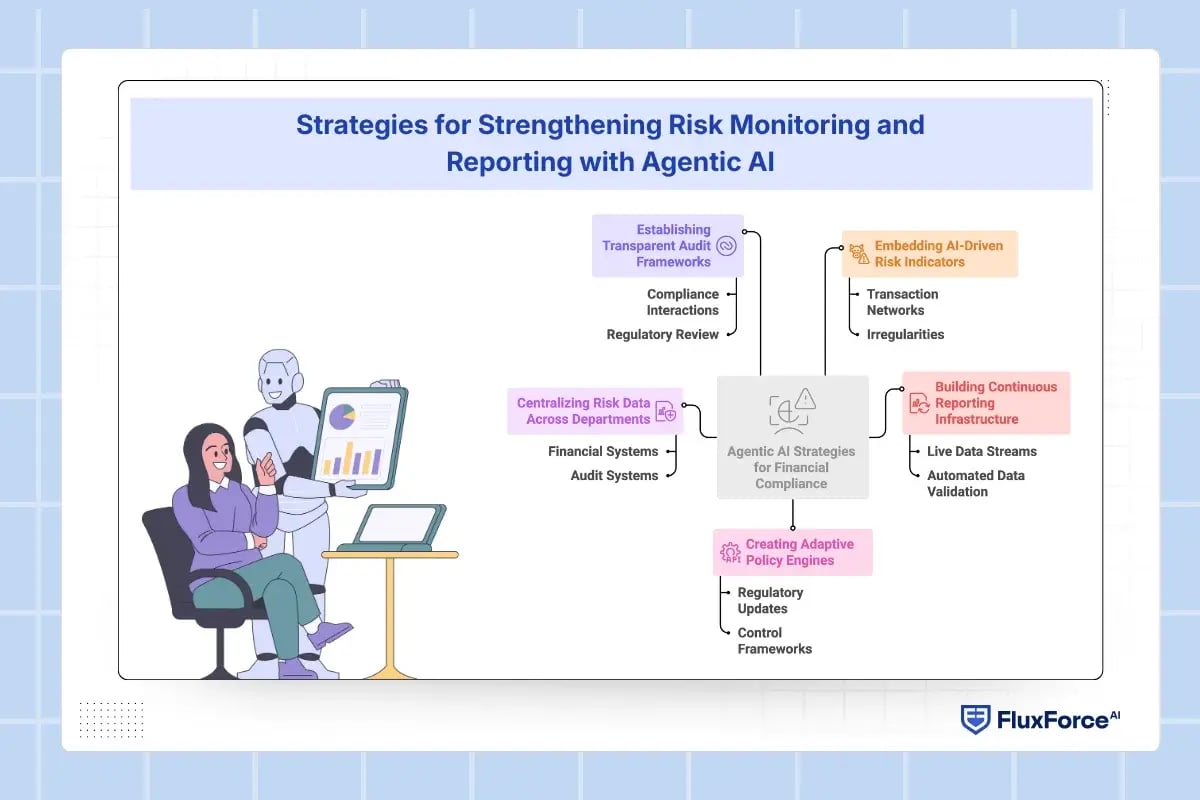
In 2026, an optimal financial compliance depends on the precision of risk detection and the speed of reporting. Agentic AI supports both by maintaining continuous oversight across transactions, regulatory changes, and audit workflows. Below are some effective strategies to implement:
1. Embedding AI-Driven Risk Indicators into Core Systems
Institutions can integrate predictive algorithms within existing transaction networks to detect irregularities at source. Early identification of high-risk activities limits exposure and supports quicker investigative action.
2. Building Continuous Reporting Infrastructure
Replacing batch reporting with live data streams ensures timely compliance visibility. Automated data validation cycles reduce backlogs and eliminate manual dependencies in regular reporting processes.
3. Creating Adaptive Policy Engines
Developing AI-based policy models enables instant interpretation of regulatory updates. Automated alignment of control frameworks ensures organizations remain compliant as regulations evolve.
4. Centralizing Risk Data Across Departments
Connecting financial, audit, and risk systems under an Agentic AI layer delivers unified access to verified information. Shared visibility enhances coordination and reduces discrepancies between departmental reports.
5. Establishing Transparent Audit Frameworks
AI-generated audit logs record every compliance interaction, ensuring full traceability for regulatory review. The approach cuts manual preparation time and minimizes operational strain during audit cycles.
Conclusion
Manual compliance and outdated systems drain significant costs that often remain unnoticed until audit failures or reporting delays expose them. Agentic AI changes this structure by introducing precision, automation, and continuous adaptation across compliance workflows.
Agentic approach supports a proactive compliance model that intelligently anticipates risk and aligns seamlessly with evolving regulations. In a sector where transparency determines credibility, adopting Agentic AI brings sustainable, data-driven governance and long-term organizational resilience.
Share this article