


















Listen To Our Podcast🎧
.png)
Introduction
The unpredictability of compliance processes continues to challenge officers responsible for maintaining accuracy and consistency across complex regulations.
Frequent regulatory updates, high data volumes, and lack of intelligent analysis make it difficult to forecast risks or ensure timely corrective action. Despite adopting automation, many compliance systems still operate on fixed rules and manual updates, leaving them unable to adjust when regulations or risk patterns change.
To build predictability, compliance functions now need systems that can interpret data, learn from past actions, and respond automatically to evolving scenarios. Agentic AI enables this shift by creating a framework that combines continuous data visibility with integrated analysis and autonomous decision-making capabilities.
Agentic AI streamlines Strong Customer Authentication (SCA),
boosting security and efficiency

Why Do Compliance Officers Need
Predictability ?
Reactive compliance management no longer meets the speed and precision modern regulations demand. Manual reviews and post-incident responses fail to prevent violations that occur in real time. The 2025 Global Fraud Report identified the lack of proactiveness as a leading cause of compliance errors, reporting delays, and regulatory penalties.
Predictability in compliance helps:
- Spot risks before they grow into violations- Predictive systems help compliance teams recognize patterns that may lead to issues months in advance.
- Stay ahead of regulatory changes- Predictability allows officers to track which rules or obligations may become challenging for their organization to meet.
- Detect process gaps in everyday operations- With automated intelligence, organizations can continuously scan workflows and highlight process gaps that might cause audit failures.
- Enable forward-looking insights to make smarter decisions- Instead of relying on old reports or static dashboards, predictive analytics provides up-to-date insights that reveal what’s likely to happen next.
Compliance officers now require forecasting capabilities, not just monitoring tools. Predictability transforms compliance from reactive oversight into proactive risk prevention, allowing teams to act before breaches occur.
How Agentic AI Drives Compliance Predictability ?
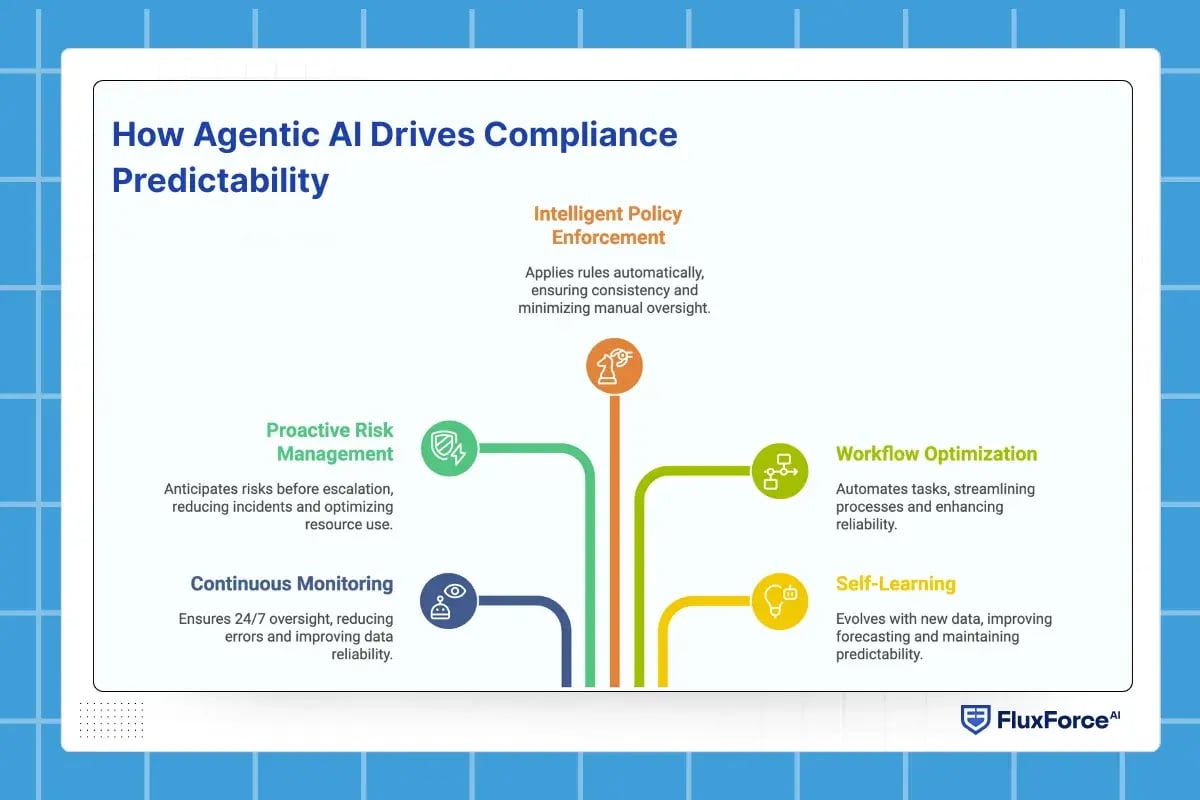
The capabilities of agentic AI in managing compliance functions enable greater predictability in decision-making and operations. By combining automation and adaptive intelligence, agents continuously monitor data, identify risk patterns, and provide action-taking steps accordingly.
1. Continuous Compliance Monitoring
Agentic AI allows organizations to maintain 24/7 oversight rather than relying on periodic reviews. It integrates directly with database to observe transactions, identify anomalies, and act in real time.
- Banking and fintech: AI relentlessly tracks customer transactions to flag potential fraud or money laundering.
- Cybersecurity compliance: AI scans systems for policy violations and early breach indicators.
- Outcome: Reduced human error, improved data reliability, and consistent regulatory adherence.
2. Proactive Risk Management
Traditional compliance processes react to problems after they appear. With intelligent automation, compliance teams can anticipate risks before they escalate. By combining real-time data with historical insights, AI provides a clearer view of potential regulatory risks and can take preventive action early.
- Predictive analytics: The system studies historical data to uncover recurring risk indicators and emerging compliance trends.
- Dynamic thresholds: Monitoring parameters adjust automatically to reduce false positives and highlight genuine threats.
- Outcome: Stronger control over risks, fewer compliance incidents, and better use of team resources.
3. Intelligent Policy Enforcement
With constant changing regulations, ensuring consistent policy enforcement across departments is challenging. Agentic AI introduces intelligent policy enforcement that applies rules as they release and identify deviations automatically.
- Policy updates: Adjustments roll out automatically when regulations or internal policies change.
- Deviation alerts: Irregularities are flagged in real time for immediate review.
- Outcome: Consistent, auditable policy execution with minimal manual oversight.
4. Compliance Workflow Optimization
Intelligent automation optimizes repetitive, manual tasks such as transaction reviews, policy checks, and reporting. With autonomous decision-making capabilities, agents either flag or escalate exceptions based on predefined risk parameters, ensuring effective use of human resource.
- Process automation: Routine reviews, validations, and control checks execute continuously.
- Integrated reporting: Data is compiled into accurate, regulation-ready reports.
- Outcome: Streamlined workflows that enhance reliability and predictability across compliance functions.
5. Self-Learning and improved forecasting
Adaptive learning allows compliance systems to evolve with every transaction, alert, and regulatory update. Instead of depending on static rule sets, models refine themselves based on past outcomes and new compliance inputs.
- Learning loops: Each decision strengthens detection logic and minimizes repetitive errors.
- Predictive insights: The system anticipates emerging risks by analysing historical behaviour and evolving data patterns.
- Outcome: A continuously improving compliance framework that sharpens foresight and maintains predictability in shifting regulatory conditions.
Key Considerations for Implementing AI Agents for Compliance
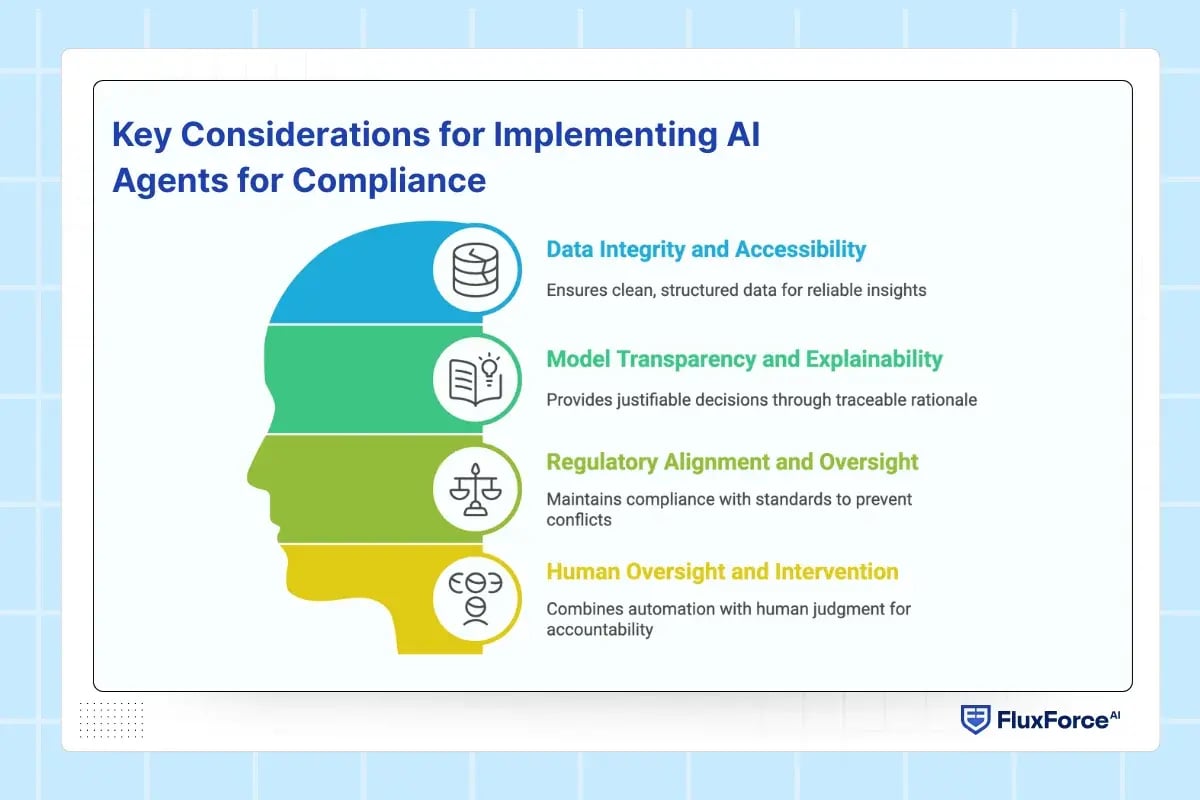
Integrating AI agents into compliance operations requires a balance between automation, governance, and accountability to ensure results align with regulatory intent.
1. Data Integrity and Accessibility
AI-driven compliance depends on clean, well-structured data. Fragmented or inconsistent datasets reduce the reliability of insights and increase false positives. A unified data framework ensures transparency, traceability, and accurate decision-making.
2. Model Transparency and Explainability
Compliance decisions must be justifiable to regulators. Black-box models can create challenges during audits or reviews. Explainable AI ensures every automated decision can be traced back to a logical, documented rationale.
3. Regulatory Alignment and Oversight
Agents must operate within clear regulatory boundaries. Continuous alignment with local and international compliance standards prevents operational conflicts and ensures readiness for external audits.
4. Human Oversight and Intervention
While automation improves speed, human review remains essential for contextual judgment calls. A hybrid setup, where AI flags and compliance officers validate, maintains accountability and builds regulatory confidence.
Success Metrics for Agentic AI-Driven Compliance Models
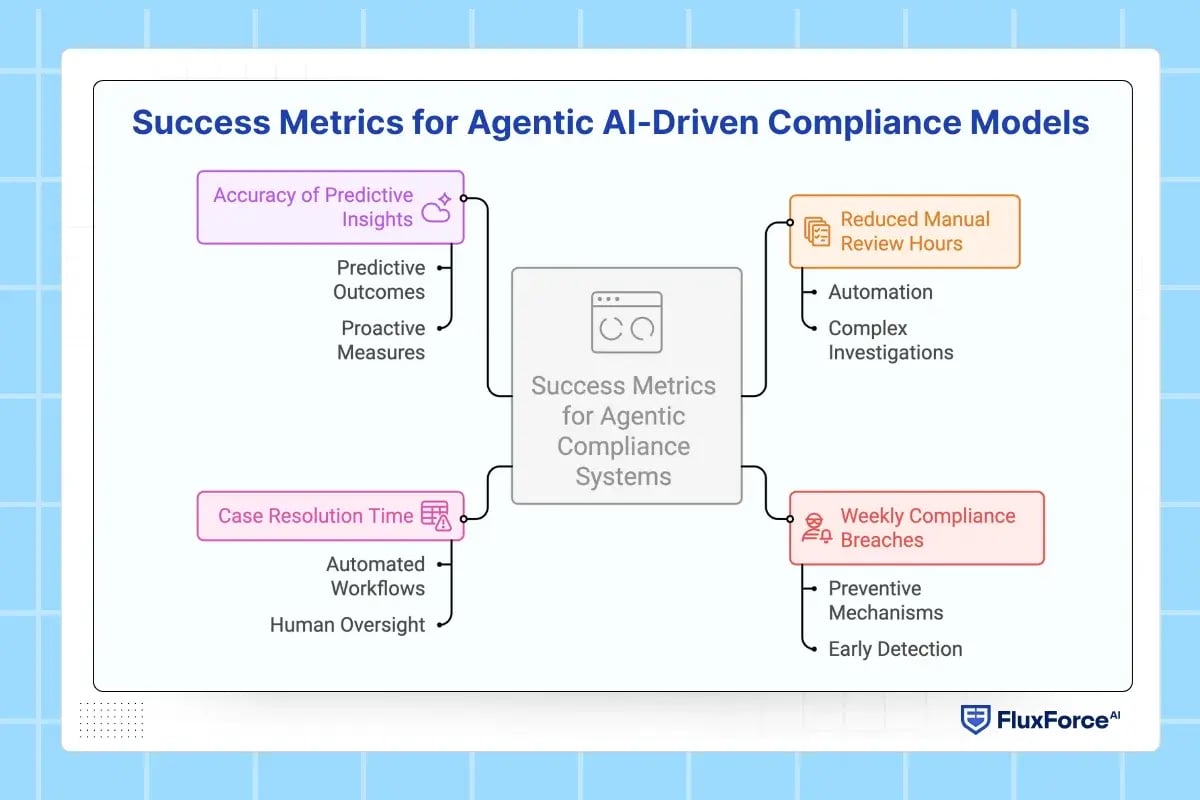
Measuring the success of Agentic compliance systems requires consistent tracking of operational and predictive performance indicators. The following metrics provide a clear view of system efficiency and reliability.
Reduced Manual Review Hours
A decline in review workload indicates effective implementation of Agentic systems. When routine checks are handled accurately with automation, compliance teams can dedicate more time to complex investigations.
Weekly Compliance Breaches
Monitoring weekly breach trends reveals how well AI systems stabilize compliance operations. A consistent decline reflects stronger preventive mechanisms and earlier detection, reducing the chance of incidents escalating to enforcement levels.
.webp?width=1200&height=800&name=Success%20Metrics%20for%20Agentic%20AI-Driven%20Compliance%20Models%20%20(2).webp)
Case Resolution Time
A shorter turnaround from flag to closure suggests improved coordination between automated workflows and human oversight. This metric highlights how efficiently the system converts alerts into resolved cases without creating process delays.
Accuracy of Predictive Insights
Predictive accuracy defines trust in AI models. When predictive outcomes consistently match actual events, officers can depend on the system’s recommendations for proactive measures.
Key takeaway: Leveraging dashboards that track and provide a unified view of these metrics allow compliance officers to identify ROI and ensure reliability.
Conclusion
Effective compliance predictability follows a process that involves continuous monitoring, comprehensive data analysis, and adaptation of dynamic regulations.
Agentic AI provides these capabilities by integrating monitoring, analysis, and automated response into a unified framework. For compliance officers, agents reduce reporting errors, ensure faster resolution of issues, and consistent policy enforcement.
By continuously learning from past actions and adjusting controls, Agentic AI enhances both foresight and reliability, creating a compliance environment where processes are measurable, repeatable, and capable of responding effectively to evolving challenges.
Share this article