





Listen to our podcast 🎧

Introduction
Strong Customer Authentication, transaction monitoring, and now GDPR compliance. Insurance companies are not struggling with evolving regulations. They are failing at the execution step where data protection risks occur.
While rule-based systems quickly capture GDPR data protection requirements in the insurance industry, the actual work of enforcing them still runs on manual workflows that were never designed for this scale.
Instead of finding ways to reduce the fear of penalties, firms add more manual checks and more documentation layers and end up on the verge of operational slowdown.
What they miss is a systematic approach that keeps compliance running without creating friction in the business. Given the capability of AI to simplify the full lifecycle of GDPR compliance, it is worth understanding what a well-structured automation strategy actually looks like in insurance.
In this blog, we explore how automation helps insurance firms meet GDPR requirements while strengthening customer trust. More importantly, we address the question risk leaders are actively trying to solve: how to make GDPR compliance scalable without slowing down the business.
What is Insurance Compliance?
Compliance in insurance means adhering to laws, regulations, and guidelines set by authorities to secure customer data, ensure transparency, and maintain fair business practices.
A major regulation that affects insurers is the General Data Protection Regulation (GDPR). While it is not insurance-specific, it requires companies to handle personal data with strict security and accuracy. This is especially important for insurers because they manage sensitive details like names, medical history, financial records, and claims data.
Non-compliance with GDPR for insurance can result in severe consequences, including fines of up to 4% of annual turnover or €20 million, whichever is higher.
Beyond GDPR, insurers must also comply with sector-specific requirements such as health insurance regulatory compliance, life insurance compliance, and other regional data protection obligations.
How Insurance Companies Ensure GDPR Compliance (Traditional Approach)
Most insurance companies are not ignoring GDPR. They have policies in place, teams assigned, and processes documented. The problem is that those processes are inefficient. Here’s how mid-sized insurers handle enormous amounts of personal and financial data:
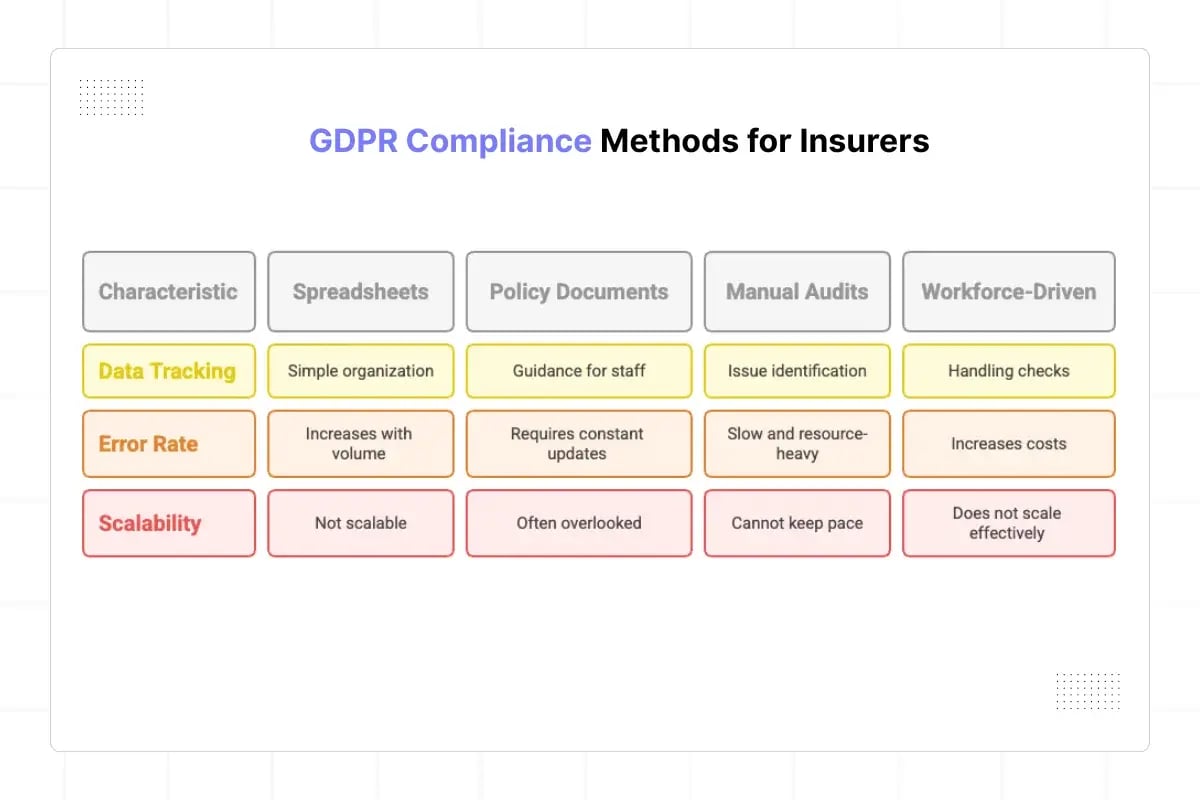
Using Spreadsheets for Data Tracking
Insurers often use spreadsheets to record and track customer data requests, updates, or corrections. While this provides a simple way to organize information, it increases errors as data volumes grow.
Collecting Data from Multiple Systems
Insurance data is scattered across CRMs, policy platforms, and third-party tools. To assemble a complete picture, teams manually pull and cross-check records. This takes hours or even days and leaves you constantly worried that something is missing or wrong.
Responding to Access Requests
Every customer has the right to see, correct, or remove their data. Handling these requests manually means routing emails between departments, chasing approvals, and double-checking records. Even small delays feel risky when regulators can measure compliance in hours or days.
Preparing for Audits
When audit season comes, risk officers spend days piecing together logs and reports. Manual methods mean you are always one step behind, often scrambling to find the evidence needed to prove compliance. It’s not just tedious, it’s stressful.
.png?width=1200&height=628&name=hubspot%20blog%20(6).png)
The Evolving role of risk officers in insurance GDPR compliance
With automation in insurance compliance, the responsibilities of risk officers are changing.
- Data is No Longer Scattered- Previously, you spent hours pulling records from multiple systems. Automation centralizes all data. You can review requests and verify compliance without manually reconciling information.
- Problems Are Visible Immediately- Manual processes mean errors appear during audits. Automated monitoring gives real-time alerts. You can act before small mistakes become compliance issues.
- Your Focus Shifts to Decisions- Tasks like logging consent or compiling reports are automated. You spend time evaluating risks, approving exceptions, and improving workflows.
- Coordination Becomes Easier- Automation shows you which teams need action. You do not chase emails or approvals constantly. You intervene only when human judgment is necessary.
- You Guide Compliance, Not Maintain It- With routine work handled by systems, you identify gaps, refine procedures, and make GDPR compliance part of business strategy. Your role moves from executing rules to shaping them.
Key GDPR Compliance Strategies for Insurance Companies
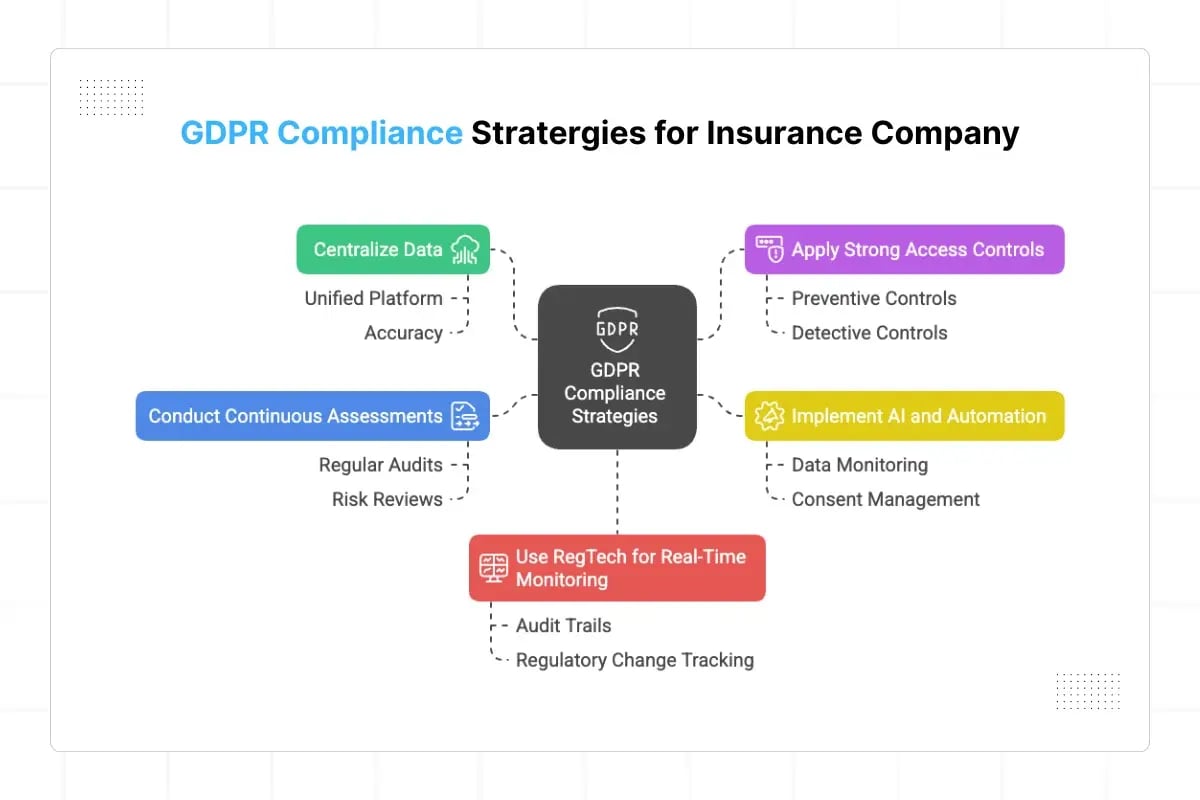
Meeting GDPR requirements in the insurance industry becomes easier when firms rely on proven strategies. Below are some key approaches insurers can implement to stay compliant and protect customer data.
1. Centralize Data Across Systems
Scattered customer records increase the chance of errors. Centralizing data in a unified, secure platform ensures accuracy, improves visibility, and makes it easier to meet GDPR reporting requirements.
2. Apply Strong Access and Encryption Controls
Limiting access to sensitive data and using encryption protects against breaches. GDPR requires both preventive and detective controls, which insurers must implement consistently.
3. Implement AI and Automation
AI and automation streamline data monitoring, detect anomalies, and enable automated workflows for critical tasks such as consent management and subject access requests. These technologies reduce human error, accelerate response times, and strengthen overall compliance.
4. Conduct Continuous Assessments
Compliance requirements frequently change, and insurers must adapt promptly. Regular audits and risk reviews help evaluate the effectiveness of processes, identify gaps early, and update procedures to stay aligned with evolving GDPR regulations.
5. Use RegTech for Real-Time Monitoring
RegTech solutions provide insurers with automated tools to continuously monitor GDPR compliance. They centralize data oversight, generate comprehensive audit trails, track regulatory changes in real time, and send alerts whenever data handling or processing falls short of GDPR requirements.
Principal Advantages of Automating Regulatory Compliance in Insurance
Automation delivers tangible benefits for risk officers and mid-sized insurers:
- Reduced manual workload: Repetitive tasks are handled by systems.
- Minimized errors: Consistent automated workflows reduce human mistakes.
- Faster responses: Real-time alerts allow quicker remediation.
- Clear audit trails: Reports are complete, traceable, and ready for regulators.
- Operational speed maintained: Compliance no longer slows business processes.
How to Automate GDPR Compliance Workflows in Insurance
Automation delivers results when it is built on a clear structure. Below are the key steps for building a GDPR compliance automation framework in your insurance firm.
1. Map Data Flows Across Insurance Processes
Document all points where customer data is collected, processed, transferred, or stored. A complete data map helps identify compliance risks, ensures visibility across systems, and forms the foundation for automating monitoring and controls.
2. Classify Customer Data by Sensitivity
Organize data into categories such as personal, financial, and health information. Clear classification helps apply appropriate protection rules and enables rigorous monitoring of the most sensitive data.
3. Implement Automated Monitoring and Alerts
Deploy AI-driven systems to track data handling in real time. Automated alerts detect unusual activity or policy breaches immediately, enabling risk officers to act quickly and prevent compliance violations.
4. Automate GDPR Reporting and Documentation
Use RPA (Robotic Process Automation) to generate audit trails, compliance reports, and logs automatically. This reduces manual effort, minimizes errors, and provides regulators with transparent, accurate documentation.
5. Enable Automated Access Control and Consent Management
Implement automated systems to manage user permissions, track consent, and enforce data retention policies across all platforms. This ensures authorized sensitive data access and consistent consent compliance maintenance.
Top GDPR Compliance Automation Tools for Insurance Firms
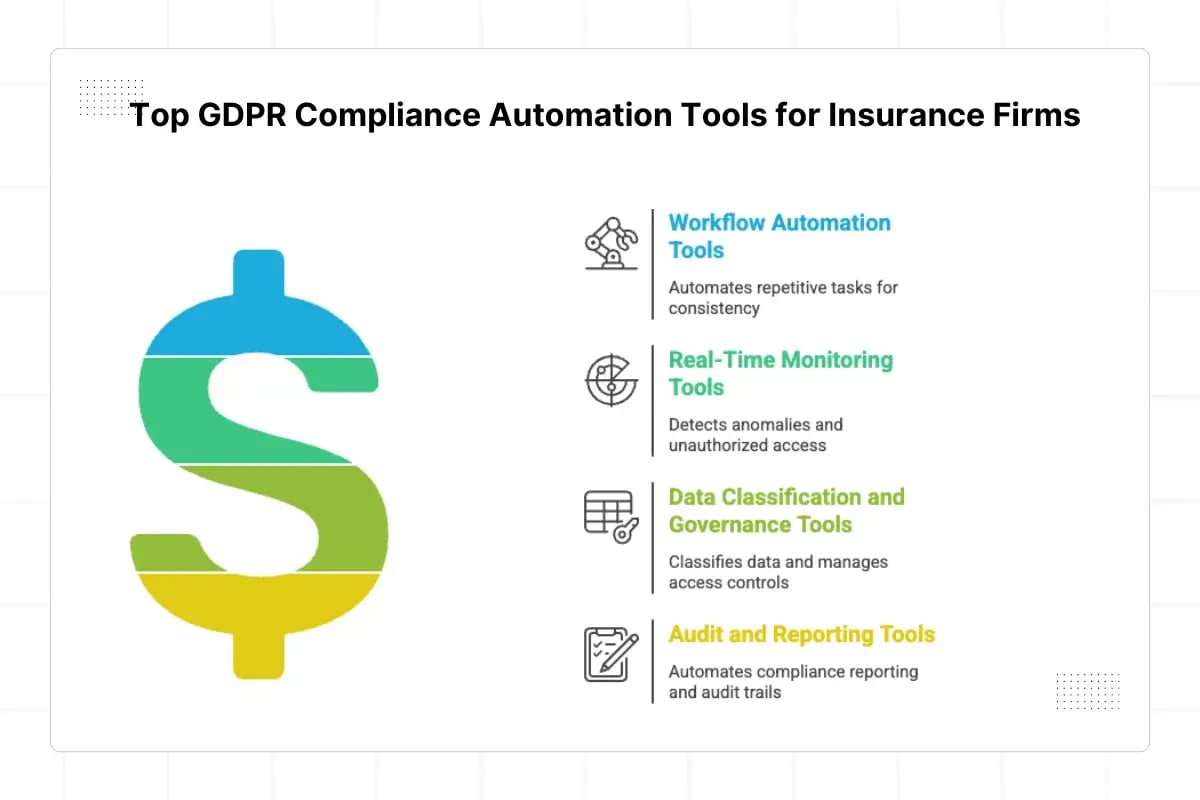
Leveraging automation in the insurance industry enables a streamlined approach to several GDPR compliance workflows. From audits to reporting, different tools and technologies work to reduce manual effort and maintain regulatory adherence.
Workflow Automation Tools
For automating repetitive compliance workflows, such as consent management, data access requests, or audit logging, Robotic Process Automation (RPA) handles the work. It ensures consistency, minimizes manual errors, and frees compliance teams for strategic tasks.
Real-Time Monitoring Tools
Artificial Intelligence (AI) and machine learning (ML) monitor data activity continuously, detecting anomalies or unauthorized access in real time. These technologies help insurers prevent breaches and maintain strict GDPR compliance.
Data Classification and Governance Tools
AI-powered data governance platforms and analytics tools automatically classify sensitive data, enforce retention policies, and manage access controls. They ensure only authorized personnel handle information and simplify audit processes.
Audit and Reporting Tools
RPA combined with analytics automates compliance reporting, tracks regulatory updates, and maintains detailed audit trails. This reduces administrative effort and allows risk teams to demonstrate accountability efficiently.
Conclusion
The insurance industry’s sensitivity to customer data demands constant vigilance. Automation enables:
- Centralized oversight across multiple systems
- Continuous monitoring with immediate alerts
- Consistent enforcement of consent and access policies
By implementing automation strategically, risk officers can achieve reliable compliance without operational friction. GDPR compliance becomes a scalable, integrated process, allowing insurers to protect data, maintain customer trust, and keep business operations moving efficiently.
Share this article