















.jpg)



Listen To Our Podcast🎧
.png)
Introduction
Can your current fraud system adapt faster than the fraudsters who exploit it?
That’s the defining question for today’s financial world. Fraudsters have evolved. They now use machine learning, deepfakes, and social engineering tactics that easily bypass traditional filters. So, how do financial institutions keep up? This is where agentic AI in fraud prevention becomes a real game-changer.
Instead of depending on static models that react only after a fraud occurs, Agentic AI acts like an intelligent decision-maker. Unlike conventional automation, these AI agents continuously learn from transaction anomaly detection, user behavior risk scoring, and machine learning behavioral patterns, making them capable of defending systems in real time.
The shift is already visible. According to research, global online payment fraud losses may exceed $343 billion by 2027, which is pushing banks and fintech firms to move beyond legacy solutions. Traditional rule-based filters can’t scale to counter the sophistication of modern threats. What organizations need today are adaptive fraud prevention models that evolve as attackers do. They learn, adjust, and respond autonomously.
That’s where behavioral analytics for fraud detection plays a vital role. It doesn’t look at what is being done; it studies how it’s being done. Every keystroke, mouse movement, and login pattern tells a behavioral story. When paired with AI-driven fraud monitoring, it builds a complete digital profile of user intent. This is something static systems could never achieve.
So, the real question for today’s leaders is simple. Are you still depending on systems that only flag known fraud patterns, or are you ready to embrace autonomous fraud detection systems that think, learn, and act like human investigators?
Why traditional fraud systems are falling behind ?

Static models in a dynamic fraud environment
Why do most fraud systems fail even when they have the right data? Because they were built for a different era. Traditional setups rely on static thresholds and rigid rule sets that don’t adjust when fraud tactics evolve. Criminals now use machine learning behavioral patterns to mimic genuine activity, making it nearly impossible for rule-based systems to keep up.
Reactive detection instead of real prevention
Legacy tools depend on pre-defined triggers. They raise alerts after the event, which means detection often happens once the damage is done. Operations teams in banks and fintech firms still spend hours reviewing false positives, while genuine fraud slips through unnoticed. In one mid-sized fintech setup, over 30% of alerts turned out to be non-critical, wasting investigation hours and delaying real action.
Lack of contextual and behavioral awareness
Old models focus on transactions, not behavior. Without user behavior risk scoring or transaction anomaly detection, systems fail to understand why something looks suspicious. They miss the subtle deviations in how users type, move, or transact signs that behavioral analytics for fraud detection can easily pick up.
Compliance gaps and operational pressure
Manual audits under AML/KYC compliance automation add to the strain. Analysts must cross-verify identities and trace histories without real-time insights. Without continuous identity verification, compliance becomes reactive instead of predictive.
Why Agentic AI is the turning point ?
Financial leaders are realizing that the solution isn’t more alerts; it’s smarter ones. Adaptive fraud prevention models and AI-driven fraud monitoring learn continuously, reducing noise and increasing precision. When fraud evolves, the system evolves with it.
Traditional tools tell you what went wrong. Agentic AI in fraud prevention tells you what’s about to go wrong and that’s the real difference between loss and prevention.

How agentic AI enhances fraud detection accuracy
Traditional systems react; agentic ai in fraud prevention predicts. It learns from every transaction to identify risky behavior before fraud occurs. In high-volume fintech environments, this predictive power matters more than speed. Adaptive fraud prevention models help systems evolve with every new data point, making detection smarter over time.
Behavior-based intelligence
Agentic AI studies how users behave, not just what they do. It maps session behavior profiling, identity behavior fingerprints, and transaction anomaly detection to understand each customer’s normal activity. When something deviates, like a late-night transfer from an unfamiliar device, the system evaluates context before flagging it.
Smarter alerts, lower noise
Teams waste hours on false alerts. AI-driven fraud monitoring and autonomous fraud detection systems refine risk thresholds in real time, using real-time fraud threat intelligence to reduce false positives. A 2024 study found that AI-based models improved fraud accuracy by over 60%, proving the value of self-learning detection.
Better accuracy, less friction
With AI-based financial crime prevention, businesses can focus on real threats instead of chasing false ones. These systems also enhance behavioral biometrics security and continuous identity verification, ensuring safer transactions without disrupting user experience.
Behavioral analytics — The new frontline for fraud prevention
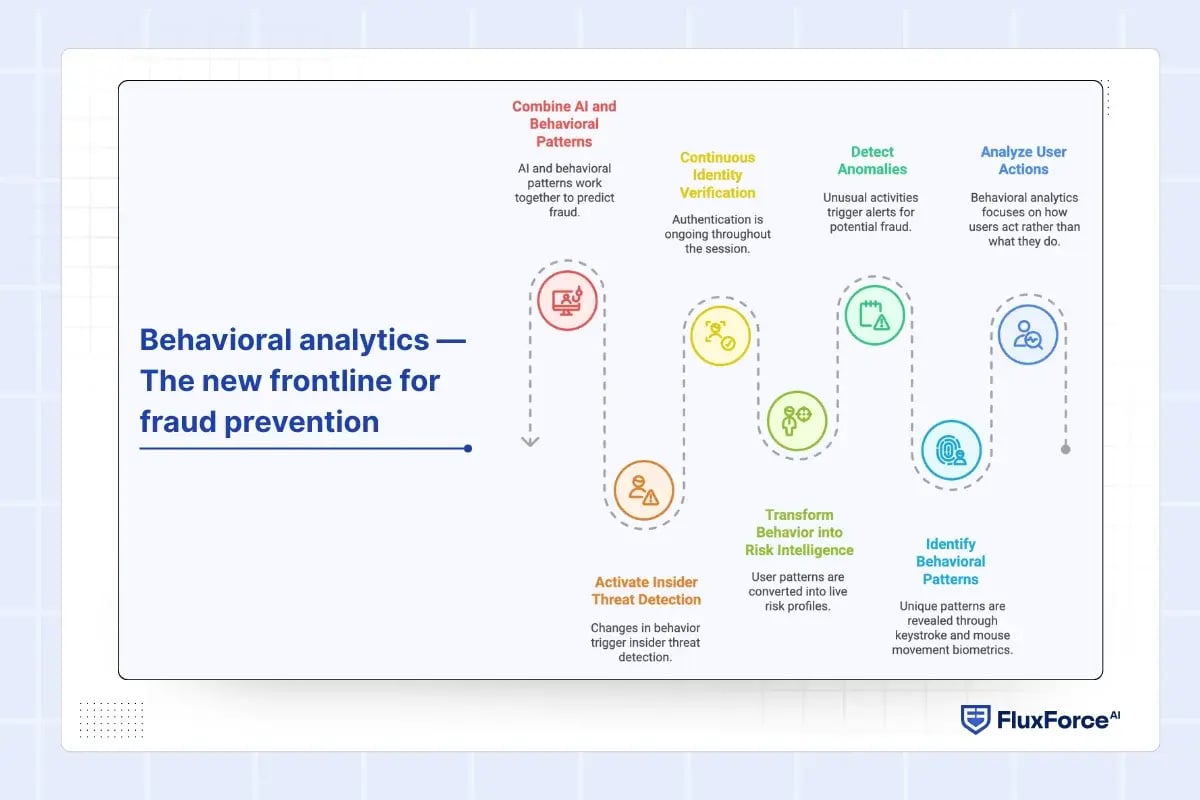
Fraud does not happen by accident. It follows behavior. That is why behavioral analytics for fraud detection is now a strategic priority across banking and fintech. Instead of focusing on what happened, it analyzes how users act.
Every small action matters. Features such as keystroke and mouse movement biometrics and session behavior profiling reveal behavioral patterns unique to each user. When these patterns shift, it signals potential fraud before credentials are even verified.
If a customer suddenly initiates a payment at an unusual time or from an unfamiliar location, behavioral deviation alerts trigger instant review and context-based decisioning.
Transforming behavior into risk intelligence
With tools like user behavior risk scoring and transaction anomaly detection, organizations can convert user patterns into live risk profiles. These systems rely on real-time fraud threat intelligence to adapt continuously, learning how genuine users behave compared to fraudulent ones.
This approach reduces dependence on manual reviews and accelerates incident response. The result is a fraud detection system that improves accuracy while minimizing disruptions for legitimate customers.
Continuous verification that never stops
Traditional security checks end once a user logs in. Continuous identity verification powered by behavioral biometrics security keeps authentication ongoing throughout a session.
If typing speed, navigation rhythm, or device handling suddenly changes, insider threat behavioral detection activates automatically. This keeps high-risk activities under constant observation without creating friction for genuine users.
When agentic AI and behavior work together
When agentic AI in fraud prevention is combined with machine learning behavioral patterns, the system evolves beyond detection. It learns continuously and predicts fraud before it occurs.
This synergy enables AI driven fraud monitoring that identifies subtle behavioral shifts invisible to rule-based models. Financial institutions using this approach have reported up to a 60 percent improvement in fraud detection accuracy while reducing false positives and operational costs.
How agentic AI and behavioral analytics work across industries
Real-time defense at the transaction core
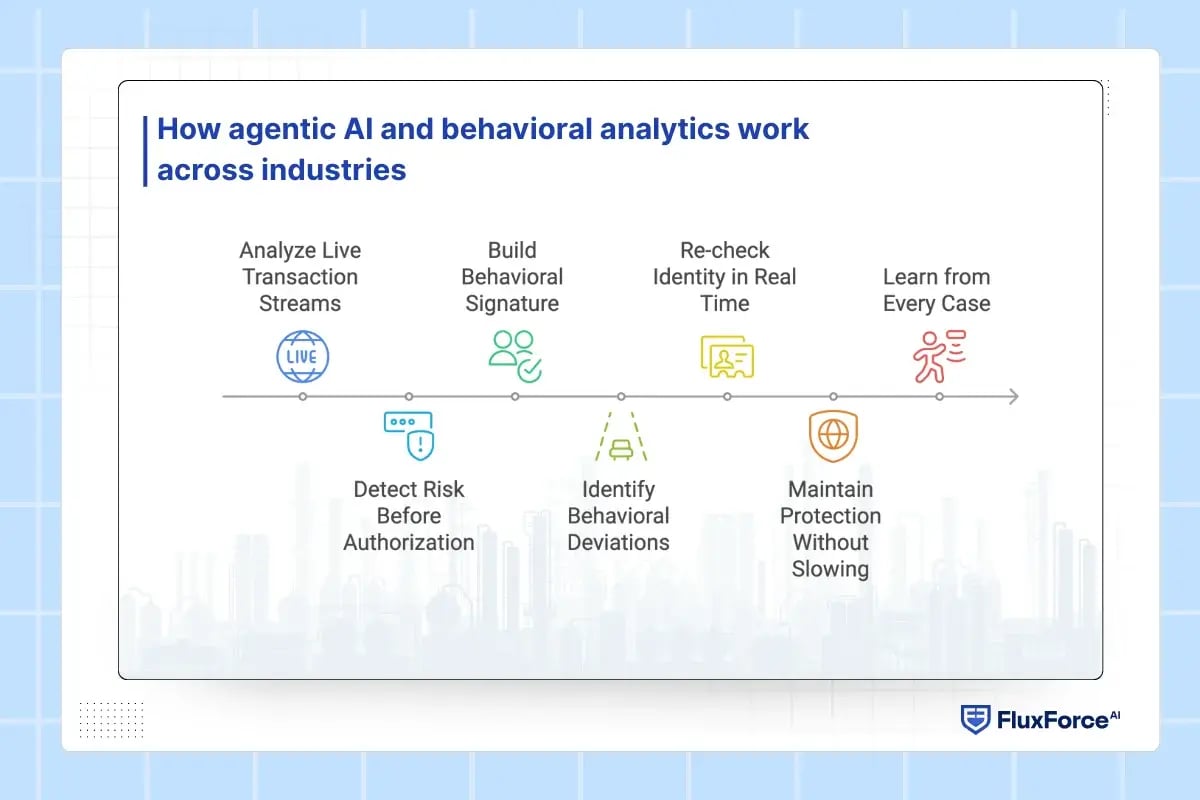
In banking, fintech, and credit unions, fraud hides in the smallest transaction gaps. Agentic AI in fraud prevention closes that window by analyzing live transaction streams and detecting risk before payment authorization. It watches IP shifts, device fingerprints, and session context, making split-second decisions that human analysts can’t match.
Organizations using AI-driven fraud monitoring report up to 80 percent faster detection rates because action happens as data moves, not after.
Behavioral intelligence that understands users
In banking, fintech, and credit unions, fraud hides in the smallest transaction gaps. Agentic AI in fraud prevention closes that window by analyzing live transaction streams and detecting risk before payment authorization. It watches IP shifts, device fingerprints, and session context, making split-second decisions that human analysts can’t match.
Organizations using AI-driven fraud monitoring report up to 80 percent faster detection rates because action happens as data moves, not after.
Continuous trust in fast-moving environments
Today’s customers expect instant transactions without losing security. Continuous identity verification and behavioral biometrics security make this possible by validating users quietly in the background.
If a session suddenly shows unusual patterns, autonomous fraud detection systems re-check identity in real time, maintaining protection without slowing the customer experience. This is now a common setup in digital banking transaction monitoring and high-frequency fintech operations.
Adaptive learning that scales
As adaptive fraud prevention models mature, they’re proving valuable beyond finance. The same logic that secures payments also protects e-commerce and digital services. Combined with ai-based financial crime prevention, these systems learn from every case, helping compliance teams automate routine checks and focus on strategic threats.
Businesses using these integrated models report fewer manual investigations, improved fraud accuracy, and stronger customer confidence.
Conclusion
The smartest defense is the one that never sleeps. By merging agentic AI with behavioral analytics, organizations can build fraud systems that evolve as fast as the threats do. For forward-thinking leaders, now is the time to invest in adaptive intelligence and make fraud prevention a cornerstone of digital growth.

Share this article