















.webp)



Listen To Our Podcast🎧
%20(1)-1.png)
Introduction
Global trade finance has long resisted full automation despite digital advances. Verification, settlement, and compliance continue to rely on institutional intermediaries and jurisdictional rules. The emergence of Agentic AI directly challenges this structure. These autonomous, goal-driven systems can interpret, decide, and act independently.
Considering the capabilities of these self-directed agents, could they eventually redefine how global trade finance operates? Could the roles of traditional hubs like Singapore, London, and Dubai shift as intelligence moves closer to the transaction layer itself?
This blog discusses how Agentic AI is reshaping trade finance workflows, the mechanisms enabling this transition, and how existing trade hubs might evolve by 2027.
Explore upcoming trends and insights
Stay informed on the future of trade and technology

How Agentic AI is Changing Global Trade Finance ?
Integrating agentic AI into cross-border trade reduces dependency on centralized finance hubs. By establishing connected, transparent workflows between banks, logistics networks, and regulatory systems, it accelerates settlements across international trade corridors.
Key mechanisms of agentic AI in global trade:
Integrating agentic AI into cross-border trade reduces dependency on centralized finance hubs. By establishing connected, transparent workflows between banks, logistics networks, and regulatory systems, it accelerates settlements across international trade corridors.
1. Intelligent Document Verification
Agentic AI authenticates key documents such as Letters of Credit, invoices, and bills of lading. It compares information across customs declarations, insurance certificates, and shipping manifests. Digital signatures and blockchain-based identifiers confirm origin and integrity. Through zero-knowledge verification, the system validates data without revealing the content itself. This process shortens document verification from several days to a few seconds.
2. Real-Time Foreign Exchange and Settlement
Autonomous agents track currency fluctuations and automate conversions continuously. They coordinate FX transactions across connected banking systems to minimize exposure risks. These agents can determine the best timing for settlement, ensuring optimal conversion values. The process eliminates multiple communication layers, creating direct agent-to-agent coordination and near-instant settlements with cryptographic privacy.
3. Dynamic Policy Alignment and Governance
Each AI agent operates under trade and financial rules defined by its host institution. When authorities update tax or compliance requirements, the system adapts automatically. These updates propagate across networks, ensuring all agents follow current legal frameworks. This allows continuous conformity with international and domestic policies without human intervention.
4. Automated Compliance and Risk Control
Agentic AI monitors all trade transactions for fraud, duplicate financing, and irregularities. It cross-checks banking, shipping, and customs data to detect inconsistencies. When unusual activity occurs, agents flag the transaction for validation before settlement. Using zero-knowledge cryptography, compliance checks remain secure while maintaining confidentiality.
5. Smart Contract Execution and Transaction Assurance
Trade agreements are embedded as smart contracts within the system. Once shipment data and payment conditions match, the contract triggers automatic release of funds. Each step is recorded in immutable ledgers with verified timestamps. This decentralized coordination ensures transparent, traceable, and accountable trade execution across multiple institutions.
The Shifting Role of Global Trade Finance Hubs with Agentic AI
Trade finance hubs are shifting from processing centers to coordination authorities. Institutions in Singapore, London, and Dubai may no longer manually verify trade documents. Instead, they will authenticate and approve the Agentic AI systems used by participants.
These hubs could act as certification authorities for autonomous trading networks. Their responsibility would be to confirm that each agentic framework adheres to global standards on data protection, security, and regulatory compliance.
However, trust remains a crucial concern. Businesses demand assurance that their commercial data will remain confidential. Unless privacy-preserving AI systems can demonstrate this protection reliably, adoption across competitive markets will remain limited.
Challenges in the Agentic AI Transition
1. Data Privacy and Competitive Security
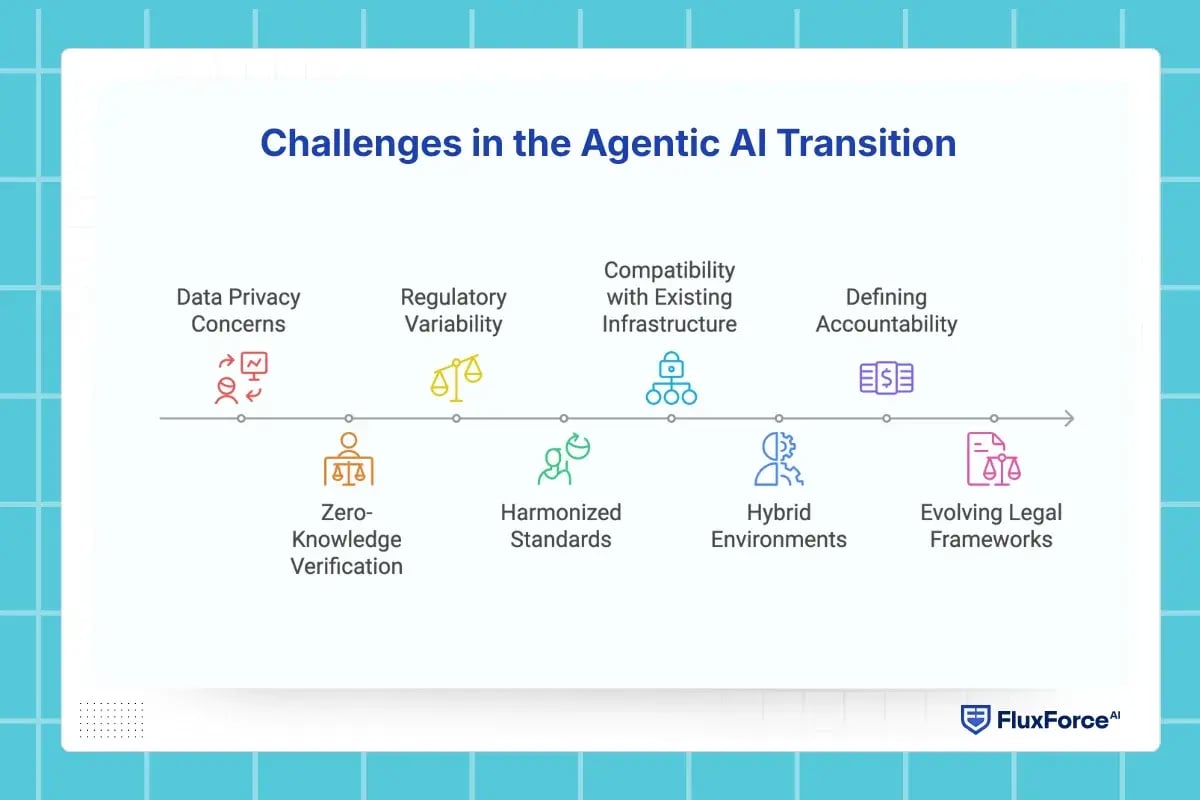
Trading firms are cautious about exposing sensitive pricing, supplier, and volume information. Conventional trade finance confines data within trusted institutional channels, while Agentic AI requires selective data exchange between autonomous systems. Zero-knowledge verification helps mitigate these fears by validating facts without revealing the underlying data. Even so, organizations will seek independent proof of confidentiality before integrating these systems.
2. Regulatory Variability Across Jurisdictions
Different nations apply inconsistent rules to AI-driven financial decisions. Some require human authorization for high-value settlements, while others permit automated execution. For Agentic AI to operate globally, consistent regulatory frameworks are essential. Trade hubs and international bodies will need to define harmonized standards for AI governance and digital compliance.
3. Compatibility with Existing Infrastructure
The global banking system still depends heavily on SWIFT and correspondent networks. Agentic AI must operate alongside these systems during the transition phase. Financial institutions cannot overhaul infrastructure immediately; instead, they will rely on hybrid environments where traditional and autonomous systems coexist. Proving secure interoperability will be vital for industry-wide adoption.
4. Defining Accountability in Autonomous Operations
Assigning liability remains complex when autonomous agents make decisions. Traditional trade finance assigns responsibility to specific institutions and authorized individuals. In distributed AI environments, decision-making is shared across multiple systems. Legal frameworks must evolve to clarify responsibility in cases of dispute or error. Without this clarity, institutions may limit deployment to low-risk scenarios.
Preparing for the AI-Driven Trade Framework
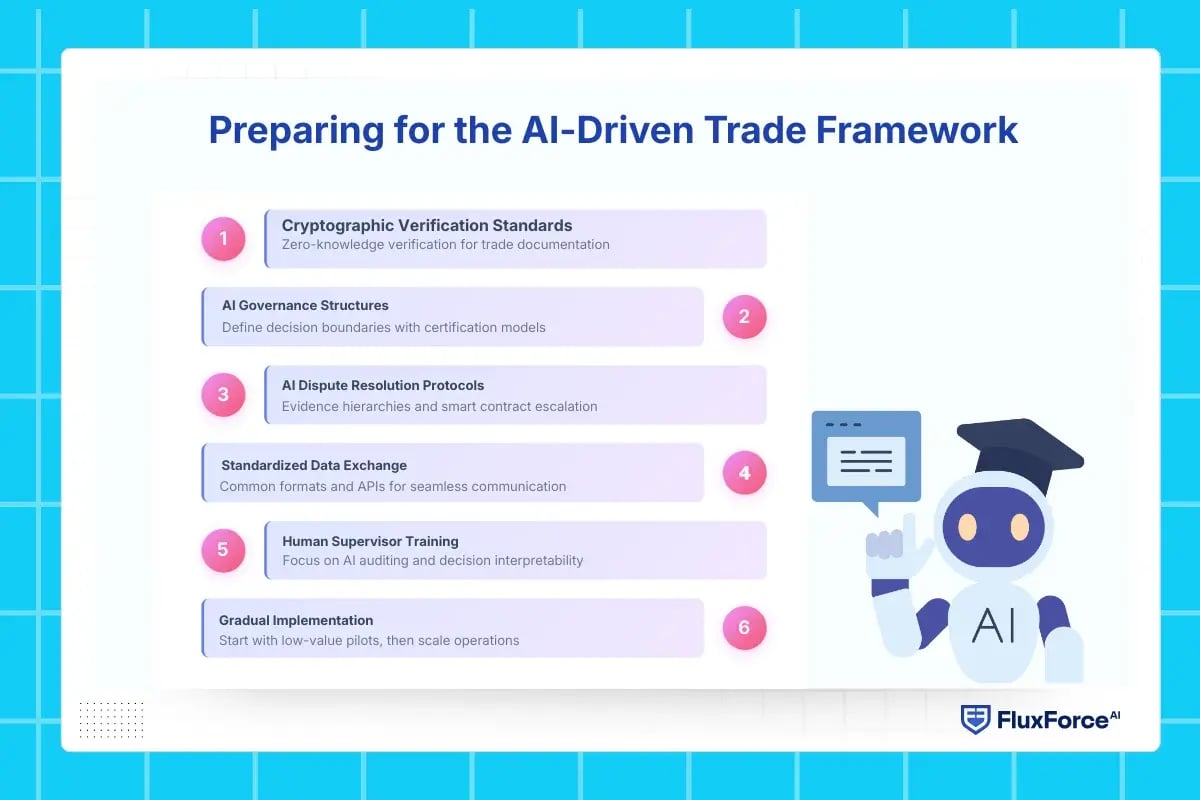
Financial institutions and regulators must establish technical, legal, and operational foundations to integrate autonomous systems securely into global trade finance. Below is a listed roadmap.
1. Establishing Cryptographic Verification Standards
Industry bodies are expected to formalize zero-knowledge verification standards for trade documentation. These standards will allow agents to confirm authenticity without accessing raw information. Agreed protocols across financial institutions will enable trusted, permissionless verification while protecting commercial secrets.
2. Building AI Governance Structures
Regulators and trade authorities must develop frameworks that define acceptable AI decision boundaries. Certification models can confirm that autonomous agents follow legal and procedural norms. Regular audits will ensure continued compliance as rules evolve. This structured certification replaces geographic trust with mathematical accountability.
3. Developing Resolution Protocols for AI Disputes
When agents reach conflicting conclusions, predefined dispute-resolution procedures are required. These protocols specify evidence hierarchies and escalation rules. Smart contracts can initiate human arbitration only after autonomous reconciliation attempts fail. Such predefined processes reduce settlement delays and maintain transactional accuracy.
4. Standardizing Data Exchange Formats
Banks, carriers, and logistics providers must agree on shared data formats to enable seamless integration. Common structures and APIs will allow multiple Agentic AI systems to communicate without central coordination. Standardization ensures lower integration costs and faster adoption across markets.
5. Training Human Supervisors for AI Auditing
The workforce in trade finance will evolve toward analytical and monitoring roles. Professionals will track AI decision behaviour, identify anomalies, and assess performance reliability. Training will focus on cryptographic validation and interpretability of autonomous decisions. Human expertise remains essential to maintain confidence and quality in automated operations.
6. Adopting Gradual Implementation Models
Institutions will likely begin with pilot programs for low-value trades. These pilots will validate performance, reliability, and privacy assurance before scaling to higher-value operations. Operating traditional and agentic systems in parallel during early stages ensures business continuity and institutional learning.
What Trade Finance Hubs Might Look Like by 2027 ?

By 2027 trade finance hubs may operate through digital ecosystems where validation, policy enforcement and system integrity become their defining roles.
1. AI Certification and Compliance Authorities
Major financial hubs may transition into certification centres for autonomous trading systems. They will validate that each AI framework meets international privacy and compliance standards. Certified agents will gain credentials allowing them to transact globally. Regular reviews will ensure continued adherence as regulations evolve.
2. Arbitration and Dispute Management Centres
Hubs may host expert panels specialized in resolving AI-related trade disputes. These centres will analyse decision logs and determine which verification outcomes were valid. Their judgments can establish industry precedents, refining future agent behaviour. This role will combine technical, legal, and economic expertise unique to each hub.
3. Protocol and Standard Development Bodies
Hubs could lead collaborative efforts to define the protocols underpinning trustless AI trade environments. They will convene banks, regulators, and developers to ensure secure interoperability. Publishing open frameworks and reference architectures will accelerate the standardization process globally.
4. Data and Privacy Verification Services
Independent auditing services will emerge within these hubs to verify that AI systems genuinely protect confidential trade data. Companies will rely on these certifications before allowing data exchange. Verified privacy will become a competitive advantage and a requirement for participation in autonomous trade networks.
Explore upcoming trends and insights
Stay informed on the future of trade and technology
Conclusion
Agentic AI represents a structural turning point for global trade finance. By 2027, core processes such as verification, settlement, and compliance may be handled by autonomous systems operating across decentralized networks. Traditional hubs will shift from executing transactions to certifying, governing, and auditing these intelligent systems.
The foundation of this transformation lies in standardized cryptographic protocols, regulatory alignment, and demonstrable privacy assurance. Institutions that begin adapting now will shape the next phase of international finance—one built on algorithmic trust and distributed intelligence rather than manual validation.
Share this article