


















Listen To Our Podcast🎧
Introduction
High insurance claim costs continue to pressure the industry’s margins and long-term profitability. According to McKinsey, claims-related expenses account for nearly 70% of total insurer costs, with automation expected to save over $80 billion annually by 2030.
In 2025, nearly three out of four insurance companies are using some form of automation in their processes. However, traditional automation tools fall short in handling modern insurance policies that are increasingly targeted by complex, AI-driven fraudulent claims.
In response, insurers across North America and Western Europe are increasingly testing Agentic AI to optimize claims processing and reduce fraud exposure. While its integration across insurance processes is experimental it is providing a profitable response to operational inefficiencies that traditional systems fail to address.
Cost-Increasing Factors in Insurance Claims Processing
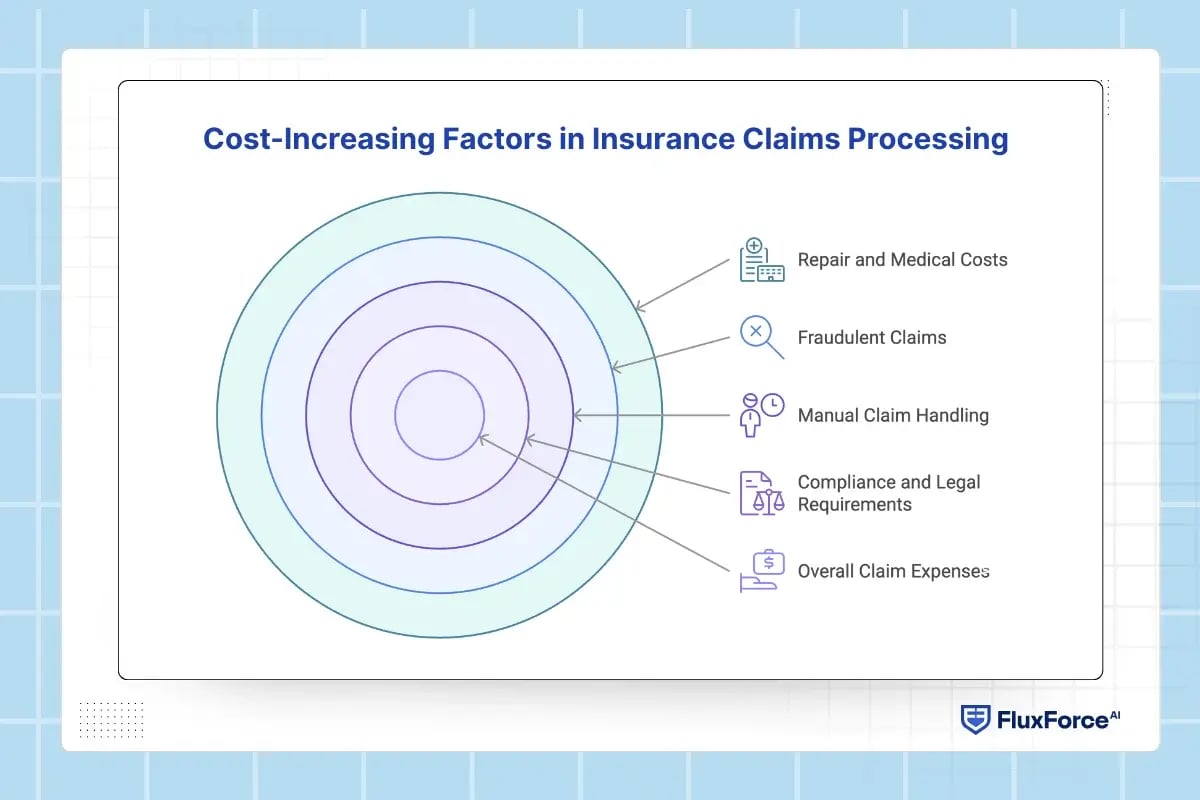 Multiple operational, economic, and technological pressures combine to push overall claim expenses higher. Common factors include:
1. Higher Repair and Replacement Costs: The rising prices of vehicle parts, construction materials, and skilled labour increase the average payout per claim. Insurers face higher repair bills, directly driving up total claim costs.
2. Growing Medical and Injury Expenses: Increasing healthcare costs, especially for accident and liability claims, significantly drive down profitability. Later hospitalization, rehabilitation, and long-term treatment further add financial pressure on insurers each year.
3. Increase in Fraudulent Claims: False or exaggerated claims are becoming more dynamic and harder to detect. Investigating these cases takes more time and resources, significantly increasing insurers’ operational and payout expenses.
4. Manual and Slow Claim Handling: Manual reviews and validations elongate claims settlement cycles. The increased time adds administrative overhead and reduces operational efficiency, leading to higher claim handling costs overall.
5. Rising Compliance and Legal Requirements: Strict regulatory standards demand additional audits, documentation, and reporting. Evolving compliance obligations increase staffing needs and administrative workloads, further increasing costs.
How Agentic AI Reduces Insurance Claim Handling Time and Cost
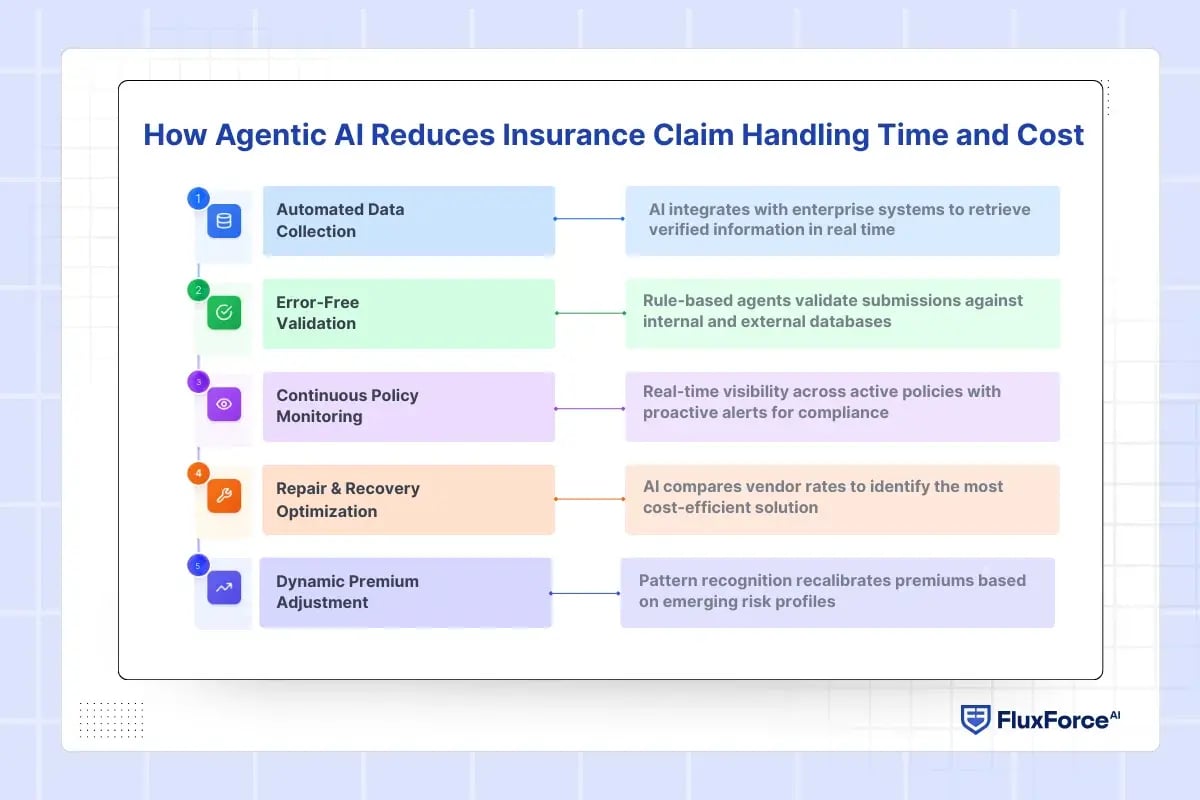
Agentic AI optimizes the claims lifecycle by autonomously analysing requests, cross-verifying information, and making optimal final decisions. Self-operated workflows enable insurers to process claims faster, minimize manual errors, and reduce related operational costs by up to 45%.
Reasons behind reduced handling time and costs:
1. Automating Multi-Source Data Collection
Agentic AI integrates directly with enterprise systems, policy databases, and third-party data sources to retrieve verified information in real time. The automated data aggregation eliminates delays and enables claim setup to begin within minutes, improving overall process velocity and decision readiness.
2. Ensuring Error-Free Claim Validation
Rule-based agents validate every submission against internal records such as policy details, billing data, and underwriting information, along with external verification databases. According to McKinsey, intelligent validation frameworks reduce rework-related delays by up to 30%.
3. Continuous Policy Monitoring
Agentic systems maintain real-time visibility across all active policies through integration with policy management infrastructure. Proactive alerts highlight coverage expirations or inconsistencies before claim progression, ensuring compliance and preventing losses.
4. Intelligent Repair and Recovery Optimization
When a claim is detected, Agentic AI compares verified repair rates and recovery options across multiple vendors. The autonomous evaluation identifies the most cost-efficient and timely solution, reducing payout amounts by up to 60%.
5. Dynamic Premium Adjustment and Risk Alignment
Continuous pattern recognition enables Agentic AI to recalibrate premium structures based on emerging risk profiles. Adaptive pricing ensures accurate risk representation, stable profitability, and balanced policy portfolios.

Key Agentic AI Integrations Across Core Insurance Processes
Agentic AI is gradually becoming part of insurers’ operational optimization systems, moving beyond pilots into core process integrations. Deloitte reports that over 82% of insurers plan to expand AI-driven process automation by 2028.
Key Integrations Include:
1. Claims Management Optimization:
Insurers integrate agentic AI within claims assessment platforms to accelerate first notice of loss (FNOL) validation and resolution. Companies such as Lemonade and AXA have expanded these systems to support continuous triage and transparent claims tracking across digital workflows.
2. Fraud Detection and Risk Evaluation
Leading insurers deploy agentic systems within fraud monitoring environments to detect early anomalies. Zurich and Prudential are examples of using these systems to strengthen fraud prevention and align detection accuracy with evolving risk models.
3. Policy Administration Efficiency
Agentic AI connects with policy administration systems to automate document synchronization, endorsements, and renewals. Generali and Liberty Mutual have integrated these frameworks to maintain operational fluidity and reduce repetitive administrative friction.
4. Underwriting Intelligence
Underwriting teams integrate AI agents with decision support tools to refine risk interpretation. Several insurers in North America now employ adaptive AI scoring systems that enhance precision and maintain underwriting consistency across diverse portfolios.
Agentic AI Efficiency in Large-Scale Insurance Claims
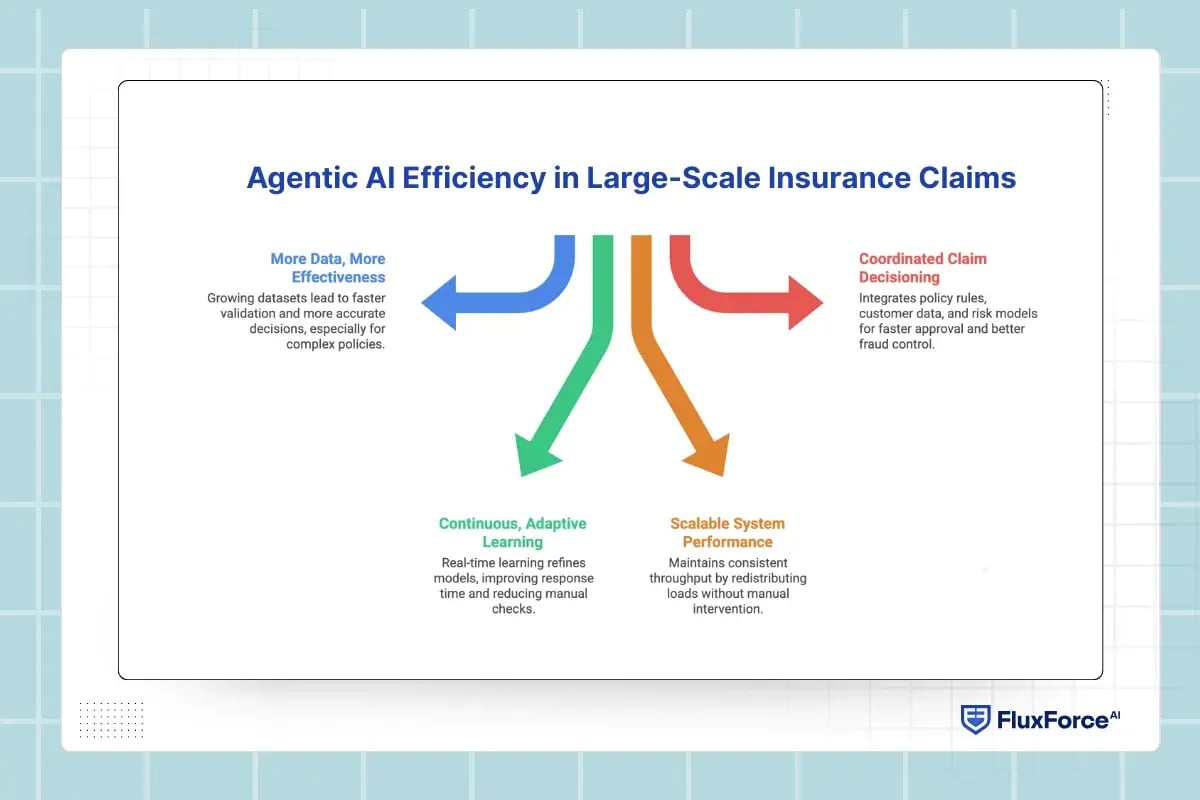
Agents adapt to high-traffic claim environments far better than traditional automation systems. With scalable datasets and an integrated machine learning model, Agentic AI drives efficiency in large-scale insurance claim processing. Here’s the
1. More Data, More Effectiveness- Each processed claim by agents strengthens its analytical power. The growing dataset enables faster validation and more accurate decisions, particularly for complex policies with multiple coverage layers.
2. Continuous, Adaptive Learning- Agents autonomously learn from every processed claim and adapt in real-time. The system refines its models after each outcome, focusing on improving response time and reducing manual checks.
3. Scalable System Performance- When claims volume surges, agentic AI redistributes processing loads across available resources without manual intervention. It maintains consistent throughput whether handling 5,000 or 50,000 claims daily.
4. Coordinated Claim Decisioning- Rather than relying on disconnected tools for intake, validation, and approval, agentic AI coordinates every decision point. It compares policy rules, customer data, and risk models in one environment, ensuring faster approval and better fraud control.
Practical strategies for improving claims accuracy using AI Agents
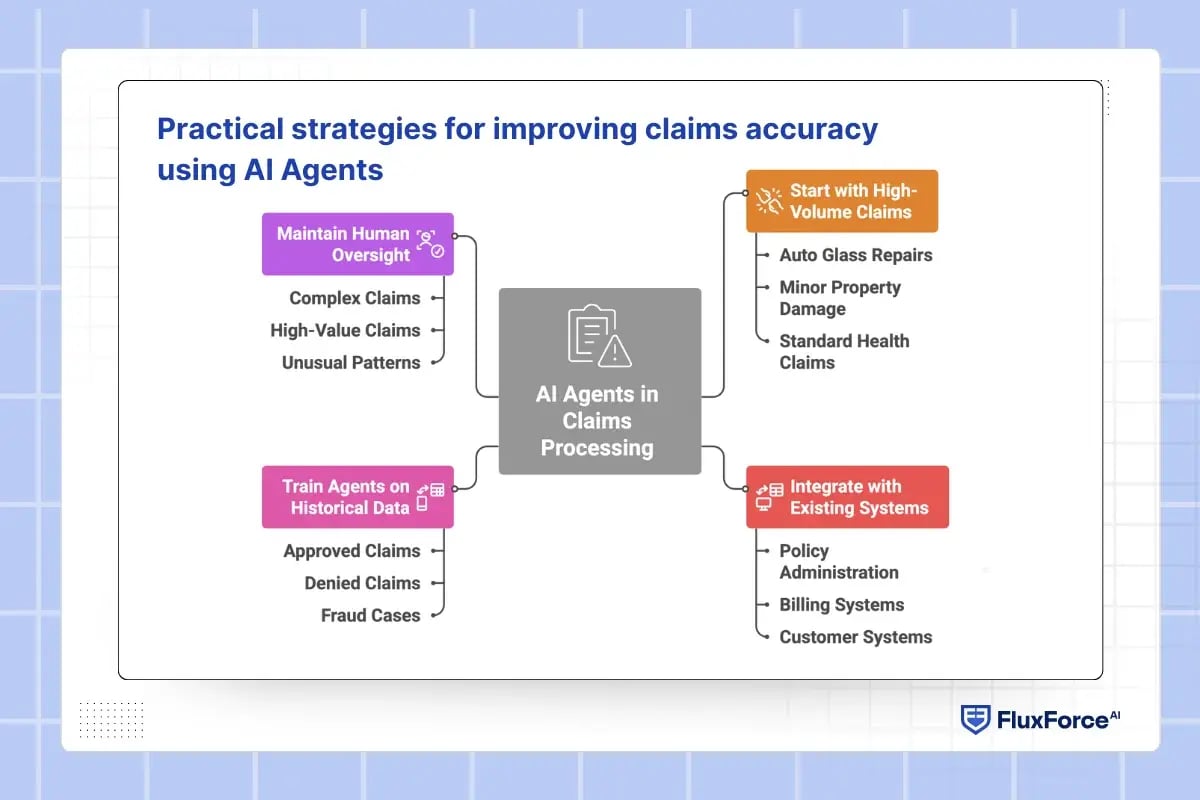
1. Start with High-Volume, Low-Complexity Claims
Deploy agents on straightforward claims first, such as auto glass repairs, minor property damage, or standard health claims. These provide quick wins and build confidence in the system. Once accuracy is proven, expand to complex claims.
2. Integrate with Existing Systems First
Connect agentic AI to your current claims management platform before replacing anything. The agents should pull data from policy administration, billing, and customer systems without disrupting workflows. Integration before transformation prevents operational disruption.
3. Train Agents on Historical Claim Data
Use 12-24 months of closed claims to train your agents before live deployment. Include both approved and denied claims, plus fraud cases and flagged scenarios. This historical training helps agents recognize patterns faster.
4. Maintain Human Oversight for Exceptions
Route complex or high-value claims to experienced handlers. Agents should flag these automatically based on claim amount, policy complexity, or unusual patterns. Human oversight prevents costly errors on edge cases and provides feedback that improves agent performance over time.
Conclusion
Agentic AI is becoming a reliable solution for insurers managing high claim volumes and operational costs. Its autonomous decision-making and adaptive capabilities streamline every stage of the claims process, from data collection to final settlement.
By minimizing manual intervention and enhancing accuracy, it helps insurers control expenses that have long strained profitability. The technology’s ability to learn and adapt ensures continuous performance improvement, supporting long-term efficiency and compliance.
As insurance policies move toward digital platforms, Agentic AI provides a stable, cost-effective foundation for sustainable growth and stronger claims management across the organization.
Share this article