



















Listen To Our Podcast🎧
.jpeg)
Introduction
If artificial intelligence has been around for years, why are so few enterprises able to prove tangible agentic AI ROI from their AI initiatives?
It’s the question that has challenged organizations since the first wave of enterprise AI investments began. Most organizations have seen promising proofs of concept but limited measurable returns. The reason isn’t the lack of innovation — it’s the gap between automation and adaptation.
According to McKinsey's 2025 State of AI Report, only a minority of enterprises have successfully scaled AI initiatives to generate consistent, measurable returns — with most still operating in fragmented deployment environments.
That gap is now being bridged by Agentic AI modules — self-optimizing, context-aware systems capable of making autonomous operational decisions. Unlike traditional automation, these modules adapt to real-time business variables, measure outcomes continuously, and self-improve based on results.
Deloitte research indicates that agent‑based AI has the potential to deliver greater long‑term financial value than traditional automation.
So, what makes this new class of AI different? The answer lies in context and autonomy.
Agentic AI understands business objectives, identifies inefficiencies across workflows, and recalibrates processes in real time.
Next, we'll examine how organizations are moving from pilot-level experimentation to scalable enterprise value — and why agentic AI has become central to achieving measurable AI investment returns and sustainable business efficiency.
Agentic AI modules drive a 300% ROI within 18 months
boost your business performance now!

How enterprises are moving from AI testing to tangible ROI ?
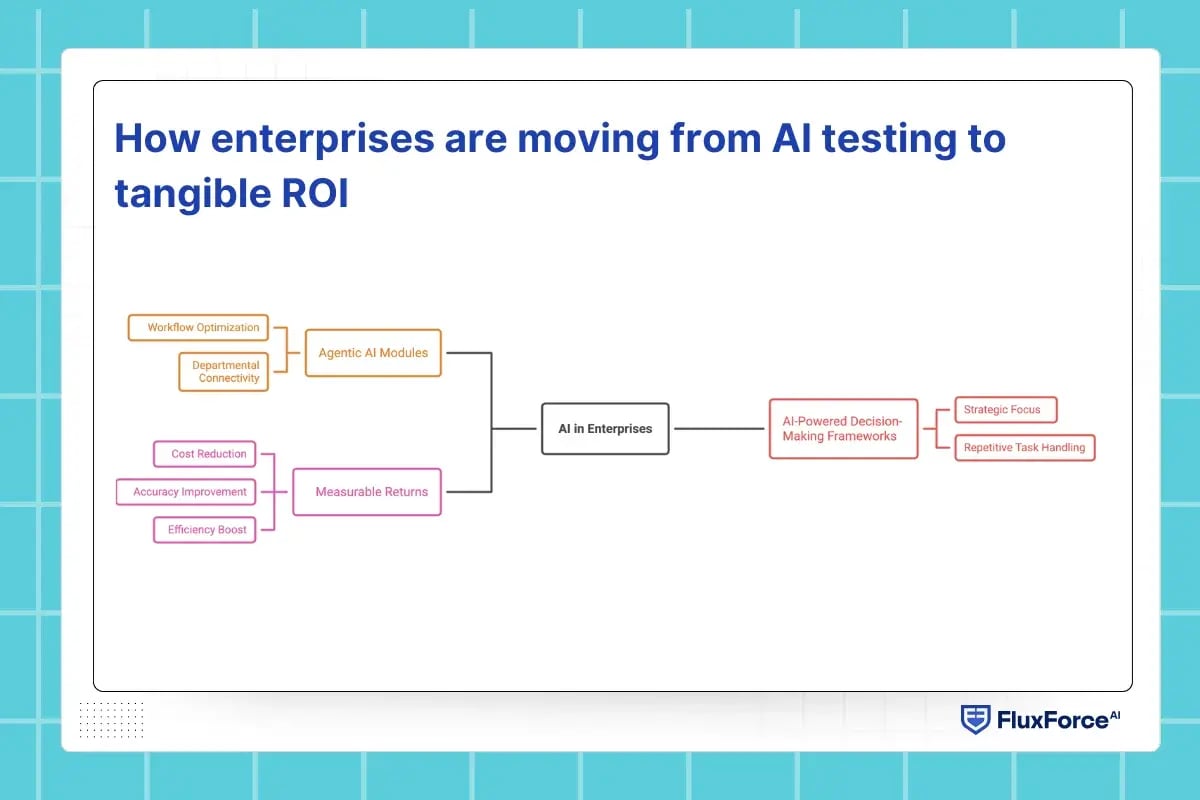
Not long ago, AI in enterprises was mostly about pilots and proof-of-concepts. Teams built models, ran experiments, and showcased early wins, but those wins rarely reached the balance sheet. The gap between innovation and impact was wide.
Now that’s changing.
Enterprises are moving beyond pilot zones by adopting Agentic AI modules that are designed for outcomes, not just analysis. These modules act as autonomous agents across business functions, optimizes workflows, cut delays, and connects departments through continuous learning.
Organizations have recognized that sustainable AI value doesn't come from a single smart tool — it comes from interconnected systems that work together. agentic AI delivers this cohesion by embedding intelligence directly into core processes such as procurement, finance, logistics, and customer operations.
Instead of running on isolated datasets, enterprises now use AI-powered decision-making frameworks that adapt to context. This allows teams to focus on strategic growth while the system handles repetitive, rule-based, or optimization-heavy work in the background.
As a result, AI become a central driver of measurable returns. Organizations have recognized that sustainable AI value doesn't come from a single smart tool — it comes from interconnected systems that work together. agentic AI delivers this cohesion by embedding intelligence directly into core processes such as procurement, finance, logistics, and customer operations.
Inside agentic AI modules: How they actually deliver ROI ?
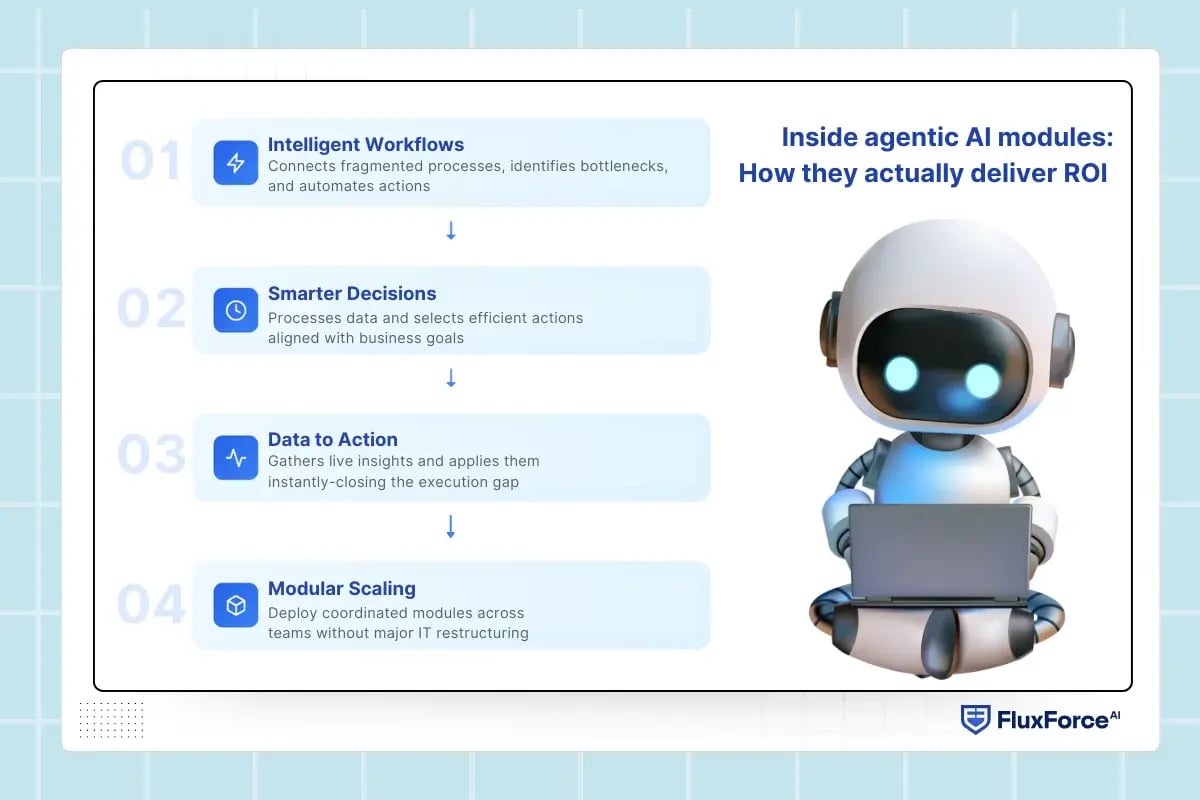
Agentic AI modules are not just another set of algorithms. They function as self-directed units that operate within an enterprise’s ecosystem to make informed, autonomous decisions. Unlike traditional automation tools that follow fixed rules, these modules are context-aware and continuously learn from how business processes behave in real time.
Here’s how they generate real and measurable ROI inside organizations.
1. Embedding intelligence directly into enterprise workflows
Most large organizations struggle with fragmented workflows across departments. Agentic AI modules act as intelligent connectors. They observe how tasks move through systems, identify bottlenecks, and automate actions when inefficiencies are detected.
In finance, for example, a module can notice repeated delays in invoice processing and automatically redirect approvals to available managers. This reduces waiting time and improves overall process speed.
2. Making smarter operational decisions
Each Agentic AI module serves as a reasoning system. It processes incoming data, evaluates multiple options, and selects the most efficient action based on current business goals.
In procurement or logistics, this means the system can adjust purchase priorities, rebalance inventory, or flag anomalies without constant human intervention. These decisions are transparent and traceable, which keeps enterprise oversight intact. For where people should still sign off, see our breakdown of human-in-the-loop AI decisions.
3. Turning data into immediate action
Agentic AI closes the gap between data analysis and execution by acting on insights the moment they emerge. It gathers live data from platforms like ERP or CRM systems, identifies patterns, and applies those insights without delay. For example, it can reallocate marketing budgets based on real-time campaign performance or recommend process adjustments when operational risks are flagged.
This direct data-to-action loop is one of the biggest reasons organizations see measurable financial returns.
4. Scaling without rebuilding
One of the most practical benefits of Agentic AI is scalability. Instead of deploying one massive AI platform, enterprises can add multiple smaller modules across departments. Each module is designed to share intelligence with others, creating a coordinated system. This modular setup lowers implementation costs and produces consistent AI-driven efficiency gains without requiring major IT restructuring. How much autonomy each module gets is its own decision. Our guide on configuring AI autonomy walks through the tradeoffs.
Through these integrated functions, Agentic AI turns automation into continuous improvement. Each cycle makes the next one more efficient, creating a compounding effect that drives sustainable ROI.
Sustaining and scaling ROI from agentic AI
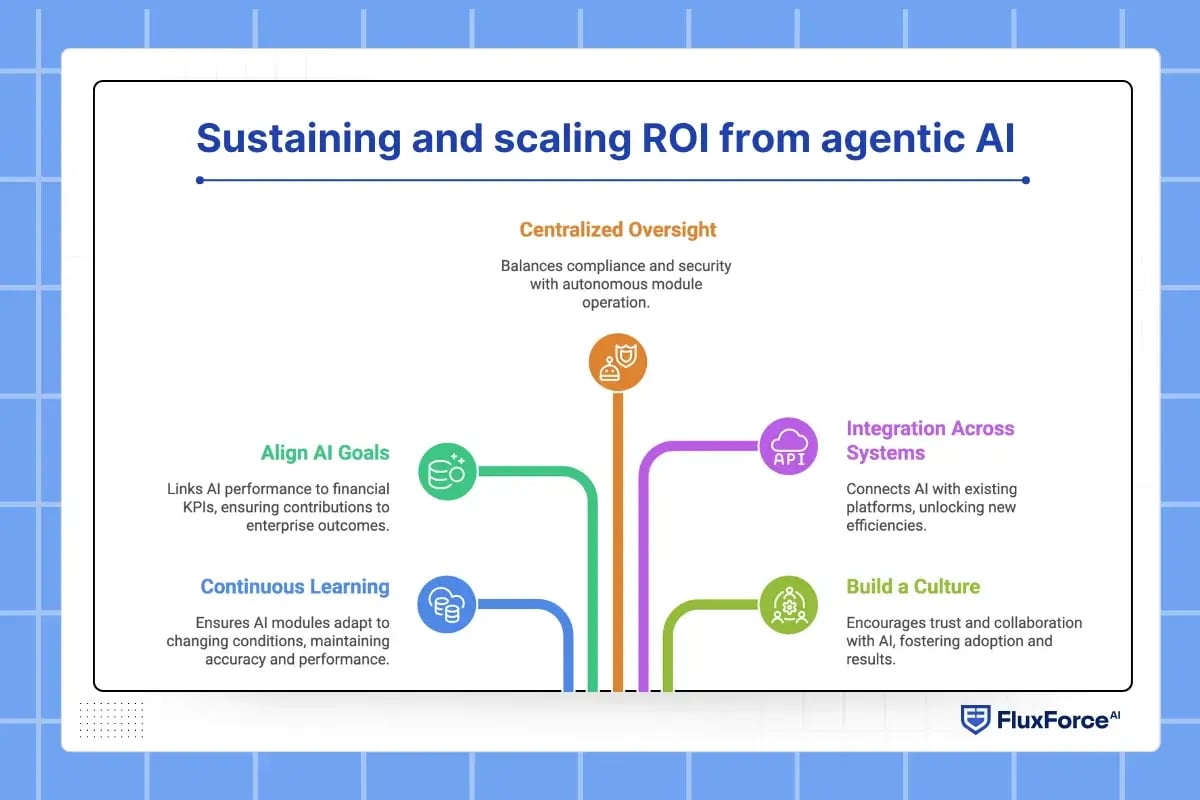
Many organizations see quick wins from early AI automation, but sustaining those gains requires structure. Agentic AI modules deliver long-term ROI only when they are integrated into continuous improvement frameworks, not treated as one-time installations.
1. Continuous learning and optimization
Agentic AI modules are designed to learn from the business environment. They track how process conditions change and adjust their models accordingly. This allows organizations to maintain accuracy and performance even when market or operational conditions shift. Regular retraining and feedback loops ensure that every module evolves in sync with business priorities.
2. Aligning AI goals with business KPIs
One of the most overlooked reasons agentic AI ROI stalls after the first year is misalignment between AI metrics and business KPIs. Successful organizations link Agentic AI performance directly to financial indicators like revenue growth, process cost reduction, and productivity improvements. For a data-backed sense of where compliance budgets are actually heading, see our 2026 compliance cost breakdown. This alignment ensures that every automation or optimization contributes to measurable enterprise outcomes.
3. Centralized oversight with decentralized intelligence
Scalability depends on balance. Enterprises use centralized governance to monitor compliance, security, and ethical use of AI, while allowing individual modules to operate autonomously. This structure minimizes risk while maintaining the flexibility that makes Agentic AI valuable.
As a result, teams in finance, logistics, and operations can innovate locally without losing visibility at the enterprise level.
4. Integration across enterprise ecosystems
Agentic AI’s strongest ROI drivers emerge when it connects with existing business systems. Seamless integration with ERP, CRM, and workflow automation platforms allows AI agents to operate in real business contexts. This level of interoperability turns data silos into shared intelligence and helps enterprises unlock new layers of efficiency.
5. Building a culture of intelligent automation
ROI from Agentic AI is not purely technical; it is cultural. Organizations that encourage teams to trust, monitor, and collaborate with AI systems see faster adoption and stronger results. When users understand how AI decisions are made, they refine processes more effectively, turning intelligent automation into a competitive advantage.
Agentic AI’s scalability lies not just in how well it automates tasks, but in how easily it adapts to evolving business needs. The real value begins when enterprises shift from measuring automation to measuring intelligence.
Agentic AI modules drive a 300% ROI within 18 months
Boost your business growth today.
Calculating Agentic AI ROI: A Simple Framework
Most finance teams ask for a number before they approve an agentic AI rollout, and that number needs a formula, not a feeling. We calculate agentic AI ROI by comparing three things: the labor hours reclaimed from a task the module now handles, the error and rework costs it removes, and the revenue effects of faster cycle times (an invoice approved two days sooner, a fraud flag caught before the funds move).
- Baseline the current process cost before deployment, including the manual review hours nobody tracks in a spreadsheet.
- Measure the module's output against that baseline monthly, not quarterly. Agentic systems improve fast in the first 90 days, and a quarterly check misses the curve.
- Separate one-time integration costs from ongoing model and infrastructure spend so the ROI figure doesn't get diluted by setup work in year two.
Banks and mid-market lenders that follow this framework typically see the first positive agentic AI ROI signal inside two to three quarters, well ahead of the 18-month mark most vendors quote.
Conclusion
For years, enterprises invested in automation but struggled to link it to financial impact. Agentic AI closes that gap. By creating systems that analyze and act within context, it converts automation into actual business results. Whether through faster approvals, reduced downtime, or optimized resource use, the financial returns are clear and repeatable.
Explainability also plays a key role in sustaining this value. “How XAI Improves ROI for AI Investments in Banking” highlights how transparent AI decisions reduce risk, improve trust, and enhance financial outcomes over time.
Agentic AI is not an experiment anymore. It is an ROI multiplier built into the enterprise core.
Share this article