


















Listen To Our Podcast🎧
Introduction
Can today’s security teams really keep up with cyberattacks that happen within seconds?
For years, cybersecurity has relied on manual monitoring, rule-based alerts, and human response teams. These methods worked when attacks were slower and more predictable. But the situation has changed. Modern hackers use automation, AI, and real-time coordination that traditional systems cannot match.
This is where Agentic AI comes into play. It refers to smart AI systems that can make decisions and take action on their own. Instead of waiting for instructions, these autonomous AI agents can detect, analyze, and respond to threats instantly. This is the foundation of a new approach known as AI-driven cybersecurity where AI becomes an active part of security operations rather than a supporting tool.
Why zero trust and Agentic AI work well together
Traditional security models often assume that internal systems can be trusted once someone gets access. That idea no longer works. Zero trust architecture starts from the belief that no one should be trusted automatically, whether inside or outside the network.
Agentic AI supports this approach by:
- Continuously verifying every user and device.
- Detecting unusual behavior and applying restrictions instantly.
- Powering identity and access management with agentic AI that keeps systems secure in real time.
In short, Zero Trust provides the security rules and Agentic AI makes sure those rules are followed all the time.
Why business leaders should pay attention towards this
- Speed: Agentic AI reacts to threats within seconds, reducing the time attackers stay unnoticed.
- Efficiency: ML-powered threat detection helps filter thousands of alerts so analysts can focus on what truly matters.
- Accuracy: Organizations using agentic systems report 30 to 40 percent better detection rates and faster containment of incidents.
- Value: In sectors like finance and defense, AI agents are improving banking compliance automation and autonomous risk scoring, helping organizations meet strict regulations while staying secure.
Agentic AI is powerful, but it is not a simple plug-in tool. It requires clear policies, proper data handling, and skilled teams to guide it. t the moment, only a small number of organizations have fully deployed these systems, but adoption is increasing rapidly as companies see their practical results.
Agentic AI is already changing how cybersecurity teams' work. It moves security from being reactive to being proactive. Yet a bigger challenge is emerging. With quantum computing threats becoming real, current encryption methods may soon fall short.
The quantum shift: Why today’s encryption will not be enough tomorrow
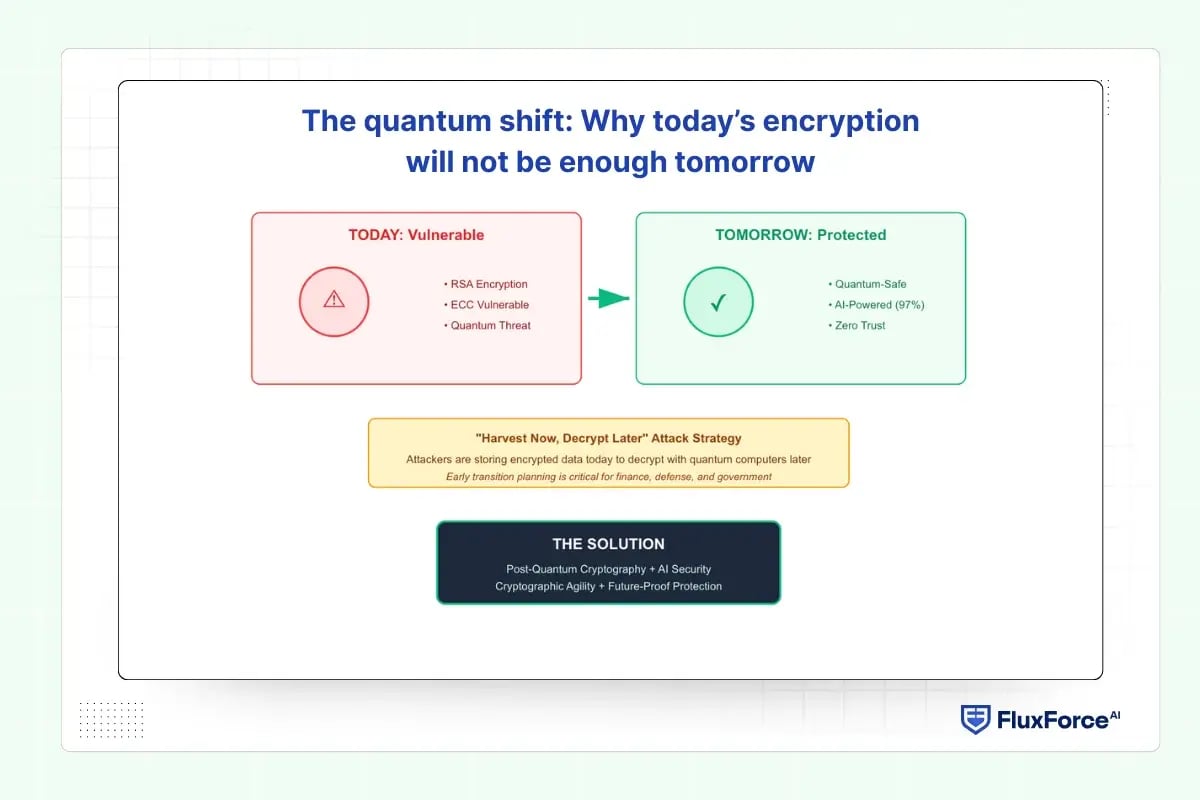
Quantum computing can process data far faster than classical systems, which means it can easily break existing encryption and ECC. This makes traditional models unreliable for long-term data protection. To stay secure, organizations are moving toward quantum-resistant cryptography and post-quantum security.
Quantum computing threats are already influencing cybercrime strategies. Attackers can steal encrypted data today and decrypt it later once quantum tools are available. This risk demands early transition planning, especially in finance, defense, and government sectors.
The solution
Adopting quantum-safe encryption and cryptographic agility allows enterprises to upgrade encryption methods without redesigning systems. These models ensure operational continuity and future-proof protection against both classical and quantum attacks.
How AI helps
Agentic AI and AI-driven cybersecurity enable real-time adaptation. Active AI agents already prevent fraud, enforce zero trust architecture, and automate compliance checks with over 97% accuracy. This fusion of AI and encryption strengthens overall resilience.
Early adoption of future-proof data security and post-quantum encryption for financial institutions will define which enterprises remain secure in the next computing era.
How Agentic AI and quantum security work together
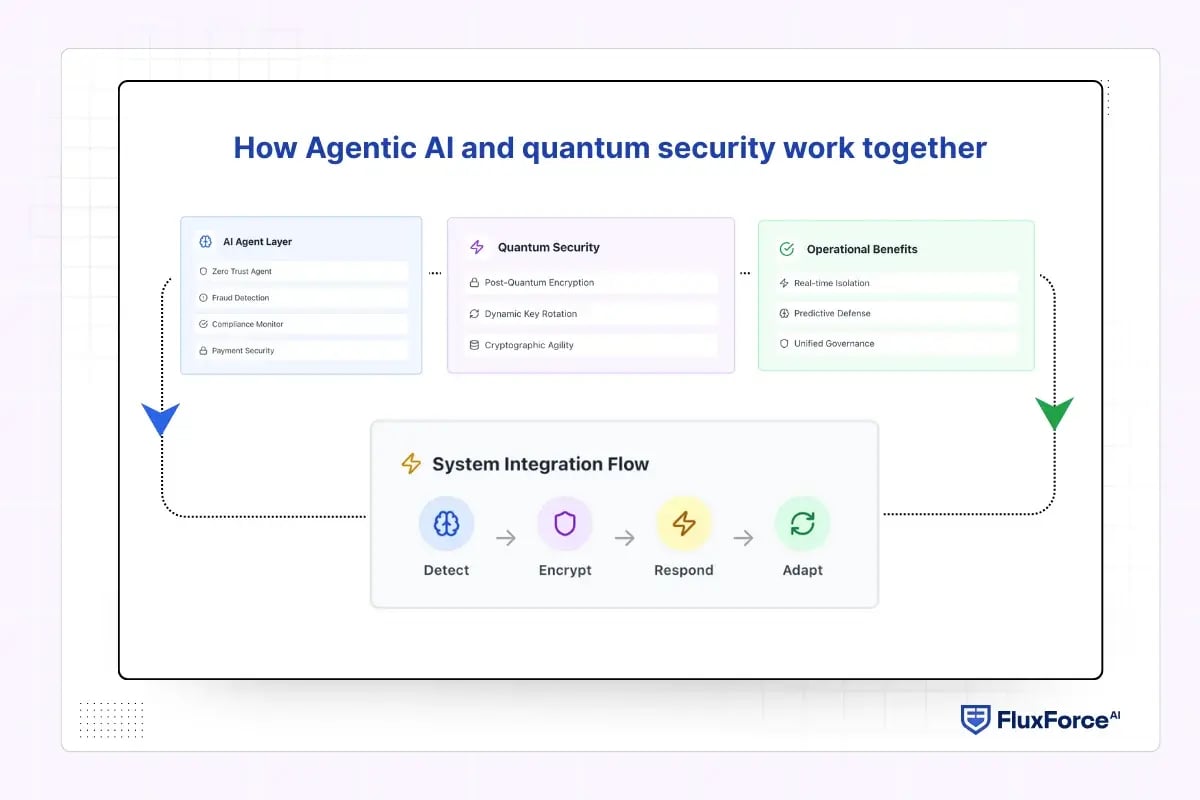
In real-world cybersecurity, delays in detection are what cause major breaches. Integrating Agentic AI with quantum-resistant cryptography directly addresses this by creating systems that can act before the threat completes its cycle.
These AI agents do not just automate responses, they interpret behavioral data, compare it against known attack patterns, and apply post-quantum security measures instantly. It’s about creating a synchronized network that continuously audits and protects every layer of infrastructure.
How the system operates in real time
In practice, each layer of the defense stack works under strict verification and encryption rules.
- The zero trust security agent operates as a gatekeeper. It enforces zero trust architecture by re-authenticating every device and user, even those inside the network perimeter.
- The fraud detection agent analyzes live transaction data through ml-powered threat detection models that track patterns across thousands of variables simultaneously.
- The compliance monitoring agent cross-references every access and data exchange with evolving policies, adjusting encryption models in line with cryptographic agility.
- The payment security agent runs on quantum-safe encryption to ensure transaction confidentiality, even against quantum-level attacks.
This continuous orchestration between agents forms a living security fabric—each node learns, shares, and adapts based on context.
Operational advantages for enterprises
From a leadership perspective, this integration changes the entire operational model of cybersecurity. Instead of periodic updates or manual oversight, organizations operate with:
-
Continuous encryption renewal:
Encryption keys evolve dynamically to match risk levels.
-
Real-time incident isolation:
Agents can quarantine compromised sessions within milliseconds.
-
Predictive security operations:
AI models forecast potential intrusion paths and preemptively close them.
-
Unified governance control:
All actions are logged automatically for compliance validation across banking compliance automation and identity and access management with Agentic AI.
This architecture reduces downtime, lowers response costs, and keeps infrastructure aligned with global post-quantum standards.
Strategic insight for decision-makers
Enterprises investing in Agentic AI for real-time fraud prevention and transition strategies to quantum-safe cryptography are not just protecting data but are building adaptive systems that evolve faster than cyber threats.
In practice, this means the organization’s defenses become self-learning, auditable, and inherently scalable. That’s how quantum security and Agentic AI move from a defensive function to a strategic business enabler.

Building quantum-ready enterprises: Operational models for scalable security
Moving from readiness to action
Preparing for the quantum era is not about waiting for threats to arrive. It’s about shaping systems that can adapt and stay strong under new risks.
Leading enterprises treat security as a continuous process — one that learns, improves, and protects without slowing operations.
By combining intelligent automation with modern encryption, companies can protect data while keeping business performance steady.
Core pillars of a quantum-ready model
Adaptive security governance
Traditional security policies are too rigid for evolving digital systems. Adaptive governance allows policies to evolve automatically, guided by real-time data and intelligent insights. This ensures that compliance and protection adjust with changing risks and regulations.
Autonomous compliance and risk control
Manual compliance checks are slow and error-prone. Automated agents now monitor user access, detect irregular activity, and record audit data instantly. This improves accuracy and keeps compliance consistent across departments.
Zero trust expansion at scale
As networks expand across multiple clouds and connected devices, continuous verification becomes essential. Zero trust ensures that every access request is verified before approval. Intelligent agents handle this in the background, maintaining both security and efficiency.
Continuous quantum-safe encryption
Encryption must evolve as technology advances. A modern system updates keys regularly and upgrades to new encryption standards as part of its routine process. This helps keep sensitive information safe from both current and future attacks.
Business advantages of quantum-ready systems
Building quantum-resilient operations brings measurable value:
- Reduced cost and time for compliance
- Stronger protection against data breaches and fraud
- Improved trust among customers and partners
- Better risk management for long-term stability
When executed well, security shifts from being a cost center to becoming a growth enabler.
Strategic insight for leaders
Businesses that begin this transition now will lead the next phase of digital security. Quantum readiness is not a technology investment alone — it’s a commitment to operational resilience and trust.
Executives who plan today will build systems capable of securing every transaction, identity, and interaction in the coming decade.
How intelligent AI systems predict and prevent quantum-age threats
Understanding the new shape of cyber risk
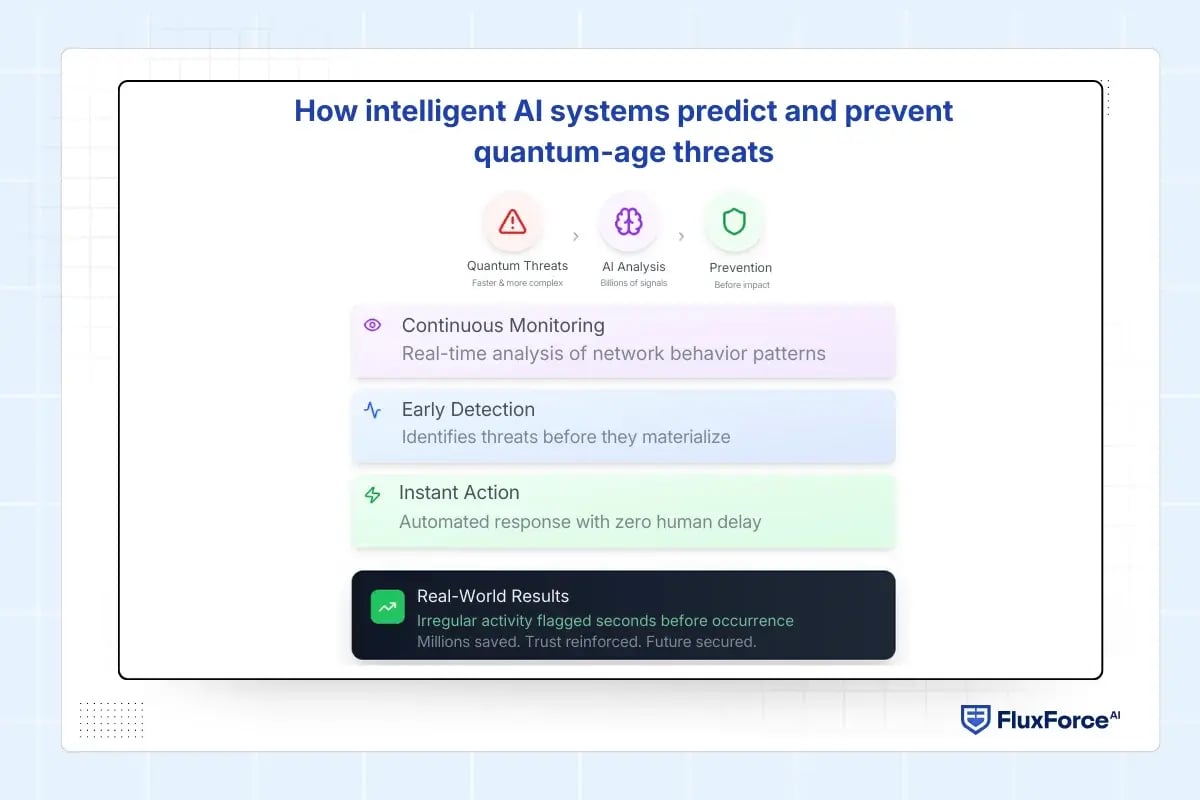
In the quantum era, threats will emerge faster and target more complex digital ecosystems. This shift demands a defense system that respond before an attack unfolds.
AI-driven cybersecurity introduces that capability. Instead of reacting to alerts, intelligent agents analyze network behavior, detect early signals of breach attempts, and prevent them in real time.
The predictive power of agentic AI
Agentic AI brings self-learning agents that operate independently yet align with enterprise security goals. These agents continuously study system patterns, identify risks, and take corrective action without human delay.
In real-world operations, predictive models built on machine learning analyze billions of signals daily — from access patterns to transaction anomalies. This allows organizations to stay ahead of both known and unknown threats.
Example in action:
A predictive fraud prevention system can flag irregular financial activity seconds before it occurs. This proactive defense saves millions in potential loss and reinforces customer confidence in digital transactions.
Modern AI agents build dynamic threat profiles, simulate attack paths, and calculate potential impact. The insights they produce allow enterprises to strengthen weak points in advance rather than after a breach.
Building an ecosystem of predictive defense
Predictive defense is most effective when integrated across all business layers. A connected ecosystem of intelligent agents can:
- Detect identity-based attacks in real time
- Secure financial transactions across platforms
- Monitor compliance status continuously
- Adjust protection models as new regulations or quantum risks arise
By combining these capabilities, enterprises create a living security network that evolves alongside digital threats.
Conclusion
The real transformation in cybersecurity has already begun. Agentic AI is reshaping how organizations detect and act on threats, while quantum-resistant cryptography is laying the foundation for data protection that can survive the next era of computing. Together, they form a new standard for digital trust — one that is proactive, intelligent, and built to last.
Those who start integrating these technologies today will define the benchmarks for security, reliability, and innovation in the years ahead.
Share this article