.webp)





Listen To Our Podcast🎧
Introduction
Banks use AI to approve loans, detect fraud, monitor transactions, and speed up customer service. But inside many financial institutions, there is a harder truth: teams can see the result, but not always the reason behind it. That gap is why explainable AI matters.
Financial services cannot treat AI like retail or media. A wrong product recommendation is inconvenient; a wrong loan decline, salary block, or fraud flag can create real financial harm. Regulators, auditors, and customers all want the same answer: why did the system decide this way?
When AI runs inside on-prem AI infrastructure, the bank itself must provide that answer with evidence.
The Daily Pain Inside On-Prem AI Infrastructure
Most banks still run on long-established core systems built for rules, not machine learning. Now those same environments are expected to host models that learn from data and change behavior over time. That creates daily problems for technology and compliance teams:
- Risk officers cannot easily trace which data points influenced a decision
- Audit teams struggle to maintain a clear AI audit trail
- Business leaders hesitate to expand AI because they fear regulatory questions
- Customers demand reasons that frontline staff cannot provide
This is why trustworthy AI matters more than raw accuracy. A model may perform well in testing, but if it cannot be explained, most banks will not use it in critical processes like credit approval or fraud review.
In practice, the lack of AI transparency slows AI projects more than budget or talent shortages. Banks are not rejecting AI. They are rejecting black boxes. Decision makers want systems that speak the language of banking, not the language of data science.
A compliance head from a regional bank described it in simple words:
“We are not afraid of AI. We are afraid of not being able to justify AI.”
For institutions that rely on private environments, the challenge is even deeper. Data often cannot move to the cloud due to security rules and national regulations. This means every part of the model—from training to explanation—must live within the same on-prem AI infrastructure. Many popular explainability tools are designed for cloud setups and do not fit this reality.
At the same time the business pressure is growing. Fraud attacks are increasing, customers expect instant decisions, and competition from fintechs is intense. Banks need automation, but they also need clear reasoning behind every automated step. Interpretable machine learning has now become a daily operational requirement.
The core question for financial institutions therefore becomes practical:
- How can a bank use advanced AI while keeping full control on its own systems?
- How can teams provide clear explanations to regulators and customers?
- How can innovation move forward without increasing compliance risk?
This blog answers these questions with a focus on real banking environments and on-prem AI infrastructure, not ideal lab conditions.

Understanding Explainable AI for Banking Systems
Artificial intelligence is no longer a side project in banking. It now sits inside credit engines, payment monitoring, treasury forecasting, and customer onboarding. The difficulty is not whether AI works. The difficulty is proving how it works inside existing on-prem AI infrastructure.
Banks operate on accountability. Every decision must be defendable to a customer, an auditor, and a regulator. A model that predicts well but cannot explain itself creates operational risk. Explainable AI has moved from a technical preference to a core banking requirement.
From Model Output to Decision Evidence
In financial institutions, a decision is not complete until it can be justified. A credit score without reasoning is only half a process. Relationship managers need explanations they can communicate. Risk officers need traceable logic they can review. Compliance teams need documented proof for regulators.
AI explainability converts mathematical outputs into decision evidence:
- which variables shaped the result
- how strong each factor was
- whether the behavior aligned with policy
- what could change the outcome
This layer turns AI from a prediction tool into an operational system that fits banking controls.
Explainable AI for Banking Systems: Practical Domains
Credit and Underwriting
Lending remains one of the most sensitive AI applications. Models influence who receives money and at what price. With interpretable machine learning, banks can show that decisions are based on financial behavior rather than hidden bias.
Financial Crime and Fraud
Fraud platforms process millions of events daily. Analysts must know why an alert was raised before freezing an account. XAI in finance provides transaction-level reasoning such as pattern deviation, network risk, or device anomalies.
Collections and Portfolio Management
AI recommends priorities and repayment strategies. Explanations ensure these recommendations respect vulnerability guidelines and internal policies. Portfolio managers can also understand macro drivers behind risk shifts.
Customer Interaction
Advisory and chatbot systems must offer transparent reasoning. Customers trust digital channels only when suggestions sound logical and personal.
How Explainable AI Supports Regulatory Compliance ?
Regulators have been specific about what they expect. SR 11-7 requires model documentation and validation before deployment. The EU AI Act Article 13 requires transparency for high-risk AI systems. DORA requires operational resilience documentation including AI systems. GDPR Article 22 covers automated decision rights. These aren't emerging requirements — they're active enforcement frameworks. An OCC examiner walking into a model risk review expects to see documentation that answers each of them.
Explainability converts model behavior into compliance documentation. Instead of presenting an algorithm to an examiner, the team presents a decision narrative: what data the model used, which factors drove the outcome, how the decision compared to policy thresholds, and what the audit log shows for that specific case. That's the difference between a clean examination and a findings letter.
For model risk teams, XAI becomes part of the control environment, similar to validation reports or policy checks. For compliance officers, it becomes evidence that automated processes remain within regulatory boundaries.
Operating Inside Legacy and Private Environments
Unlike digital startups, banks run on decades of technology. Core systems, data warehouses, and security controls are deeply embedded. AI must adapt to this reality rather than replace it.
This makes private AI infrastructure the default choice. Explainability tools must:
- work close to sensitive data
- respect internal access policies
- integrate with existing model lifecycle
- support offline and controlled networks
Cloud-first explanations are often impractical for critical banking workloads. Real value appears when XAI functions directly within on-prem AI infrastructure where the actual decisions occur.
Strategic Value Beyond Regulation
While compliance triggered interest in XAI, operational benefits are equally strong:
- shorter investigation cycles in fraud
- higher approval throughput in lending
- faster model validation
- stronger collaboration between risk and data teams
There's a consistent pattern: AI adoption inside a bank accelerates once risk and compliance teams can read what the model is doing. The bottleneck was never enthusiasm for AI. It was the inability to sign off on something you can't explain.
XAI for On-Premise Banking Infrastructure
Production AI in a bank runs in a controlled data center, on a legacy core platform, behind a firewall with access controls that haven't changed in a decade. XAI has to work in that environment. Not a demo environment. Not a cloud sandbox. The actual production environment where the decisions happen.
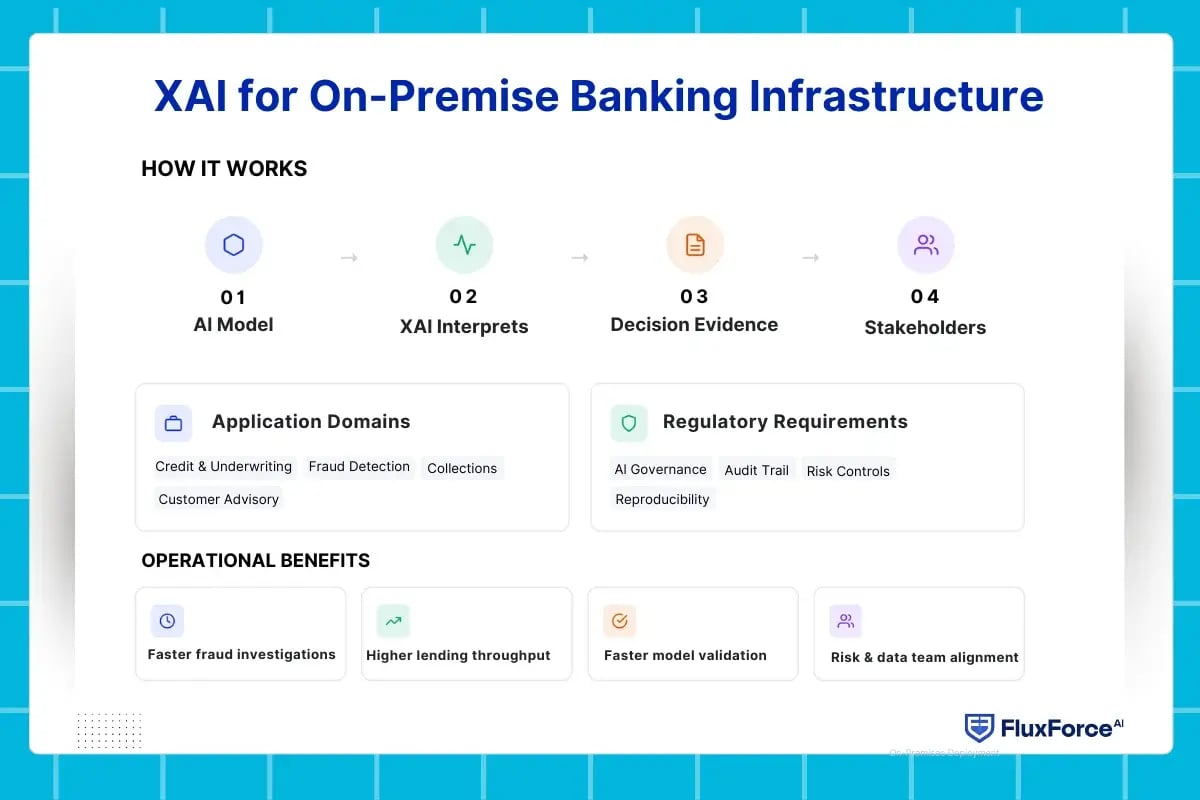
If the model runs in a restricted data center and the explanation is generated by a separate cloud service, the audit trail has a gap. The explanation doesn't trace back to the actual inference. Under SR 11-7's model documentation requirements, that gap is a finding.
Explainability in banking is less an algorithm problem than a placement problem. The fraud alert that a sanctions block generates has to be explainable inside the same environment that holds the customer record and the compliance history. Moving data to an external tool for interpretation creates a data governance issue, adds latency that real-time operations can't absorb, and breaks the chain of custody that auditors need to trace.
Making Explainability Work with Legacy Platforms
Legacy integration is the practical challenge most XAI vendors underestimate. Core banking platforms handle accounts. Payment rails handle transactions. Risk engines handle exposure calculations. None of them were designed to emit explanation metadata. The answer is an interpretation layer that reads the same inputs the model uses and produces a structured rationale alongside the decision, without touching the core system.
In practice: a credit engine produces a score of 643. The XAI layer produces alongside it: "Primary drivers — high credit utilization (38% vs. 25% policy threshold), two missed payments in last 6 months. Mitigating factors — income stable, tenure 4+ years." The decision stays inside the existing workflow. The relationship manager has something to discuss with the customer. The auditor has something to file. Nothing in the core system changed.
Why Location of Explanation Matters ?
In financial services, explanations are evidence. Investigators need to open a case and immediately see why a system acted. Compliance officers must reproduce the logic months later. If the explanation is generated in a separate environment, the chain of custody breaks. Embedding XAI directly within on-prem AI infrastructure preserves that chain and supports reliable AI audit trail records.
Speed matters in fraud operations more than almost anywhere else in banking. A payment authorization decision happens in under 200 milliseconds. The investigation window on a suspicious transaction is often 30-60 minutes before the customer calls. If the explanation requires a round-trip to an external analytics layer, that window shrinks.
Everyday Use Inside the Bank
The output isn't a visualization or a model card. It's a working note in the case screen. "Transaction flagged: device location changed from UK to Nigeria, amount 280% above 30-day average, new payee." Or in lending: "Application declined: two missed payments in Q3, credit utilization 41%, income-to-debt ratio outside policy range." An investigator reads it in 10 seconds and makes a decision. A loan officer reads it and calls the customer with something useful to say.
The operational benefit compounds over time. Data scientists stop spending afternoons explaining model behavior to risk teams. Frontline staff stop saying "I'll have to check with the back office" in customer conversations. Risk managers can run a validation review in hours rather than days because the documentation is already there. That's what trustworthy AI looks like in practice.
Security and Control Considerations
Financial institutions treat explanations with the same sensitivity as personal data. Access must follow existing identity rules, and records must be immutable. By keeping XAI inside secure AI systems on premises, banks can apply familiar controls instead of inventing new ones. The explanation becomes another regulated artifact, similar to transaction logs or call recordings.
Growing Without Disruption
Adopting explainability does not need a big transformation program. Many banks begin with a single high-impact process such as fraud monitoring or credit origination. Once teams see value, the same pattern extends to other domains. The infrastructure remains the same; only the interpretation layer expands. This gradual path fits the cautious culture of financial institutions and protects operational stability.
How Explainable AI Supports Regulatory Compliance ?
The compliance argument for XAI isn't theoretical. SR 11-7 requires model documentation. The EU AI Act requires transparency for high-risk systems. GDPR Article 22 requires explanation rights for automated decisions. DORA requires operational resilience records. A bank deploying AI without embedded explainability is building a compliance deficit that compounds with every decision the model makes.
What regulators specifically ask for: the data inputs used in the decision, the model version active at the time, the key factors that drove the outcome, evidence of bias testing, and the ability to reproduce the decision under examination. Those five elements are the standard model documentation checklist for SR 11-7 and EBA model risk guidelines. XAI provides four of them automatically if it's embedded in the production workflow.
A strong AI governance framework relies on traceability. Each automated decision needs an AI audit trail that records inputs, model logic, and key drivers. Without these records, even high-performing models become compliance risks and are difficult to defend during reviews or customer disputes.
Explainability also catches model risk problems before they become regulatory findings. If a fraud model starts placing disproportionate weight on a single variable — say, geographic location — the explanation layer surfaces that pattern before it becomes a disparate impact issue. In a standard monitoring setup that only tracks aggregate accuracy, the bias can accumulate for months before it appears in outcome data.
Customer trust is an operational outcome, not a principle. A customer who understands why a payment was blocked is less likely to call the contact center, less likely to file a complaint, and more likely to provide the additional verification that resolves the case. That reduces complaint volumes and contact center load.
Explainable AI therefore acts as the bridge between innovation and regulation. It enables financial institutions to modernize with confidence while keeping decisions controlled, fair, and audit-ready.
Challenges in Explainable AI for On-Prem AI Infrastructure
The case for XAI is clear. The deployment challenges are real. Here's what banks actually encounter.
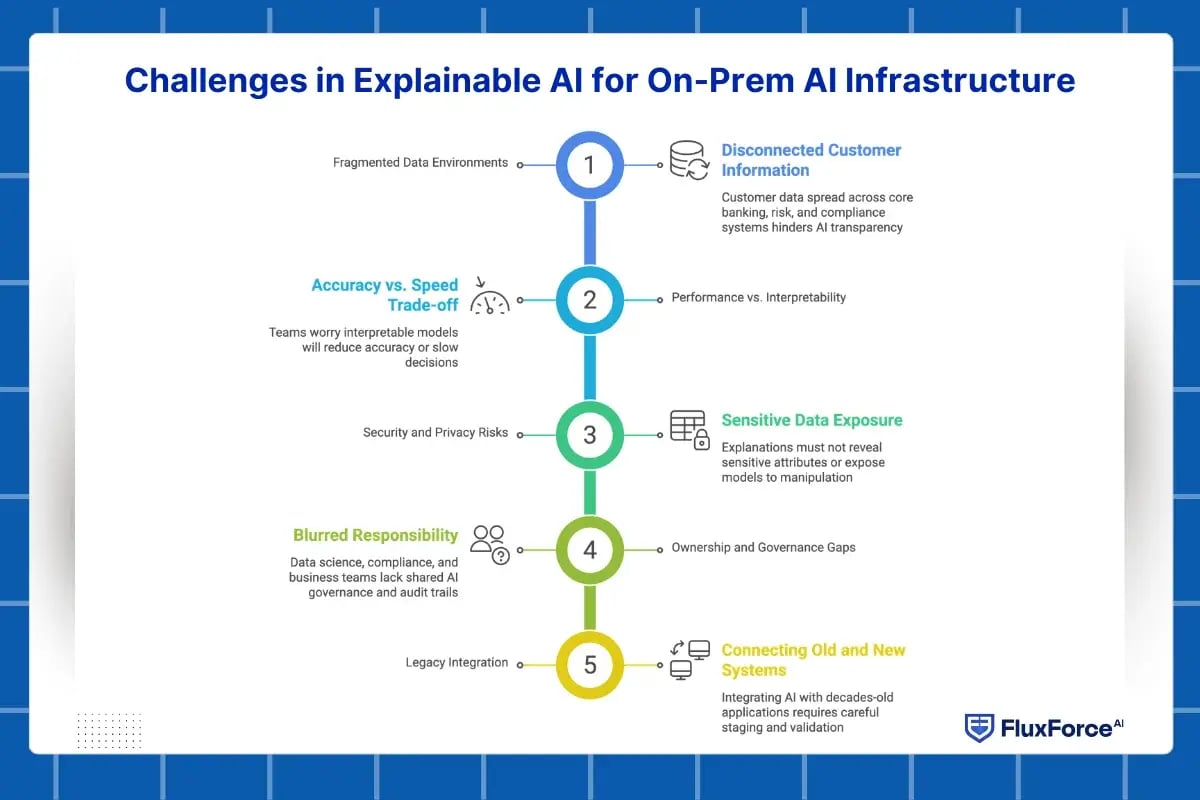
Existing technology stacks, security rules, and regulatory pressure make it difficult to deliver clear explanations inside on-prem AI infrastructure.
Fragmented data environments are the first challenge. Customer information is spread across core banking, risk platforms, and compliance systems that were never built for modern AI. When models pull from disconnected sources, explanations become inconsistent and AI transparency suffers.
Performance versus interpretability is another concern. Teams worry that interpretable machine learning will reduce accuracy or slow decisions. The real issue is poor model design. Well-structured AI can remain fast while still providing readable reasons for every outcome.
Security and privacy risks also create hesitation. Explanations must not reveal sensitive attributes or expose models to manipulation. Building secure AI systems within private AI infrastructure requires strict access controls and encrypted audit logs.
Ownership and governance gaps complicate operations. Data science teams create models, but compliance and business teams must defend them. Without a shared AI governance framework and a reliable AI audit trail, responsibility becomes blurred during reviews.
Legacy integration remains a persistent obstacle. Many institutions rely on decades-old applications. Connecting them with AI for legacy systems and on-premise machine learning, demands careful staging and validation to avoid disrupting daily operations.
These challenges are real, but they are manageable. Institutions that address them methodically can turn explainability into a control layer that strengthens trust rather than slowing innovation.
Business Impact and Measurable Outcomes
Explainable AI delivers value only when it improves daily banking operations. 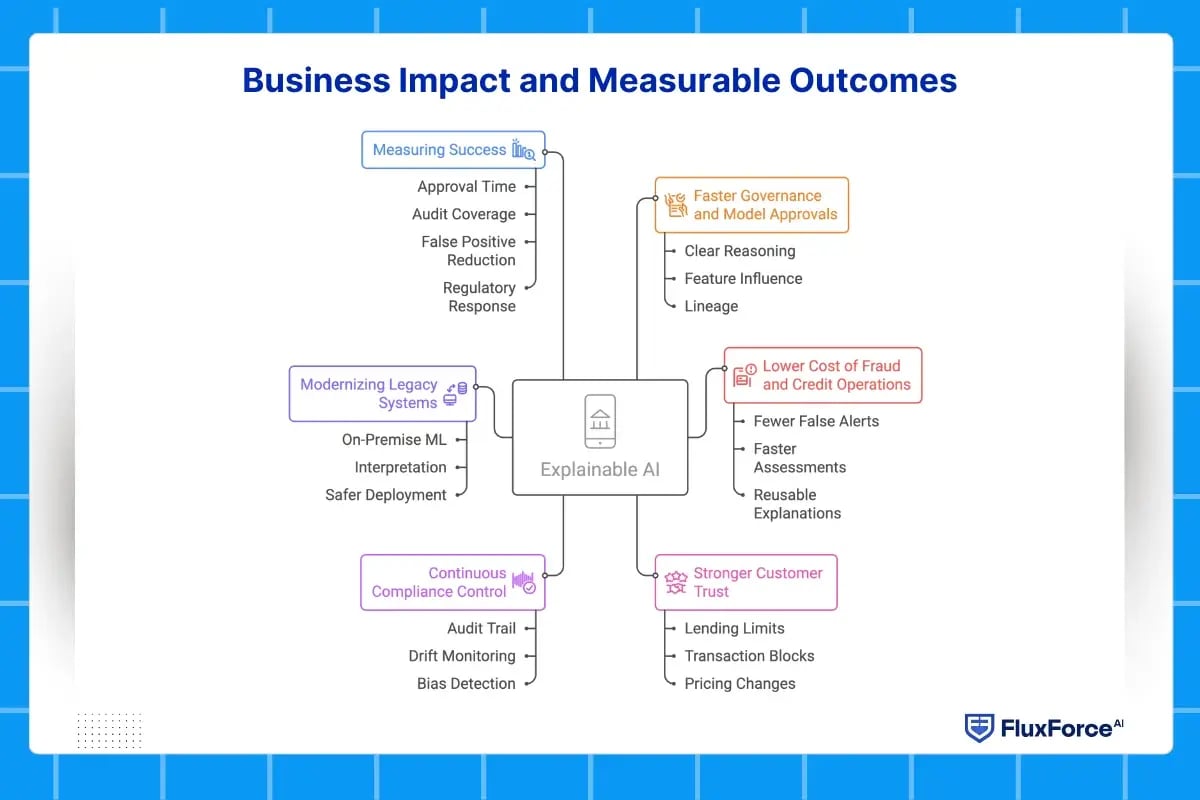 Within on-prem AI infrastructure, transparency becomes part of the production workflow rather than a reporting exercise. The impact appears across speed, cost, compliance, and customer experience.
Faster Governance and Model Approvals
Risk and compliance teams often delay AI adoption because decisions cannot be justified. With AI model explainability embedded on-prem, approval cycles shorten because every decision carries clear reasoning, feature influence, and lineage.
This directly supports AI governance framework reviews and reduces back-and-forth between data science and audit teams.
Lower Cost of Fraud and Credit Operations
Explainable decisions cut investigation time. Analysts no longer validate raw scores; they review structured reasons.
Inside on-premise AI, institutions achieve:
- Fewer false fraud alerts
- Faster credit assessments
- Reusable explanations for customer queries
This strengthens AI risk management while keeping sensitive data inside controlled environments.
Stronger Customer Trust
Customers accept decisions when they understand them. Transparent reasoning improves acceptance of lending limits, transaction blocks, and pricing changes. This is the core of trustworthy AI and a practical benefit of explainable AI for financial institutions.
Continuous Compliance Control
Regulators expect more than accurate models. They expect traceable logic. With AI audit trail capabilities in on-prem AI infrastructure, banks can monitor drift, bias, and policy violations before they become incidents, supporting explainable AI compliance.
Modernizing Legacy Systems
Explainability allows institutions to extend existing platforms instead of replacing them. AI for legacy systems can be layered through on-premise machine learning, creating interpretation over old decision engines without major rewrites. This enables safer enterprise AI deployment.
Measuring Success
Organizations track explainability through clear indicators:
- Time required for model approval
- Coverage of decisions with audit evidence
- Reduction in false positives
- Response time to regulatory requests
These metrics connect interpretable machine learning directly to financial outcomes.
Conclusion
AI adoption in financial institutions depends on one factor: trust. Models must not only predict outcomes but also explain them in a way that risk teams, auditors, and regulators can accept. Explainable AI for banking systems makes this possible by turning opaque decisions into clear, traceable reasoning.
For institutions running AI on private infrastructure — with data residency requirements, restricted networks, and decades of embedded systems — explainability isn't an add-on. It's the condition under which AI can operate at all. Without it, the model risk committee won't approve it, the compliance team won't defend it, and the examiner will find the gap.
FluxForce is an Agentic OS for Regulated Industries. Our financial security agents — fraud detection, AML monitoring, compliance reporting — run on-premise, on hybrid, or on SaaS infrastructure, with decision explainability and audit trail generation built in at the inference layer. If you're managing a model risk program at a mid-size bank and the gap between your on-prem AI capability and your regulatory documentation requirements is a live problem, book a 30-minute session to see how it works in practice.

Share this article