.webp)







Listen To Our Podcast🎧
Introduction
Real-time fraud detection in cross-border payments has become operationally critical as fraud losses now cost businesses 5% of annual revenue, according to the ACFE. Enterprises managing global trade supply chains are deploying Agentic AI to secure cross-border payment flows, validate trade documents across jurisdictions, and protect financial workflows from increasingly sophisticated fraud schemes.
From anomaly detection to compliance verification, Agentic AI executes every step of trade financing autonomously, delivering speed, security, and precision at a scale previously unattainable.
Greg Ulrich, Chief AI and Data Officer at Mastercard, highlights the transformative potential of Agentic AI by stating: “The rapid emergence of Agentic AI is powered by the convergence of advanced reasoning models, multimodal capability, and user-level interface control.”
Why Cross-Border Payments Need Real-Time Fraud Detection with Agentic AI
Cross-border payment flows through multiple currencies, jurisdictions, and regulatory frameworks. Traditional AI and automation tools, limited by static rules and requiring frequent manual updates, fail to detect evolving fraud patterns.
Under global trade environments, undetected fraudulent transactions, delayed payments, and compliance errors cost institutions millions in annual losses.
Agentic AI addresses these challenges by continuously learning from transactional data, detecting anomalies in real-time, and adapting automatically to new fraud patterns. Its real-time fraud detection architecture predicts risks, flags suspicious activities instantly, and automates KYC and AML compliance checks, helping organizations reduce fraud losses, improve operational efficiency, and secure cross-border payments across multiple jurisdictions simultaneously.
How Agentic AI Reduces Cross-Border Fraud in Finance ?
Agentic AI transforms cross-border fraud detection by autonomously connecting fragmented data systems, executing real-time verifications across jurisdictions, and adapting detection models as fraud patterns evolve.
1. Real-Time Cross-Border Payment Validation
Agentic AI simultaneously validates invoices, customs declarations, and shipping documents against regional databases without manual coordination. It flags mismatches, such as invoices showing different amounts to banks versus customs, in real time, catching over-invoicing schemes that exploit jurisdiction gaps.
2. Expansion of AI Use Cases in Supply Chain
The system continuously analyses transaction behaviours across currencies and corridors, automatically adjusting risk thresholds when it detects emerging fraud tactics. When circular trading patterns appear between subsidiaries in different countries, agentic AI traces the full network and blocks suspicious flows before funds clear.
3. Continuous Integration with Sanctions and Watchlists
Instead of periodic batch checks, agentic AI queries sanctions list, PEP databases, and adverse media sources the moment a transaction initiates. It reconciles entity names across languages and legal structures, catching beneficial owners hiding behind shell companies in low-transparency jurisdictions.
For AML teams managing ongoing sanctions screening and KYC verification across global supplier networks, our post on agentic AI for KYC and AML covers how autonomous agents handle continuous watchlist monitoring across complex jurisdictional environments.
4. Adaptive Response to Regulatory Differences
Agentic AI maps compliance requirements across jurisdictions and automatically applies the strictest standard when transactions span multiple regions. It detects when parties exploit regulatory arbitrage, such as routing payments through lax AML jurisdictions, and triggers enhanced due diligence protocols.
AI Use Cases in Supply Chain Finance: Blockchain, Compliance, and Vendor Risk
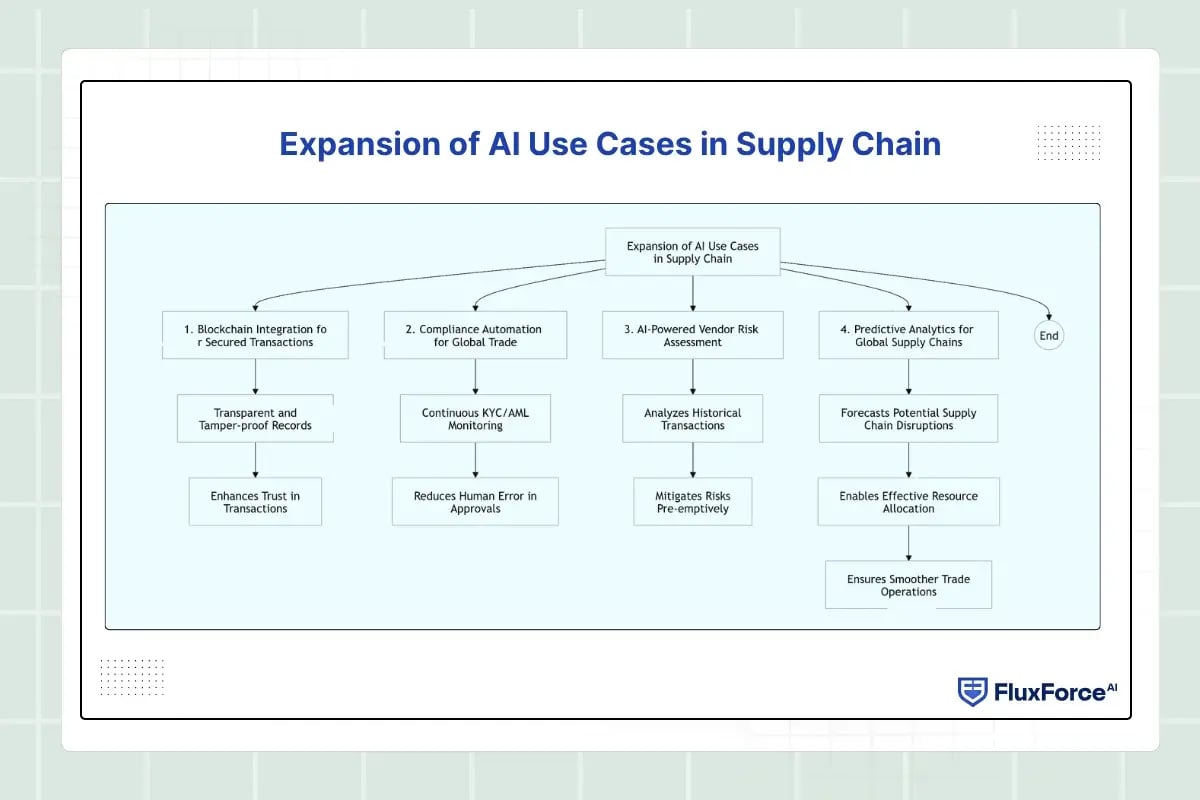
Agentic AI applies real-time fraud detection in the banking sector to supply chain networks, extending coverage from individual transaction security to end-to-end cross-border payment process optimization. Within global trade environments, these AI use cases in supply chain finance address four specific operational gaps: transaction verification, compliance automation, vendor risk, and predictive disruption management.
1. Blockchain Integration for Secured Transactions
The use of blockchain and AI in trade finance provide transparent and tamper-proof transaction records. Each payment, invoice, or shipment record is verified against the ledger, reducing the risk of duplicate or fraudulent claims. This combination enhances trust between international trade partners and ensures that cross-border payments are accurate, timely, and auditable.
2. Compliance Automation for Global Trade
Compliance automation in trade finance leverages Agentic AI to continuously monitor KYC and AML requirements across jurisdictions. By automatically validating suppliers, monitoring sanctions lists, and reconciling regulatory changes, AI reduces human error, accelerates approval processes, and ensures every transaction meets local and international standards.
For compliance teams building automated monitoring programs that cover KYC and AML simultaneously across trade finance workflows, check agentic AI for continuous compliance monitoring that covers how autonomous agents maintain regulatory coverage across multiple frameworks.
3. AI-Powered Vendor Risk Assessment
Agentic AI evaluates supplier behaviour by analysing historical transactions, payment patterns, and shipment histories. It flags high-risk vendors who exhibit anomalies, such as inconsistent documentation or irregular cash flows. This proactive assessment allows supply chain managers and finance officers to mitigate risks before they impact cross-border operations.
4. Predictive Analytics for Global Supply Chains
Using predictive modelling, Agentic AI forecasts potential disruptions in supply chain finance, such as delayed payments, currency volatility, or supplier defaults. By anticipating these risks, organizations can adjust workflows, allocate resources effectively, and prevent financial losses, ensuring smoother and more secure trade operations.

Real-World AI Fraud Detection in Cross-Border Payments: Payoneer and TerraPay Case Studies
AI-powered real time fraud detection approaches have significantly improved security in international payments across organizations. Few real-world examples include:
1: Payoneer – Combating Document Fraud in Cross-Border Payments
Payoneer, a global payment platform, struggled with verifying the authenticity of documents submitted by users from various regions, leading to potential fraud risks.
Solution: The company integrated AI-powered document analysis tool to detect fake documents, and serial fraud attempts without relying on reading the content of the documents.
Outcome:
- Significantly reduced instances of document-related fraud.
- Streamlined the verification process, enhancing operational efficiency.
- Improved compliance with regional regulatory standards.
2: TerraPay's Cross-Border Payment Optimization
TerraPay was struggling to enhance the efficiency and security of its cross-border payment processes. The company faced challenges in ensuring compliance with diverse regulatory requirements across different jurisdictions.
Solution: The company adopted Agentic AI to automate various aspects of the payment process, including fraud detection, compliance checks, and transaction monitoring. The AI system was integrated with existing infrastructure to provide real-time insights and adaptive responses to emerging threats.
Outcome:
- Streamlined operations and reduced processing times.
- Improved adherence to regulatory compliance.
- Measurable decrease in fraudulent activities across cross-border payment corridors.
- Adaptive monitoring for evolving fraud patterns.
End-to-End Supply Chain Finance Fraud Protection Strategies
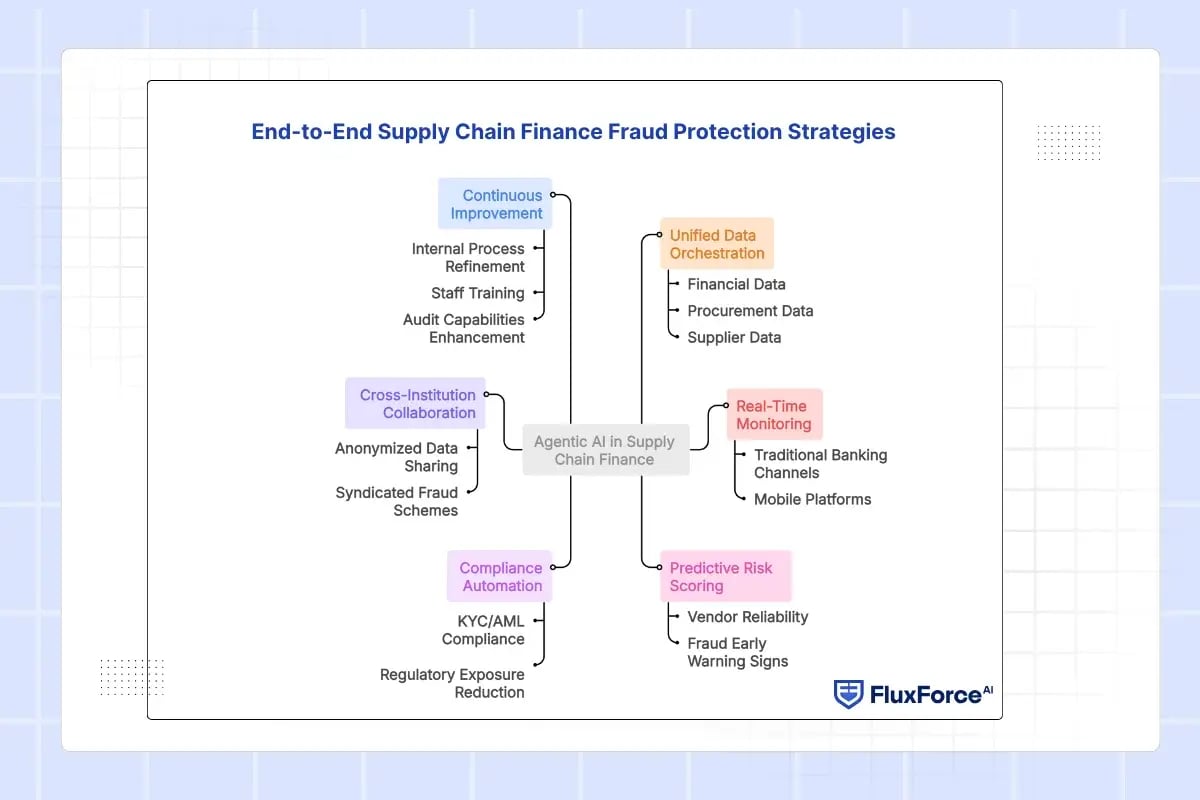
To maximize the value of Agentic AI in supply chain finance, organizations should consider a holistic, integrated approach:
1. Unified Data Orchestration
Ensure all financial, procurement, and supplier data feeds into the AI system. This integration eliminates blind spots and enables a comprehensive view of transactional risk across currencies and jurisdictions.
2. Real-Time Monitoring Across Payment Channels
Deploy AI across both traditional banking channels and mobile platforms to catch anomalies instantly. Continuous monitoring prevents fraud before transactions are completed.
3. Predictive and Adaptive Risk Scoring
Use AI-driven predictive analytics to assess vendor reliability and detect early warning signs of fraud. Adaptive models adjust thresholds automatically as fraud tactics evolve.
4. Compliance Automation and Regulatory Mapping
Agentic AI should automatically enforce the strictest applicable standards across jurisdictions, ensuring KYC/AML compliance and reducing regulatory exposure.
5. Cross-Institution Collaboration
Participate in anonymized data sharing networks with other banks or supply chain partners. This enables AI to detect coordinated, syndicated fraud schemes that span multiple organizations.
6. Continuous Improvement and Feedback Loops
Leverage AI insights to refine internal processes, train staff on high-risk patterns, and enhance audit capabilities. Agentic AI thrives when it continuously receives feedback from both transactional data and human analysts.
Onboard Customers in Seconds

Conclusion
Connected supply chain workflows require connected, intelligent technological assistance. Agentic AI provides real-time fraud detection across cross-border transactions, detects evolving fraud patterns, and automates KYC and AML compliance across multiple jurisdictions simultaneously.
With real-time insights, predictive risk scoring, and integration with diverse data sources, financial institutions reduce losses, improve operational efficiency, and strengthen regulatory adherence.
For organizations evaluating real-time fraud detection and supply chain compliance automation, the FluxForce regulatory compliance automation solution provides a starting point.


Share this article