



















Listen To Our Podcast🎧
-1.png)
Introduction
US model risk guidance (SR 11-7, replaced by SR 26-2 in April 2026) has required model explainability for over a decade. GDPR's Article 22 gives customers the right to contest automated decisions. The EU AI Act now classifies credit scoring and fraud detection as high-risk systems with mandatory transparency obligations. And yet, most banks still can't tell an examiner precisely why their model flagged a specific transaction. That gap is what this article addresses.
Across finance, more than 70% of professionals use AI for productizing tasks, but the value of a solution in regulated sectors is not measured by speed alone. Banks and financial institutions must understand a core concept of AI that determines whether systems can be trusted by regulators and internal risk teams.
Explainable Artificial Intelligence (XAI) uncovers the opaqueness of black-box AI models by providing full visibility into model behaviour behind completing a task. Before implementing AI in financial services, organizations must clearly understand how neglecting this capability can create significant operational and regulatory impact.
This guide explains how explainable AI in finance works via practice, where it fits inside financial systems, and what organizations must consider while deploying it.
Explainable AI in finance enhances transparency, trust, and decision-making
with FluxForce AI’s explainability tools.

What is Explainable AI in Finance?
Explainability in AI refers to providing a detailed summary of all the steps a model takes to reach a decision. In finance, this means showing the information the AI uses and the calculations that influence the final outcome. For banks and financial institutions, AI model explainability supports visibility across key operational decisions such as credit approvals, fraud alerts, risk scoring, and more.
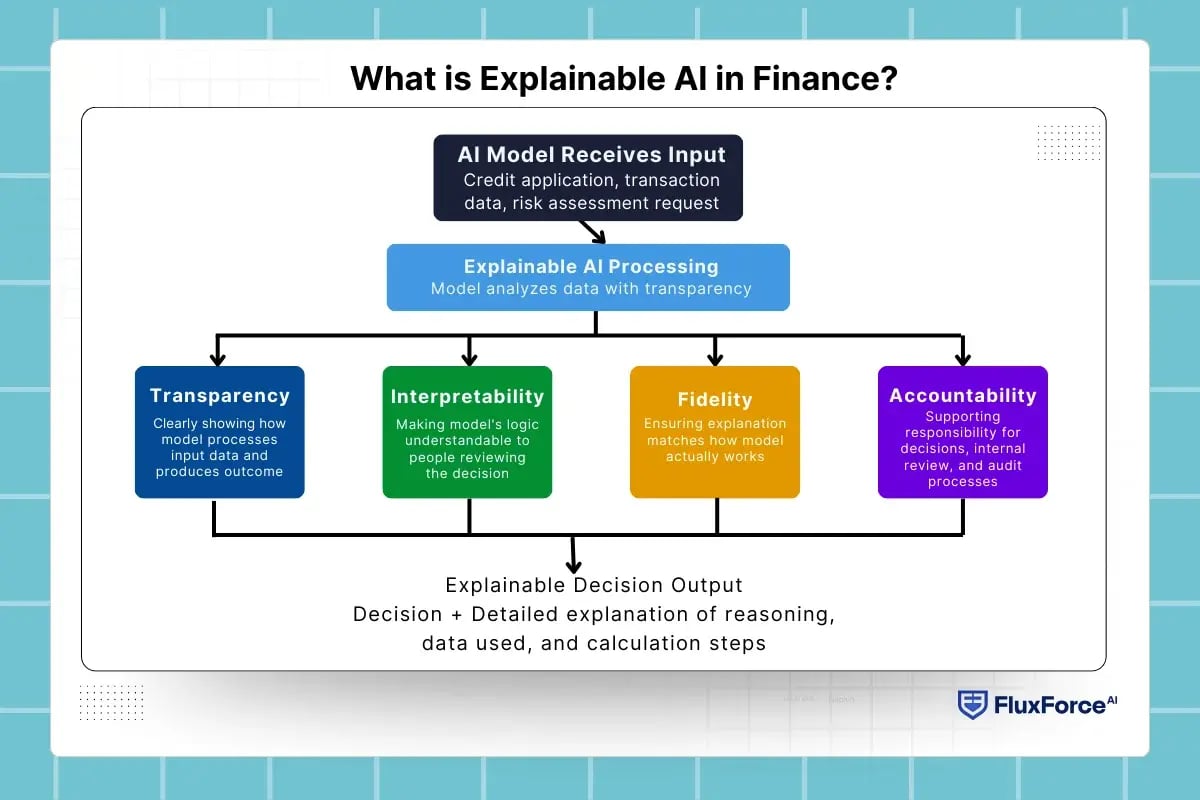
Explainable Artificial Intelligence (XAI) works on four core principles:
- Transparency- Clearly showing how a model processes input data and produces an outcome.
- Interpretability- Making the model’s logic understandable to people reviewing the decision.
- Fidelity (Accuracy of Explanation)- Ensuring the explanation matches how the model works.
- Accountability- Supporting responsibility for decisions, internal review, and audit processes.
The combination of these principles allows organizations to validate AI behaviour and justify model decisions in regulated environments.
Why Explainability is Essential in Regulated Financial Environments ?
AI model explainability is vital for finance as well as the organizations operating under strict regulatory requirements. Several ongoing conditions clearly show why AI model interpretability is necessary across financial systems. Some of these include:
Regulators Expecting Transparency in Models
All major regulatory bodies now expect financial institutions to demonstrate transparency in how models operate and how decisions are produced.
- US model risk guidance requires strong model risk management practices
- The EU AI Act introduces transparency obligations.
- GDPR provides rights around automated decisions.
- OCC and FCA supervision expects traceable decision records that support audit reviews and regulatory examinations.
Key note: Although a dedicated global regulation for AI governance is still emerging, current regulatory frameworks have created a benchmark to meet essential requirements.
Ensuring AI Risk Management and Model Validation
Enterprises strictly need AI model interpretability to support risk management and ongoing model validation. Explainability provides clear visibility into model behaviour that allows teams to verify consistency, identify data issues, and monitor performance changes.
Gaining Customer Trust and Supporting Dispute Resolution
AI model explainability plays a key role in supporting customer trust. By enabling customer support teams to explain automated decisions clearly, outcomes become fair. When customers raise disputes, transparent decision logic allows faster investigation and resolution.
Maintaining Audit Traceability and Accountability
Before regulators request evidence, explainable systems provide internal audit teams with presentation-ready explanations that trace model behavior, data usage, and approval history. Without explainability, audit reviews become slow, inconsistent, and difficult to defend.
Where Explainable AI is Used in Finance ?
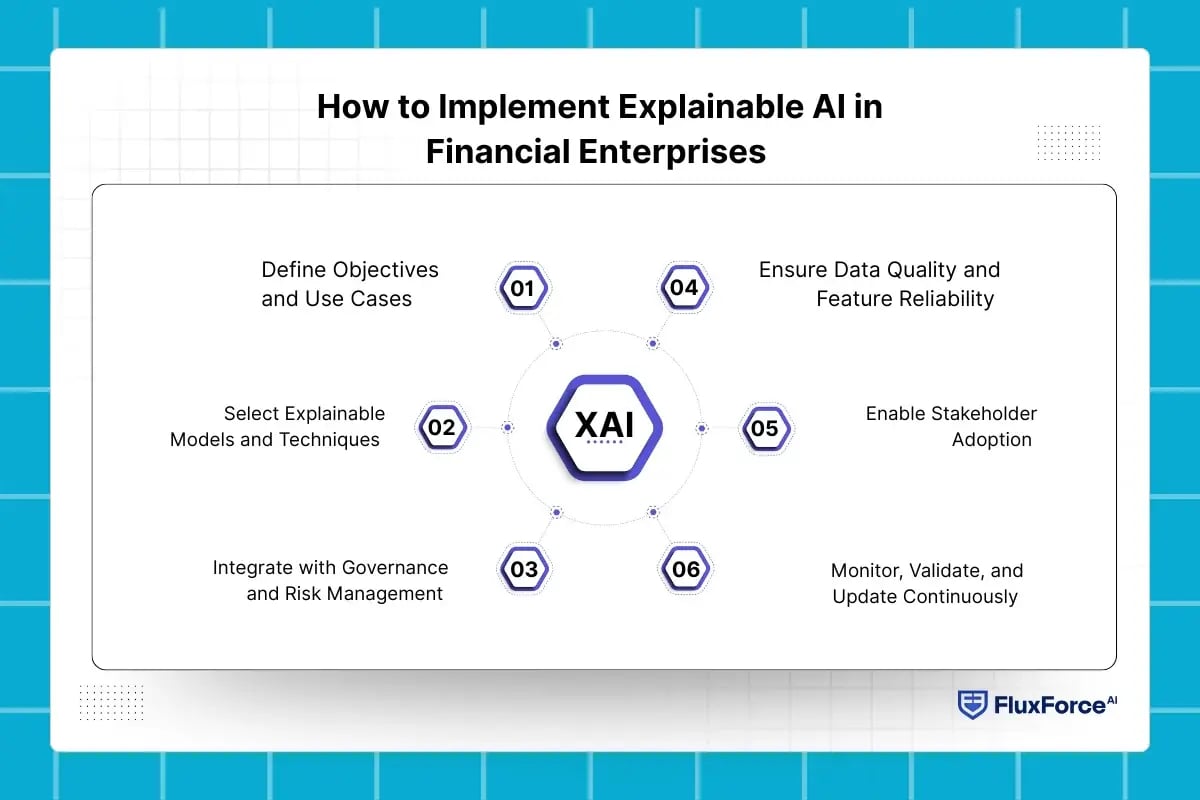
Explainable AI is applied wherever financial institutions must justify automated decisions, show regulatory compliance, and maintain operational accountability. Below are the six areas that represent the highest regulatory involvement and business impact:
1. Credit Risk Assessment and Loan Processing
Banks use AI models to evaluate borrower risk, approve credit, and set pricing. Explainable AI allows lenders to clearly understand which financial attributes influenced each approval or rejection.
- Risk teams can validate model behaviour.
- Compliance teams can confirm fair lending adherence.
- Customer-facing teams can generate defensible adverse action explanations.
Transparency of AI models contribute to reduced regulatory issues, improved underwriting consistency, and strengthened audit readiness across consumer and commercial portfolios.
2. Fraud Detection and Transaction Monitoring
Across banks, AI systems monitor transactions in real time to detect potential fraud. Explainable AI allows teams to see which transaction details, user behaviours, or historical patterns triggered each alert.
- Investigators can verify the accuracy and relevance of fraud alerts.
- Compliance teams can trace decision rationale for regulatory reporting.
- Risk managers can reduce false positives, improve alert prioritization, and streamline investigative workflows.
This visibility allows teams to focus on truly suspicious activity rather than chasing every anomaly.
3. Anti-Money Laundering (AML) and Financial Crime Compliance
Financial institutions use AI to detect suspicious transactions and potential money laundering activity. Explainable AI allows compliance teams to understand which transaction patterns, account behaviours, or network connections triggered alerts.
- Investigators can verify that alerts are accurate and relevant.
- Risk teams can document rationale for regulatory filings.
- Compliance teams can demonstrate adherence to AML requirements.
Clear visibility reduces unnecessary investigations, supports faster regulatory reporting, and ensures that financial crime monitoring programs remain defensible.
4. Insurance Underwriting, Pricing, and Claims Decisions
Insurance companies use AI to evaluate applications, set pricing, and process claims. Explainable AI clarifies which factors influenced risk assessment or claim approval.
- Underwriters can confirm model consistency and accuracy.
- Compliance teams can verify adherence to regulatory and fairness requirements.
- Customer service teams can provide transparent explanations to policyholders.
Operational consistency improves, regulatory audits are supported, and customers gain trust in automated insurance decisions.
5. Market Risk, Portfolio Management, and Trading
AI models help portfolio managers assess market risks, optimize trading strategies, and monitor positions. Explainable AI shows how individual assets, market factors, or historical trends influence risk and performance scores.
- Risk managers can validate model outputs and detect anomalies.
- Compliance teams can trace model rationale for internal and external reporting.
- Traders can understand why a model recommends particular positions.
Greater clarity strengthens governance, reduces operational risk, and provides an auditable record of decisions.
6. Customer Risk Scoring, Collections, and Decision Automation
AI models are used to score customer risk, prioritize collections, and automate operational decisions. Explainable AI shows which customer attributes and behaviours influence scoring and workflow recommendations.
- Collections teams can justify prioritization decisions.
- Risk managers can validate scoring models for accuracy and fairness.
- Compliance teams can maintain audit-ready decision records.
Improved visibility allows teams to make accountable, defendable decisions while maintaining operational efficiency.
Benefits of Explainable AI in Financial Services
Implementing explainable AI helps financial institutions achieve measurable improvements across several impactful areas.
1. Clear Communication on Credit Decisions: Explainable AI enables institutions to provide transparent reasons for approvals or denials. When a loan application is declined, customers receive specific factors like debt-to-income ratio or payment history rather than opaque rejections.
2. Regulators Receive Audit-Ready Compliance: AI model explainability creates detailed decision logs for regulatory review. Institutions can show adherence to SR 26-2, GDPR, FCA, and other major requirements through transparent audit trails.
3. Organizations Strengthen Governance and Formal Recognition: Firms with explainable AI frameworks meet regulatory expectations and industry best practices. For instance, banks using XAI for credit models are often cited in examiner reports for strong model risk management practices.
4. Disputes Resolve Faster with Clear Explanations: By showing customers specific decision factors, institutions reduce complaint volumes and accelerate remediation. Transparency improves operational efficiency and customer satisfaction.
5. Enhanced Model Performance: Research on Norwegian bank data showed that LightGBM models with explainability frameworks outperformed traditional logistic regression models by 17% in ROC AUC. Explainability allows teams to identify which variables drive outcomes and refine models accordingly.
6. Trust Through Transparency: Research shows that explainability frameworks using SHAP and LIME help financial analysts make AI-based fraud classifications reliable by addressing transparency issues.
How Explainable AI Works in Financial Services (The Backend Workflow) ?
In automated systems, explainability operates as a layer that ensures every decision can be understood, verified, and audited. Once a prediction is generated, the explainable lifecycle processes the decision through five operational stages.
.webp?width=1200&height=800&name=How%20Explainable%20AI%20Works%20in%20Financial%20Services%20(The%20Backend%20Workflow).webp)
Stage 1. Capturing the Data Used in the Decision
Transitioning from black box systems to human-centric AI in finance starts with data aggregation. The system captures every data point AI used to reach a decision, such as income, payment behavior, transaction history or account age. It keeps these inputs together as a single decision record so teams can later review exactly what information influenced the outcome.
Stage 2. Measuring How Each Factor Influenced the Outcome
Once inputs are captured, the explainable layer calculates how strongly each variable influenced the final decision. Contribution scoring models quantify whether a factor increased or decreased risk, approval probability, pricing, or prioritization.
Stage 3. Generating Human-Readable Explanations
The system converts contribution scores into structured, readable explanations, producing full decision explanations. It highlights the strongest drivers (often in percentage), shows how related factors interacted, and explains why the outcome reached its final value.
Stage 4. Detecting Drift and Abnormal Influence Patterns
Beyond individual decisions, the platform continuously monitors how explanations behave across varied cases. It observes which input factors repeatedly dominate outcomes, approval rates, and rejection drivers over time. When influence patterns drift outside approved thresholds or when unexpected variables begin dominating outcomes, automated alerts surface the deviation.
Stage 5. Storing Evidence for Audit, Compliance, and Regulatory Review
Finally, the platform stores each decision with its inputs, explanations, outcomes, timestamps, and model versions. Teams can retrieve the exact record later and verify what data and logic applied at the time.
Key Explainability Techniques That Translate AI Decisions for Humans
Inside explainable AI systems, the techniques that help organizations understand the “Why” and “How” behind AI-driven decisions in human centric way are:
1. SHAP (SHapley Additive exPlanations)
SHAP translates AI predictions into human-understandable explanations by assigning a clear contribution score to each input feature (often in percentages or positive and negative impact scores).
For example, in loan approvals, it shows exactly how income, credit history, or debt levels influenced the decision. By breaking down model outputs this way, SHAP allows stakeholders to see which factors drive each outcome and ensures transparent, auditable AI decisions.
2. LIME (Local Interpretable Model-Agnostic Explanations)
LIME helps teams understand why a model made a specific prediction by approximating complex calculations with a simpler, interpretable version for that decision. It identifies which features had the greatest influence, such as credit history, income, or outstanding debts. This level of clarity allows compliance teams to justify automated decisions and communicate reasoning to regulators or customers.
3. PDP (Partial Dependence Plots)
Partial Dependence Plots (PDPs) show how a feature affects predictions across the entire model. For instance, PDPs can illustrate how debt-to-income ratio or past delinquencies impact loan approvals. This global perspective helps executives and auditors understand model behaviour, validate fairness, and identify risks before they affect outcomes.
4. Counterfactual Explanations
Counterfactual explanations describe the minimal change required to alter a prediction. For example: “If income increased by $5,000, the loan would be approved.” This approach makes AI decisions actionable, intuitive, and easy to explain to customers, internal stakeholders, and regulators, enhancing trust and transparency.
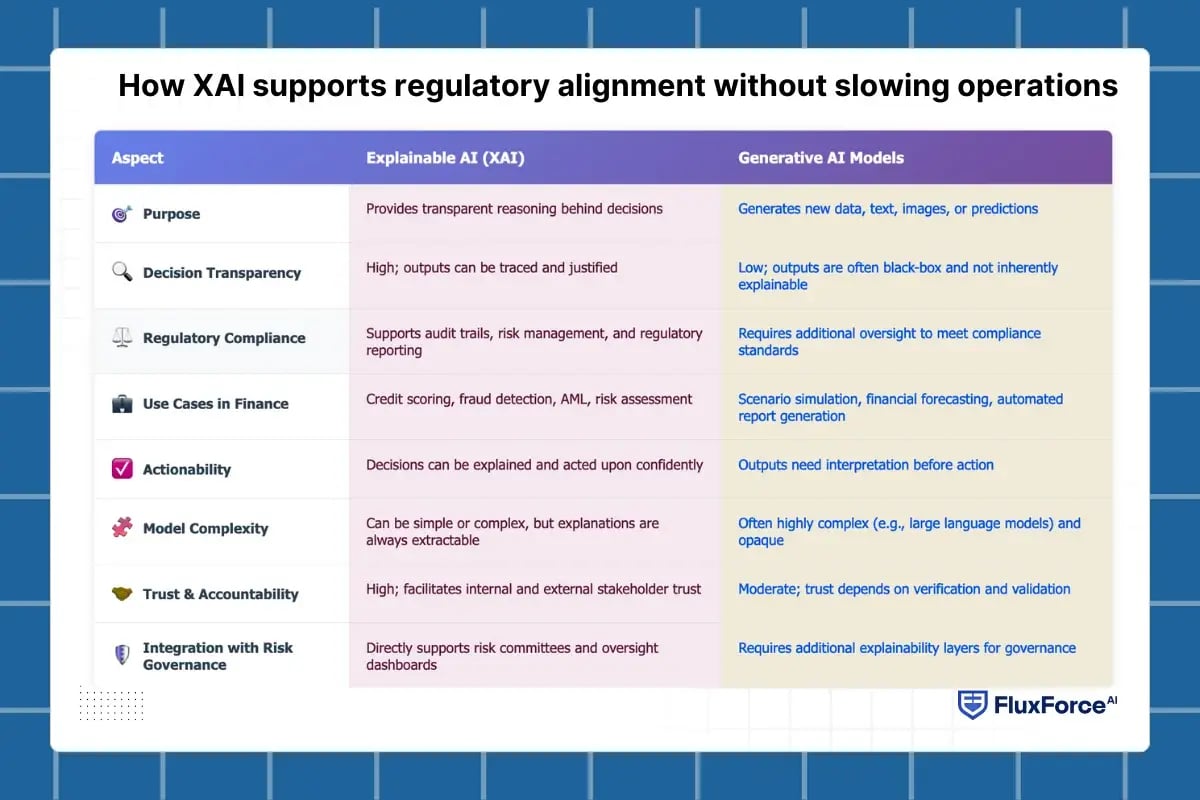
Explainable AI vs Generative AI Models
Think of the difference between Explainable AI (XAI) and Non-Explainable AI as understanding every decision your AI makes versus creating outputs without knowing why they were generated. Here’s a table demonstrating in a better way:
Explainable AI Governance and Model Risk Management
For the stability of AI, several financial institutions and regulators have created frameworks to manage AI risks in financial services. These frameworks define clear processes for checking, monitoring, and controlling AI models to ensure they operate safely and comply with regulations.
Here are the key components of governance and model risk management for explainable AI in:
1. Aligning AI Models with Risk Management Frameworks
Institutions formally review AI models before deployment. Actions include:
- Testing how inputs affect decisions and outputs.
- Validating accuracy, stability, and fairness of model predictions.
- Documenting assumptions, testing results, and approval decisions.
- Following SR 26-2, EBA, or ISO guidelines for compliance.
This ensures models meet regulatory standards and behave predictably.
2. Implementing Policy-Driven AI Governance
Organizations define policies for building, deploying, and maintaining AI models. These policies require:
- Logging all model decisions and updates.
- Controlling access to model development and production environments.
- Requiring formal approvals for updates or retraining.
- Maintaining full documentation for audits and regulatory reviews.
This ensures consistent and controlled model management.
3. Monitoring and Controlling Model Risk
After deployment, models are continuously monitored to maintain reliability. This includes:
- Tracking model performance over time.
- Detecting drift, errors, or biased predictions.
- Testing models against new data or stress scenarios.
- Making immediate corrections if models deviate from expected behavior.
This prevents operational failures and regulatory violations.
4. Supporting Oversight by Boards and Risk Committees
Risk committees and boards are provided with clear evidence about AI systems, including:
- Key decision outputs and explanations.
- Any anomalies, exceptions, or high-risk predictions.
- Documentation of approvals, changes, and model performance trends.
This transparency supports informed oversight, accountability, and regulatory compliance.
5. Ensuring Regulatory Alignment and Audit Readiness
Institutions maintain detailed records for every AI model:
- Inputs, outputs, and feature explanations.
- Change logs and approvals.
- Validation reports and testing results.
These records ensure organizations can demonstrate compliance and defend automated decisions in credit risk, fraud detection, anti-money laundering, and other financial operations.
Implementation Realities: Challenges in Deploying Explainable AI
The challenges below represent the most common friction points encountered by banks, insurers, and regulated financial enterprises:
1. Legacy Systems Hinder Integration- Many banks and insurers operate on fragmented IT infrastructures with multiple scoring engines, databases, and case management tools. Explainability engines struggle to access consistent data across these systems.
2. Performance and Latency Pressure- Generating explanations places extra load on AI models. High-volume operations such as fraud detection experience slower response times. Teams face difficult choices between speed and producing explanations that meet operational and regulatory standards.
3. Unreliable Data Impacts Accuracy- Data pipelines often contain gaps or inconsistencies. Changes in feature definitions or missing historical information cause explanations to vary unexpectedly. Staff spend significant time validating outputs, which delays decision-making.
4. Complex Models Confuse Stakeholders- Even when explanations are available, technical teams struggle to make sense of outputs from advanced models. Business and compliance staff find it challenging to interpret results, leading to repeated clarification and errors in decision-making.
5. Scaling Governance Overwhelms Resources- Maintaining explainability across multiple models strains documentation and validation processes. Teams struggle to enforce consistent practices, and regulatory review cycles often take longer than anticipated.
6. Teams Lack Skills to Use Explanations Effectively- Staff often do not understand how to act on the explanations provided. Misinterpretation results in inconsistent decisions and reduced trust in AI systems, creating resistance to wider adoption.
What Regulated Enterprises Need in an Explainable AI Platform ?
In 2026, AI models not just predict outcomes but must explain decisions, ensure compliance, and integrate with risk frameworks. Below is an essential checklist for CTOs:
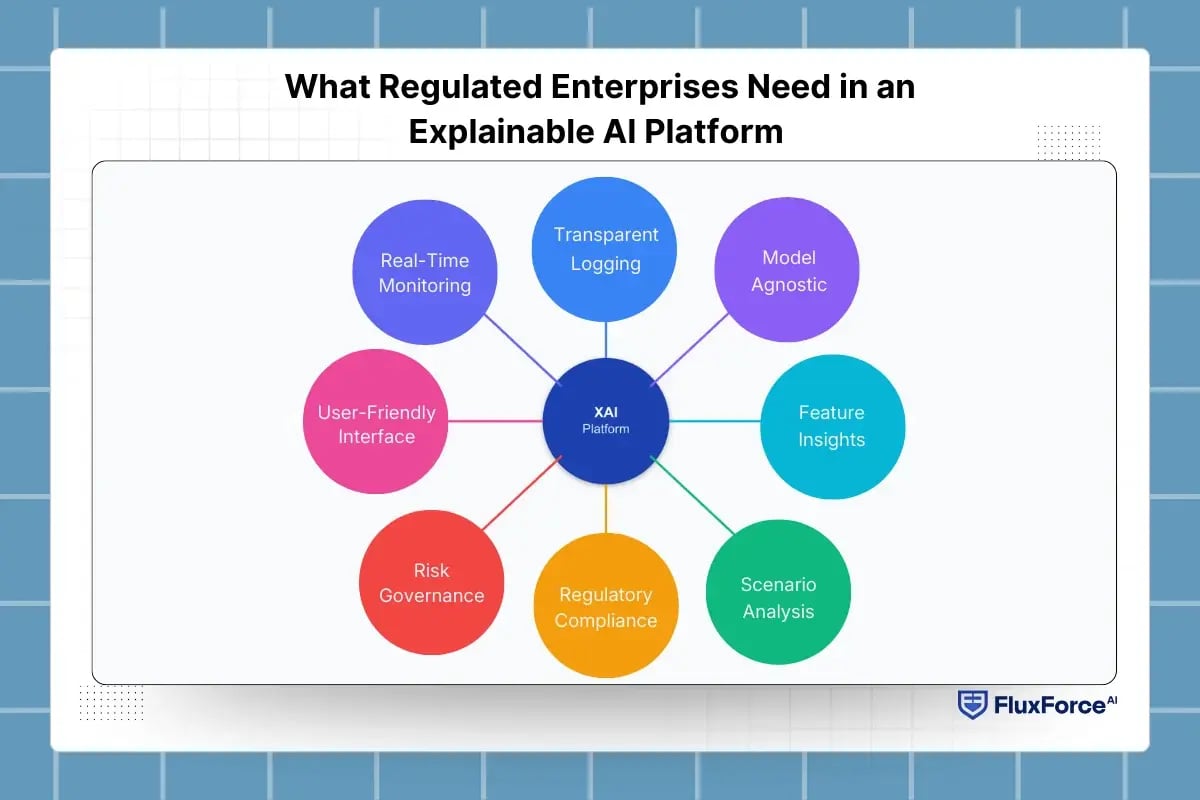
1. Transparent Decision Logging- The platform should capture every input, intermediate step, and output for each AI decision. This audit trail enables risk teams and regulators to verify why a decision was made, improving accountability and compliance.
2. Model-Agnostic Explainability- It should support multiple model types, from linear models to complex neural networks. This ensures that all AI applications, whether for credit scoring, fraud detection, or claims automation, can be explained consistently.
3. Feature-Level Insights- The platform should highlight which variables most influence a decision. For example, in loan approvals, income, credit history, and outstanding debt should be clearly represented. Feature-level insights allow teams to monitor bias, validate fairness, and detect anomalies.
4. Scenario and Counterfactual Analysis- XAI platforms should enable “what-if” analyses to understand how small changes in inputs affect outcomes. This is critical for risk assessment, stress testing, and customer-facing explanations.
5. Regulatory Compliance Support- The platform must produce outputs in formats that align with regulatory requirements, including audit-ready reports, explanation logs, and compliance dashboards. This reduces regulatory friction and accelerates audit processes.
6. Governance and Risk Management- Integration with model risk management frameworks and risk dashboards ensures AI decisions are continuously monitored, validated, and aligned with enterprise governance policies.
7. User-Friendly Interfaces- The platform should present explanations in a format accessible to non-technical stakeholders, including risk officers, auditors, and executives. Clear visualizations and dashboards make AI decisions intuitive and actionable.
8. Continuous Monitoring and Alerts- Finally, the platform should monitor AI models in real time for drift, anomalies, or unexpected patterns. Proactive alerts allow teams to intervene before small issues become systemic risks.
Explainable AI is revolutionizing finance. Dive into key benefits, real-world applications
with FluxForce AI’s explainability tools.
Explainable AI Future developments and trends
In 2026, financial institutions are moving beyond black-box AI toward models that are transparent, auditable, and continuously monitored. Here’s what is revolving around:
1. Agentic AI Integration
Financial institutions are increasingly adopting agentic AI, where autonomous AI agents make decisions independently. Explainable AI in Finance ensures these systems provide clear reasoning and transparent audit trails, allowing multiple AI agents to coordinate decisions while reducing error rates and maintaining regulatory accountability.
2. Regulatory-Driven Transparency Requirements
With upcoming regulations, including high-risk system obligations, explainability is moving from best practice to compliance imperative. Financial institutions must document decision-making processes, map AI deployments, and ensure audit-ready transparency, aligning AI operations with evolving regulatory expectations.
3. Real-Time Risk Monitoring
Modern XAI frameworks enable continuous validation of AI models, highlighting feature contributions and detecting drift patterns in real time. Risk committees can leverage these insights for adaptive stress testing, automated audit readiness, and ongoing governance, shifting oversight from periodic reviews to continuous monitoring.
What Supervisors Have Actually Said
Explainability in finance is not an emerging expectation. It is written down, in force, and already being enforced. The specific instruments matter, because each one asks for something slightly different.
United States
The baseline predates the technology. SR 11-7, the guidance the Federal Reserve and OCC issued in 2011, established that banks must be able to explain model outputs, validate that models perform as intended, and document model limitations. The standard is that outputs are understandable to senior management and to validators, not only to the team that built the model. In April 2026 the agencies replaced SR 11-7 with SR 26-2 (OCC Bulletin 2026-13), which the Fed says is most relevant to banking organizations with more than $30 billion in total assets.
Credit decisions carry a sharper obligation. The CFPB's Circular 2023-03 made clear that ECOA adverse action notice requirements apply to AI-based credit decisions, and its January 2025 Supervisory Highlights reminded institutions that using a black-box algorithm does not exempt them from providing those explanations. Examiners from the OCC, Federal Reserve, and FDIC reviewing a BSA/AML program ask the same question in a different register: how was this specific decision reached?
Europe and the UK
The EU AI Act, Regulation 2024/1689, entered into force in August 2024 with provisions phasing in from 2025. It classifies AI used to assess the creditworthiness of individuals as high-risk, and it expressly excludes AI used to detect financial fraud from that category. Under the 2026 Digital Omnibus, the high-risk obligations for these systems apply from 2 December 2027. High-risk status brings requirements for technical documentation, human oversight mechanisms, and clear and understandable information for the people a decision affects.
The European Banking Authority got to lending earlier. Its guidelines on loan origination and monitoring, EBA/GL/2020/06, require institutions to document how input features affect model outputs, with particular attention to features that could act as proxies for protected characteristics. In the UK, the FCA covered the same ground in Discussion Paper DP22/4, noting that firms must be able to explain model decisions both to customers and to the regulator. For AML specifically, FATF's 2021 guidance on the risk-based approach for the banking sector acknowledges technology-based transaction monitoring and notes that supervisors reviewing these systems expect documented reasoning for alerts.
Adoption is running ahead of governance in places. ECB Banking Supervision's 2025 data collection found that AI adoption in European banks increased sharply between 2023 and 2024, with credit scoring and fraud detection among the most widely deployed use cases.
The UK: PRA SS1/23 on model risk
The PRA's Supervisory Statement SS1/23 took effect on 17 May 2024. It applies to UK banks and building societies with approval to use internal models for regulatory capital, and the PRA expects other firms to treat it as a reference. Its definition of a model is wide enough to cover AI and machine learning tools, and it requires a named senior manager to own model risk.
So if an AI model influences an AML, fraud or credit decision at a UK bank, it belongs in the model inventory with an owner, a risk tier and a validation record.
What Failure Costs
In July 2025 the Massachusetts Attorney General settled a $2.5 million case against a lender whose AI underwriting models produced disparate impacts by race and immigration status. The finding was not that the models were biased in the abstract. It was that the institution failed to test its models for disparate impact and could not document a business justification for the variables it used. Both of those are explainability failures before they are fairness failures.
Explainable vs auditable: two different questions
Explainable answers why the model produced this output. Auditable answers whether you can show, months later, exactly what happened: which data went in, which model version ran, which thresholds applied, who reviewed the result and what they decided.
Examiners test the second question far more often. In a model or AML exam, expect requests like these:
- The model inventory entry, with an owner and a risk tier
- A validation report from someone independent of the people who built it
- For a sampled decision, the inputs, model version, output and the reviewer's rationale
- Evidence that the record wasn't changed after the fact
- Monitoring results for drift and overrides, and what you did about them
- A change log for thresholds and retraining
FluxForce is built around this: the AI agent investigates and prepares the case, your analyst decides, and every decision leaves tamper-evident evidence an examiner can replay.
What Good Looks Like in Production
Some of this is already routine. HSBC launched Dynamic Risk Assessment for AML in 2021 with Google Cloud, using machine learning models that analyze transaction patterns, network behaviors, and KYC data. Google Cloud and HSBC both report the outcome: roughly 60% fewer alerts, two to four times as much suspicious activity identified, and time-to-detection down to eight days after the first alert. The alert reduction is the headline, but the detection increase is the part that matters to a supervisor. A system that raises fewer alerts and finds more is doing something different from one that has simply had its thresholds loosened, and the explanation is what lets you tell those two apart. The scale is what makes automation unavoidable: the Federal Reserve estimates annual losses from synthetic identity fraud alone exceed $6 billion. That is also why the reasoning behind each automated decision has to stay reviewable.
The NIST AI Risk Management Framework lists explainability among the characteristics of trustworthy AI, and adds a point worth repeating. An explanation has to be useful to the audience receiving it, not merely correct in technical terms. A feature attribution table satisfies a validator. It does not satisfy a declined applicant, and it will not satisfy the regulator asking on their behalf.
Where to Go Deeper
Explainability looks different depending on which decision you are defending. These cover the specific cases in more detail.
- XAI for automated regulatory reporting workflows: what supervisors expect a generated report to show its working for.
- XAI for synthetic identity fraud: thin-file detection, document fraud, and the evidence a fraud decision has to carry.
- XAI for governance, risk, and controls: model risk rules and what they require of an explanation.
- XAI for cloud deployments: traceability across environments and the documentation examiners ask for.
- XAI for biometric authentication: bias, fairness, and what the EU AI Act requires of biometric systems.
- Explainability dashboards for agentic AI decisions: how decision reasoning gets surfaced to the people who need it.
- XAI for cross-border validation: entity resolution and validation across jurisdictions.
- XAI for compliance and AML: screening, monitoring, and audit-ready decision records.

Share this article